

119
6
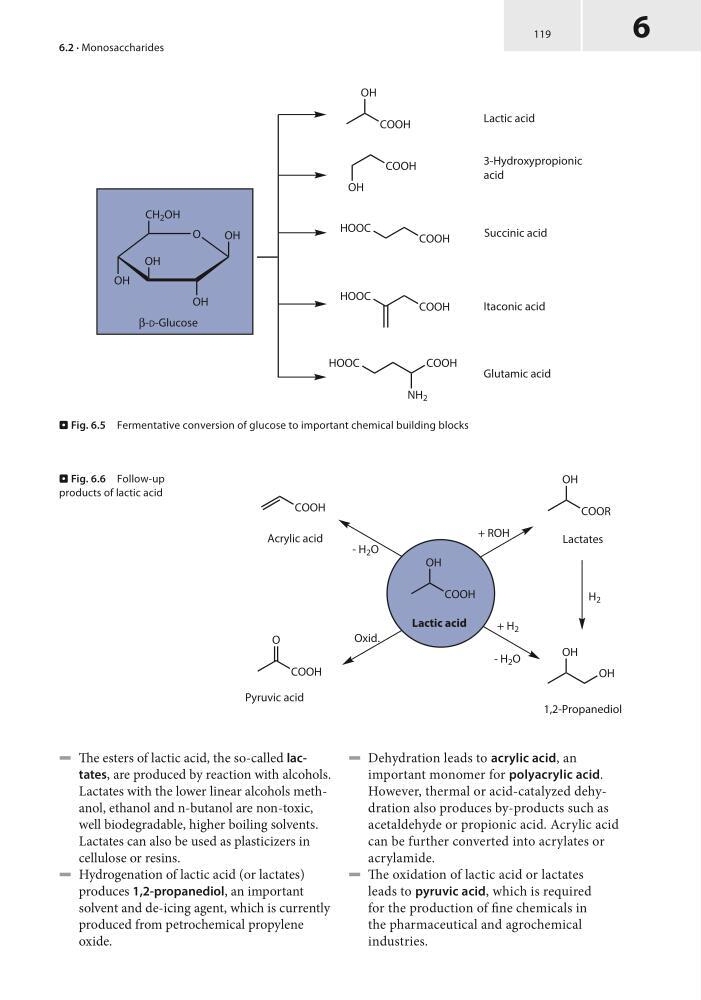
5 Dehydration leads to acrylic acid, an
important monomer for polyacrylic acid.
However, thermal or acid-catalyzed dehydration also produces by-products such as
acetaldehyde or propionic acid. Acrylic acid
can be further converted into acrylates or
acrylamide.
5 The oxidation of lactic acid or lactates
leads to pyruvic acid, which is required
for the production of fine chemicals in
the pharmaceutical and agrochemical
industries.
5 The esters of lactic acid, the so-called lactates, are produced by reaction with alcohols.
Lactates with the lower linear alcohols methanol, ethanol and n-butanol are non-toxic,
well biodegradable, higher boiling solvents.
Lactates can also be used as plasticizers in
cellulose or resins.
5 Hydrogenation of lactic acid (or lactates)
produces 1,2-propanediol, an important
solvent and de-icing agent, which is currently
produced from petrochemical propylene
oxide.
CH 2 OH
β-D-Glucose
O
OH
OH
OH
OH
COOH
OH
COOH
OH
COOH
HOOC
COOH
HOOC
HOOC
COOH
NH 2
Lactic acid
3-Hydroxypropionic
acid
Succinic acid
Itaconic acid
Glutamic acid
. Fig. 6.5 Fermentative conversion of glucose to important chemical building blocks
. Fig. 6.6 Follow-up
products of lactic acid
+ ROH
+ H 2
OH
COOR
OH
OH
Lactates
1,2-Propanediol
Oxid.
- H 2 O
O
COOH
COOH
Pyruvic acid
Acrylic acid
H 2
COOH
OH
Lactic acid
- H 2 O
6.2 · Monosaccharides
6
5 Dehydration leads to acrylic acid, an
important monomer for polyacrylic acid.
However, thermal or acid-catalyzed dehydration also produces by-products such as
acetaldehyde or propionic acid. Acrylic acid
can be further converted into acrylates or
acrylamide.
5 The oxidation of lactic acid or lactates
leads to pyruvic acid, which is required
for the production of fine chemicals in
the pharmaceutical and agrochemical
industries.
5 The esters of lactic acid, the so-called lactates, are produced by reaction with alcohols.
Lactates with the lower linear alcohols methanol, ethanol and n-butanol are non-toxic,
well biodegradable, higher boiling solvents.
Lactates can also be used as plasticizers in
cellulose or resins.
5 Hydrogenation of lactic acid (or lactates)
produces 1,2-propanediol, an important
solvent and de-icing agent, which is currently
produced from petrochemical propylene
oxide.
CH 2 OH
β-D-Glucose
O
OH
OH
OH
OH
COOH
OH
COOH
OH
COOH
HOOC
COOH
HOOC
HOOC
COOH
NH 2
Lactic acid
3-Hydroxypropionic
acid
Succinic acid
Itaconic acid
Glutamic acid
. Fig. 6.5 Fermentative conversion of glucose to important chemical building blocks
. Fig. 6.6 Follow-up
products of lactic acid
+ ROH
+ H 2
OH
COOR
OH
OH
Lactates
1,2-Propanediol
Oxid.
- H 2 O
O
COOH
COOH
Pyruvic acid
Acrylic acid
H 2
COOH
OH
Lactic acid
- H 2 O
6.2 · Monosaccharides