

118
Chapter 6 · Sweet Chemistry - Mono- and Disaccharides
6
variants that omit precipitation and work with
membrane separations instead.
Lactic acid can be used in many different
applications, such as foods, pharmaceuticals
and cosmetics or it can be converted chemically.
An important application is the production of
polylactic acid (PLA). This reaction does not take
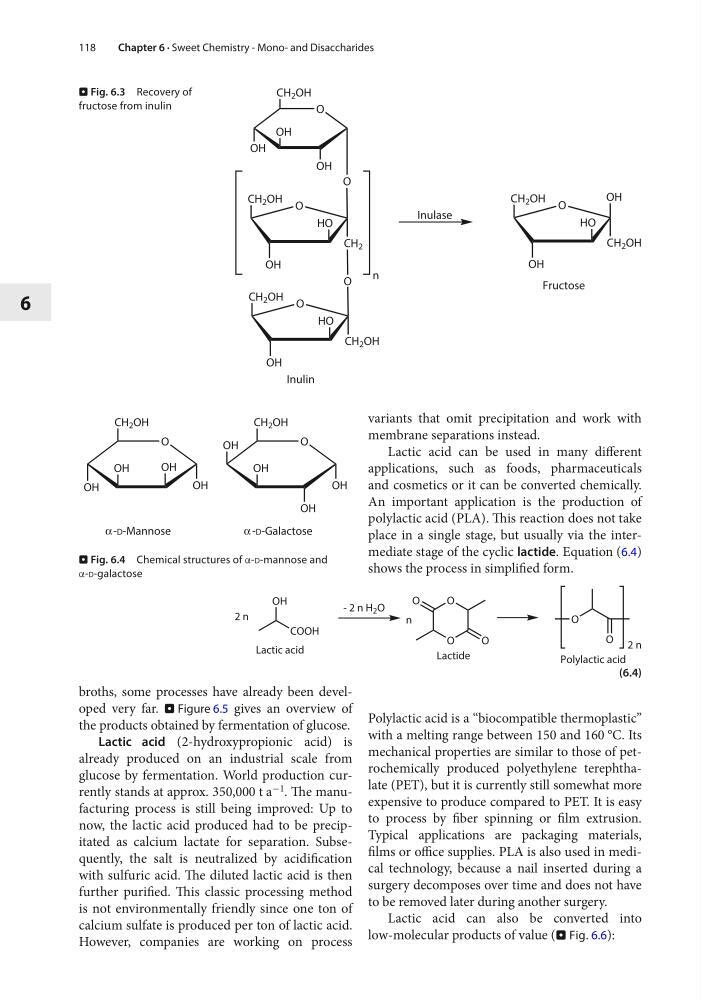
place in a single stage, but usually via the intermediate stage of the cyclic lactide. Equation (6.4)
shows the process in simplified form.
Polylactic acid is a “biocompatible thermoplastic”
with a melting range between 150 and 160 °C. Its
mechanical properties are similar to those of petrochemically produced polyethylene terephthalate (PET), but it is currently still somewhat more
expensive to produce compared to PET. It is easy
to process by fiber spinning or film extrusion.
Typical applications are packaging materials,
films or office supplies. PLA is also used in medical technology, because a nail inserted during a
surgery decomposes over time and does not have
to be removed later during another surgery.
Lactic acid can also be converted into
low-molecular products of value (. Fig. 6.6):
(6.4)
COOH
OH
2 n
Lactic acid
- 2 n H 2 O
O
O
O
O
Lactide
O
O 2 n
Polylactic acid
n
broths, some processes have already been developed very far. . Figure 6.5 gives an overview of
the products obtained by fermentation of glucose.
Lactic acid (2-hydroxypropionic acid) is
already produced on an industrial scale from
glucose by fermentation. World production currently stands at approx. 350,000 t a −1 . The manufacturing process is still being improved: Up to
now, the lactic acid produced had to be precipitated as calcium lactate for separation. Subsequently, the salt is neutralized by acidification
with sulfuric acid. The diluted lactic acid is then
further purified. This classic processing method
is not environmentally friendly since one ton of
calcium sulfate is produced per ton of lactic acid.
However, companies are working on process
. Fig. 6.3 Recovery of
fructose from inulin
CH 2 OH
CH 2 OH
OH
HO
O
CH 2
CH 2 OH
OH
HO
O
O
OH
O
OH
OH
CH 2 OH
O
n
CH 2 OH
OH
CH 2 OH
OH
HO
O
Fructose
Inulase
Inulin
O
OH
OH
OH
OH
CH 2 OH
O
OH
OH
OH
OH
CH 2 OH
-D-Mannose
-D-Galactose
α
α
. Fig. 6.4 Chemical structures of α-d-mannose and
α-d-galactose
Chapter 6 · Sweet Chemistry - Mono- and Disaccharides
6
variants that omit precipitation and work with
membrane separations instead.
Lactic acid can be used in many different
applications, such as foods, pharmaceuticals
and cosmetics or it can be converted chemically.
An important application is the production of
polylactic acid (PLA). This reaction does not take
place in a single stage, but usually via the intermediate stage of the cyclic lactide. Equation (6.4)
shows the process in simplified form.
Polylactic acid is a “biocompatible thermoplastic”
with a melting range between 150 and 160 °C. Its
mechanical properties are similar to those of petrochemically produced polyethylene terephthalate (PET), but it is currently still somewhat more
expensive to produce compared to PET. It is easy
to process by fiber spinning or film extrusion.
Typical applications are packaging materials,
films or office supplies. PLA is also used in medical technology, because a nail inserted during a
surgery decomposes over time and does not have
to be removed later during another surgery.
Lactic acid can also be converted into
low-molecular products of value (. Fig. 6.6):
(6.4)
COOH
OH
2 n
Lactic acid
- 2 n H 2 O
O
O
O
O
Lactide
O
O 2 n
Polylactic acid
n
broths, some processes have already been developed very far. . Figure 6.5 gives an overview of
the products obtained by fermentation of glucose.
Lactic acid (2-hydroxypropionic acid) is
already produced on an industrial scale from
glucose by fermentation. World production currently stands at approx. 350,000 t a −1 . The manufacturing process is still being improved: Up to
now, the lactic acid produced had to be precipitated as calcium lactate for separation. Subsequently, the salt is neutralized by acidification
with sulfuric acid. The diluted lactic acid is then
further purified. This classic processing method
is not environmentally friendly since one ton of
calcium sulfate is produced per ton of lactic acid.
However, companies are working on process
. Fig. 6.3 Recovery of
fructose from inulin
CH 2 OH
CH 2 OH
OH
HO
O
CH 2
CH 2 OH
OH
HO
O
O
OH
O
OH
OH
CH 2 OH
O
n
CH 2 OH
OH
CH 2 OH
OH
HO
O
Fructose
Inulase
Inulin
O
OH
OH
OH
OH
CH 2 OH
O
OH
OH
OH
OH
CH 2 OH
-D-Mannose
-D-Galactose
α
α
. Fig. 6.4 Chemical structures of α-d-mannose and
α-d-galactose