

117
6
as a 5–50% solution for inflammations or
states of exhaustion as well as for parenteral
nutrition. Glucose can be converted chemically and biochemically into many important secondary products and is therefore an
important component of a future chemistry
based on renewable raw materials.
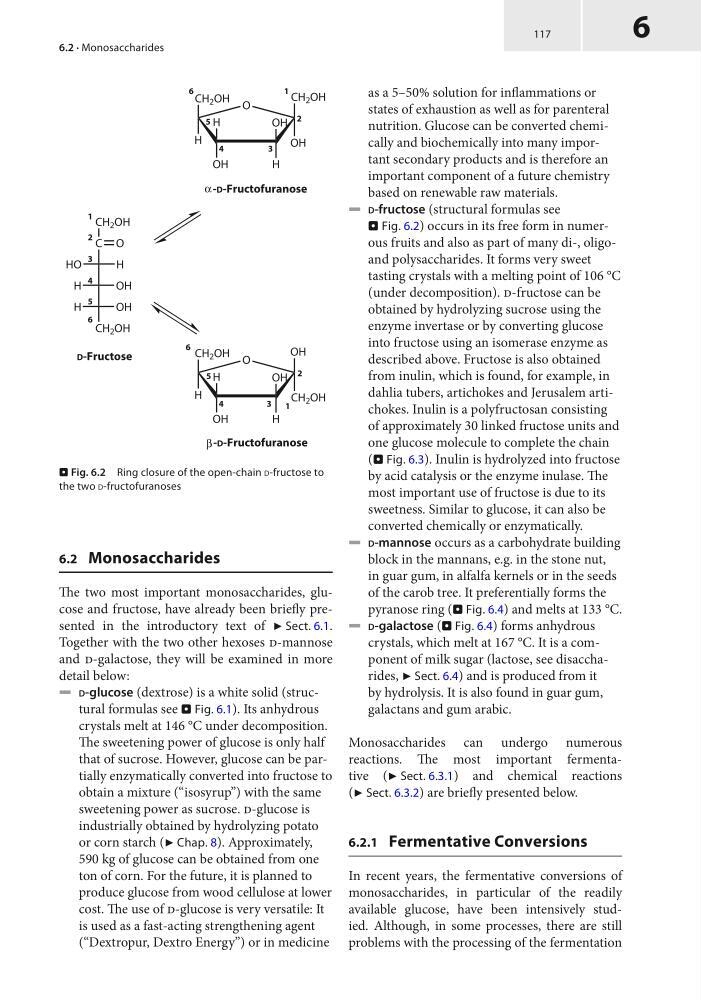
5 d-fructose (structural formulas see
. Fig. 6.2) occurs in its free form in numerous fruits and also as part of many di-, oligoand polysaccharides. It forms very sweet
tasting crystals with a melting point of 106 °C
(under decomposition). d-fructose can be
obtained by hydrolyzing sucrose using the
enzyme invertase or by converting glucose
into fructose using an isomerase enzyme as
described above. Fructose is also obtained
from inulin, which is found, for example, in
dahlia tubers, artichokes and Jerusalem artichokes. Inulin is a polyfructosan consisting
of approximately 30 linked fructose units and
one glucose molecule to complete the chain
(. Fig. 6.3). Inulin is hydrolyzed into fructose
by acid catalysis or the enzyme inulase. The
most important use of fructose is due to its
sweetness. Similar to glucose, it can also be
converted chemically or enzymatically.
5 d-mannose occurs as a carbohydrate building
block in the mannans, e.g. in the stone nut,
in guar gum, in alfalfa kernels or in the seeds
of the carob tree. It preferentially forms the
pyranose ring (. Fig. 6.4) and melts at 133 °C.
5 d-galactose (. Fig. 6.4) forms anhydrous
crystals, which melt at 167 °C. It is a component of milk sugar (lactose, see disaccharides, 7 Sect. 6.4) and is produced from it
by hydrolysis. It is also found in guar gum,
galactans and gum arabic.
Monosaccharides can undergo numerous
reactions. The most important fermentative (7 Sect. 6.3.1) and chemical reactions
(7 Sect. 6.3.2) are briefly presented below.
6.2.1 Fermentative Conversions
In recent years, the fermentative conversions of
monosaccharides, in particular of the readily
available glucose, have been intensively studied. Although, in some processes, there are still
problems with the processing of the fermentation
6.2 Monosaccharides
The two most important monosaccharides, glucose and fructose, have already been briefly presented in the introductory text of 7 Sect. 6.1.
Together with the two other hexoses d-mannose
and d-galactose, they will be examined in more
detail below:
5 d-glucose (dextrose) is a white solid (structural formulas see . Fig. 6.1). Its anhydrous
crystals melt at 146 °C under decomposition.
The sweetening power of glucose is only half
that of sucrose. However, glucose can be partially enzymatically converted into fructose to
obtain a mixture (“isosyrup”) with the same
sweetening power as sucrose. d-glucose is
industrially obtained by hydrolyzing potato
or corn starch (7 Chap. 8). Approximately,
590 kg of glucose can be obtained from one
ton of corn. For the future, it is planned to
produce glucose from wood cellulose at lower
cost. The use of d-glucose is very versatile: It
is used as a fast-acting strengthening agent
(“Dextropur, Dextro Energy”) or in medicine
D-Fructose
1
CH 2 OH
OH
H
CH 2 OH
OH
H
H
OH
O
CH 2 OH
C O
H
HO
OH
H
OH
H
CH 2 OH
2
3
4
5
6
OH
CH 2 OH
H
CH 2 OH
OH
H
H
OH
O
-D-Fructofuranose
-D-Fructofuranose
1
1
2
2
3
3
4
4
5
5
6
6
α
β
. Fig. 6.2 Ring closure of the open-chain d-fructose to
the two d-fructofuranoses
6.2 · Monosaccharides
6
as a 5–50% solution for inflammations or
states of exhaustion as well as for parenteral
nutrition. Glucose can be converted chemically and biochemically into many important secondary products and is therefore an
important component of a future chemistry
based on renewable raw materials.
5 d-fructose (structural formulas see
. Fig. 6.2) occurs in its free form in numerous fruits and also as part of many di-, oligoand polysaccharides. It forms very sweet
tasting crystals with a melting point of 106 °C
(under decomposition). d-fructose can be
obtained by hydrolyzing sucrose using the
enzyme invertase or by converting glucose
into fructose using an isomerase enzyme as
described above. Fructose is also obtained
from inulin, which is found, for example, in
dahlia tubers, artichokes and Jerusalem artichokes. Inulin is a polyfructosan consisting
of approximately 30 linked fructose units and
one glucose molecule to complete the chain
(. Fig. 6.3). Inulin is hydrolyzed into fructose
by acid catalysis or the enzyme inulase. The
most important use of fructose is due to its
sweetness. Similar to glucose, it can also be
converted chemically or enzymatically.
5 d-mannose occurs as a carbohydrate building
block in the mannans, e.g. in the stone nut,
in guar gum, in alfalfa kernels or in the seeds
of the carob tree. It preferentially forms the
pyranose ring (. Fig. 6.4) and melts at 133 °C.
5 d-galactose (. Fig. 6.4) forms anhydrous
crystals, which melt at 167 °C. It is a component of milk sugar (lactose, see disaccharides, 7 Sect. 6.4) and is produced from it
by hydrolysis. It is also found in guar gum,
galactans and gum arabic.
Monosaccharides can undergo numerous
reactions. The most important fermentative (7 Sect. 6.3.1) and chemical reactions
(7 Sect. 6.3.2) are briefly presented below.
6.2.1 Fermentative Conversions
In recent years, the fermentative conversions of
monosaccharides, in particular of the readily
available glucose, have been intensively studied. Although, in some processes, there are still
problems with the processing of the fermentation
6.2 Monosaccharides
The two most important monosaccharides, glucose and fructose, have already been briefly presented in the introductory text of 7 Sect. 6.1.
Together with the two other hexoses d-mannose
and d-galactose, they will be examined in more
detail below:
5 d-glucose (dextrose) is a white solid (structural formulas see . Fig. 6.1). Its anhydrous
crystals melt at 146 °C under decomposition.
The sweetening power of glucose is only half
that of sucrose. However, glucose can be partially enzymatically converted into fructose to
obtain a mixture (“isosyrup”) with the same
sweetening power as sucrose. d-glucose is
industrially obtained by hydrolyzing potato
or corn starch (7 Chap. 8). Approximately,
590 kg of glucose can be obtained from one
ton of corn. For the future, it is planned to
produce glucose from wood cellulose at lower
cost. The use of d-glucose is very versatile: It
is used as a fast-acting strengthening agent
(“Dextropur, Dextro Energy”) or in medicine
D-Fructose
1
CH 2 OH
OH
H
CH 2 OH
OH
H
H
OH
O
CH 2 OH
C O
H
HO
OH
H
OH
H
CH 2 OH
2
3
4
5
6
OH
CH 2 OH
H
CH 2 OH
OH
H
H
OH
O
-D-Fructofuranose
-D-Fructofuranose
1
1
2
2
3
3
4
4
5
5
6
6
α
β
. Fig. 6.2 Ring closure of the open-chain d-fructose to
the two d-fructofuranoses
6.2 · Monosaccharides