

116
Chapter 6 · Sweet Chemistry - Mono- and Disaccharides
6
Using the example of ketohexose d-fructose
(. Table 6.1), we will take a closer look at the
reaction to semi-ketals and the formation of
five-membered rings, the so-called furanoses
(. Fig. 6.2). Again, two anomers are formed,
α-d-fructofuranose, whose OH group points downwards at the C-atom 2, and β-d-fructofuranose,
whose OH group is arranged above the
five-membered ring at the C-atom 2.
Monosaccharides can not only react intramolecularly but also intermolecularly. From
a glucose and a fructose unit, for example,
the disaccharide sucrose is formed, which is
the well-known cane or beet sugar. By linking
numerous glucose units to form long polymeric,
linear or branched chains, cellulose or starch is
formed, which belong to the polysaccharides.
Both molecules, which differ only in the chiral
C-atom 1, are called anomers. The simplified
representation of the ring molecules in . Fig. 6.1
is known as Haworth projection: The rings are
drawn as a plane, the C-atoms at the corners of
the rings are omitted, and reinforced lines are
closest to the observer. In reality, the six-membered ring of the pyranoses forms two conformations, i.e. chair or boat conformation, which are
also known from the cyclohexane ring.
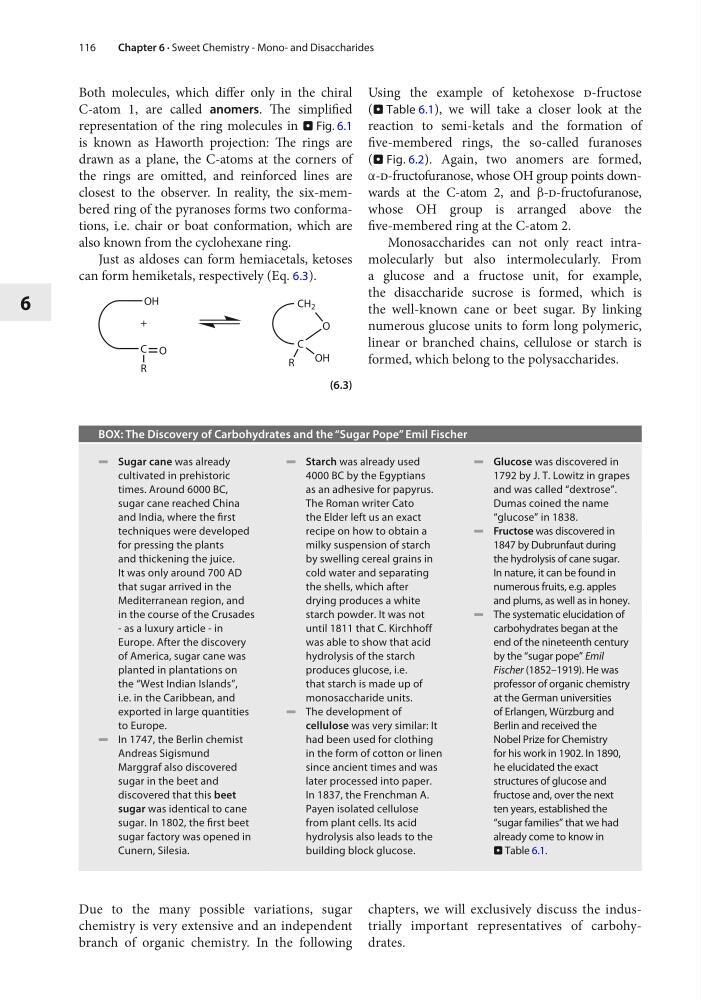
Just as aldoses can form hemiacetals, ketoses
can form hemiketals, respectively (Eq. 6.3).
(6.3)
C
OH
+
O
R
O
CH 2
C
OH
R
BOX: The Discovery of Carbohydrates and the “Sugar Pope” Emil Fischer
5 Sugar cane was already
cultivated in prehistoric
times. Around 6000 BC,
sugar cane reached China
and India, where the first
techniques were developed
for pressing the plants
and thickening the juice.
It was only around 700 AD
that sugar arrived in the
Mediterranean region, and
in the course of the Crusades
- as a luxury article - in
Europe. After the discovery
of America, sugar cane was
planted in plantations on
the “West Indian Islands”,
i.e. in the Caribbean, and
exported in large quantities
to Europe.
5 In 1747, the Berlin chemist
Andreas Sigismund
Marggraf also discovered
sugar in the beet and
discovered that this beet
sugar was identical to cane
sugar. In 1802, the first beet
sugar factory was opened in
Cunern, Silesia.
5 Starch was already used
4000 BC by the Egyptians
as an adhesive for papyrus.
The Roman writer Cato
the Elder left us an exact
recipe on how to obtain a
milky suspension of starch
by swelling cereal grains in
cold water and separating
the shells, which after
drying produces a white
starch powder. It was not
until 1811 that C. Kirchhoff
was able to show that acid
hydrolysis of the starch
produces glucose, i.e.
that starch is made up of
monosaccharide units.
5 The development of
cellulose was very similar: It
had been used for clothing
in the form of cotton or linen
since ancient times and was
later processed into paper.
In 1837, the Frenchman A.
Payen isolated cellulose
from plant cells. Its acid
hydrolysis also leads to the
building block glucose.
5 Glucose was discovered in
1792 by J. T. Lowitz in grapes
and was called “dextrose”.
Dumas coined the name
“glucose” in 1838.
5 Fructose was discovered in
1847 by Dubrunfaut during
the hydrolysis of cane sugar.
In nature, it can be found in
numerous fruits, e.g. apples
and plums, as well as in honey.
5 The systematic elucidation of
carbohydrates began at the
end of the nineteenth century
by the “sugar pope” Emil
Fischer (1852–1919). He was
professor of organic chemistry
at the German universities
of Erlangen, Würzburg and
Berlin and received the
Nobel Prize for Chemistry
for his work in 1902. In 1890,
he elucidated the exact
structures of glucose and
fructose and, over the next
ten years, established the
“sugar families” that we had
already come to know in
. Table 6.1.
Due to the many possible variations, sugar
chemistry is very extensive and an independent
branch of organic chemistry. In the following
chapters, we will exclusively discuss the industrially important representatives of carbohydrates.
Chapter 6 · Sweet Chemistry - Mono- and Disaccharides
6
Using the example of ketohexose d-fructose
(. Table 6.1), we will take a closer look at the
reaction to semi-ketals and the formation of
five-membered rings, the so-called furanoses
(. Fig. 6.2). Again, two anomers are formed,
α-d-fructofuranose, whose OH group points downwards at the C-atom 2, and β-d-fructofuranose,
whose OH group is arranged above the
five-membered ring at the C-atom 2.
Monosaccharides can not only react intramolecularly but also intermolecularly. From
a glucose and a fructose unit, for example,
the disaccharide sucrose is formed, which is
the well-known cane or beet sugar. By linking
numerous glucose units to form long polymeric,
linear or branched chains, cellulose or starch is
formed, which belong to the polysaccharides.
Both molecules, which differ only in the chiral
C-atom 1, are called anomers. The simplified
representation of the ring molecules in . Fig. 6.1
is known as Haworth projection: The rings are
drawn as a plane, the C-atoms at the corners of
the rings are omitted, and reinforced lines are
closest to the observer. In reality, the six-membered ring of the pyranoses forms two conformations, i.e. chair or boat conformation, which are
also known from the cyclohexane ring.
Just as aldoses can form hemiacetals, ketoses
can form hemiketals, respectively (Eq. 6.3).
(6.3)
C
OH
+
O
R
O
CH 2
C
OH
R
BOX: The Discovery of Carbohydrates and the “Sugar Pope” Emil Fischer
5 Sugar cane was already
cultivated in prehistoric
times. Around 6000 BC,
sugar cane reached China
and India, where the first
techniques were developed
for pressing the plants
and thickening the juice.
It was only around 700 AD
that sugar arrived in the
Mediterranean region, and
in the course of the Crusades
- as a luxury article - in
Europe. After the discovery
of America, sugar cane was
planted in plantations on
the “West Indian Islands”,
i.e. in the Caribbean, and
exported in large quantities
to Europe.
5 In 1747, the Berlin chemist
Andreas Sigismund
Marggraf also discovered
sugar in the beet and
discovered that this beet
sugar was identical to cane
sugar. In 1802, the first beet
sugar factory was opened in
Cunern, Silesia.
5 Starch was already used
4000 BC by the Egyptians
as an adhesive for papyrus.
The Roman writer Cato
the Elder left us an exact
recipe on how to obtain a
milky suspension of starch
by swelling cereal grains in
cold water and separating
the shells, which after
drying produces a white
starch powder. It was not
until 1811 that C. Kirchhoff
was able to show that acid
hydrolysis of the starch
produces glucose, i.e.
that starch is made up of
monosaccharide units.
5 The development of
cellulose was very similar: It
had been used for clothing
in the form of cotton or linen
since ancient times and was
later processed into paper.
In 1837, the Frenchman A.
Payen isolated cellulose
from plant cells. Its acid
hydrolysis also leads to the
building block glucose.
5 Glucose was discovered in
1792 by J. T. Lowitz in grapes
and was called “dextrose”.
Dumas coined the name
“glucose” in 1838.
5 Fructose was discovered in
1847 by Dubrunfaut during
the hydrolysis of cane sugar.
In nature, it can be found in
numerous fruits, e.g. apples
and plums, as well as in honey.
5 The systematic elucidation of
carbohydrates began at the
end of the nineteenth century
by the “sugar pope” Emil
Fischer (1852–1919). He was
professor of organic chemistry
at the German universities
of Erlangen, Würzburg and
Berlin and received the
Nobel Prize for Chemistry
for his work in 1902. In 1890,
he elucidated the exact
structures of glucose and
fructose and, over the next
ten years, established the
“sugar families” that we had
already come to know in
. Table 6.1.
Due to the many possible variations, sugar
chemistry is very extensive and an independent
branch of organic chemistry. In the following
chapters, we will exclusively discuss the industrially important representatives of carbohydrates.