

120
Chapter 6 · Sweet Chemistry - Mono- and Disaccharides
6
Itaconic acid, the methylene succinic acid,
is of great interest because of its three functionalities, a C=C double bond and two carboxyl groups. The double bond can be used
for
polymerization.
Low-molecular-weight
derivatives are e.g. methyl-butyrolactone or
3-methyltetrahydrofuran.
We will discuss glutamic acid in more detail
in 7 Chap. 14 (Proteins/Amino Acids).
6.2.2 Chemical Conversions
of Monosaccharides
Dehydration Reactions
An important reaction in sugar chemistry is
dehydration, i.e. the cleavage of water. Cyclic
compounds, especially furfural derivatives, are
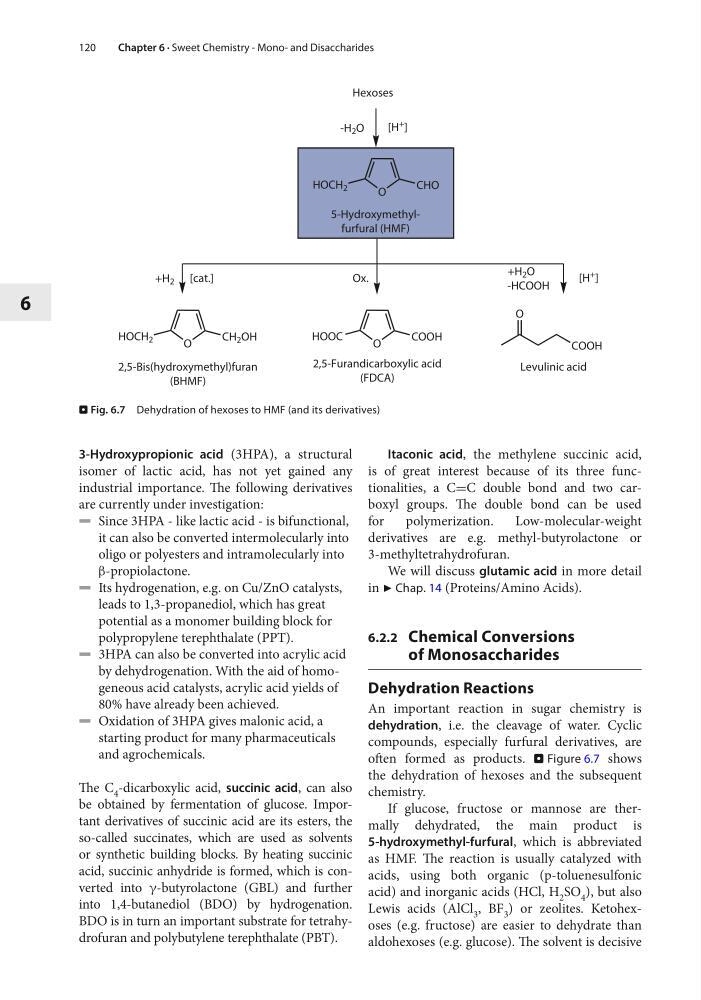
often formed as products. . Figure 6.7 shows
the dehydration of hexoses and the subsequent
chemistry.
If glucose, fructose or mannose are thermally dehydrated, the main product is
5-hydroxymethyl-furfural, which is abbreviated
as HMF. The reaction is usually catalyzed with
acids, using both organic (p-toluenesulfonic
acid) and inorganic acids (HCl, H 2 SO 4 ), but also
Lewis acids (AlCl 3 , BF 3 ) or zeolites. Ketohexoses (e.g. fructose) are easier to dehydrate than
aldohexoses (e.g. glucose). The solvent is decisive
3-Hydroxypropionic acid (3HPA), a structural
isomer of lactic acid, has not yet gained any
industrial importance. The following derivatives
are currently under investigation:
5 Since 3HPA - like lactic acid - is bifunctional,
it can also be converted intermolecularly into
oligo or polyesters and intramolecularly into
β-propiolactone.
5 Its hydrogenation, e.g. on Cu/ZnO catalysts,
leads to 1,3-propanediol, which has great
potential as a monomer building block for
polypropylene terephthalate (PPT).
5 3HPA can also be converted into acrylic acid
by dehydrogenation. With the aid of homogeneous acid catalysts, acrylic acid yields of
80% have already been achieved.
5 Oxidation of 3HPA gives malonic acid, a
starting product for many pharmaceuticals
and agrochemicals.
The C 4 -dicarboxylic acid, succinic acid, can also
be obtained by fermentation of glucose. Important derivatives of succinic acid are its esters, the
so-called succinates, which are used as solvents
or synthetic building blocks. By heating succinic
acid, succinic anhydride is formed, which is converted into γ-butyrolactone (GBL) and further
into 1,4-butanediol (BDO) by hydrogenation.
BDO is in turn an important substrate for tetrahydrofuran and polybutylene terephthalate (PBT).
Hexoses
-H 2 O
[H + ]
O
HOCH 2
CHO
5-Hydroxymethylfurfural (HMF)
O
HOCH 2
CH 2 OH
O
HOOC
COOH
COOH
O
+H 2 [cat.]
Ox.
+H 2 O
-HCOOH
[H + ]
2,5-Bis(hydroxymethyl)furan
(BHMF)
2,5-Furandicarboxylic acid
(FDCA)
Levulinic acid
. Fig. 6.7 Dehydration of hexoses to HMF (and its derivatives)
Chapter 6 · Sweet Chemistry - Mono- and Disaccharides
6
Itaconic acid, the methylene succinic acid,
is of great interest because of its three functionalities, a C=C double bond and two carboxyl groups. The double bond can be used
for
polymerization.
Low-molecular-weight
derivatives are e.g. methyl-butyrolactone or
3-methyltetrahydrofuran.
We will discuss glutamic acid in more detail
in 7 Chap. 14 (Proteins/Amino Acids).
6.2.2 Chemical Conversions
of Monosaccharides
Dehydration Reactions
An important reaction in sugar chemistry is
dehydration, i.e. the cleavage of water. Cyclic
compounds, especially furfural derivatives, are
often formed as products. . Figure 6.7 shows
the dehydration of hexoses and the subsequent
chemistry.
If glucose, fructose or mannose are thermally dehydrated, the main product is
5-hydroxymethyl-furfural, which is abbreviated
as HMF. The reaction is usually catalyzed with
acids, using both organic (p-toluenesulfonic
acid) and inorganic acids (HCl, H 2 SO 4 ), but also
Lewis acids (AlCl 3 , BF 3 ) or zeolites. Ketohexoses (e.g. fructose) are easier to dehydrate than
aldohexoses (e.g. glucose). The solvent is decisive
3-Hydroxypropionic acid (3HPA), a structural
isomer of lactic acid, has not yet gained any
industrial importance. The following derivatives
are currently under investigation:
5 Since 3HPA - like lactic acid - is bifunctional,
it can also be converted intermolecularly into
oligo or polyesters and intramolecularly into
β-propiolactone.
5 Its hydrogenation, e.g. on Cu/ZnO catalysts,
leads to 1,3-propanediol, which has great
potential as a monomer building block for
polypropylene terephthalate (PPT).
5 3HPA can also be converted into acrylic acid
by dehydrogenation. With the aid of homogeneous acid catalysts, acrylic acid yields of
80% have already been achieved.
5 Oxidation of 3HPA gives malonic acid, a
starting product for many pharmaceuticals
and agrochemicals.
The C 4 -dicarboxylic acid, succinic acid, can also
be obtained by fermentation of glucose. Important derivatives of succinic acid are its esters, the
so-called succinates, which are used as solvents
or synthetic building blocks. By heating succinic
acid, succinic anhydride is formed, which is converted into γ-butyrolactone (GBL) and further
into 1,4-butanediol (BDO) by hydrogenation.
BDO is in turn an important substrate for tetrahydrofuran and polybutylene terephthalate (PBT).
Hexoses
-H 2 O
[H + ]
O
HOCH 2
CHO
5-Hydroxymethylfurfural (HMF)
O
HOCH 2
CH 2 OH
O
HOOC
COOH
COOH
O
+H 2 [cat.]
Ox.
+H 2 O
-HCOOH
[H + ]
2,5-Bis(hydroxymethyl)furan
(BHMF)
2,5-Furandicarboxylic acid
(FDCA)
Levulinic acid
. Fig. 6.7 Dehydration of hexoses to HMF (and its derivatives)