

98
Chapter 5 · The Coproduct of Oleochemistry - Glycerol
5
molecule, several linear and cyclic derivatives
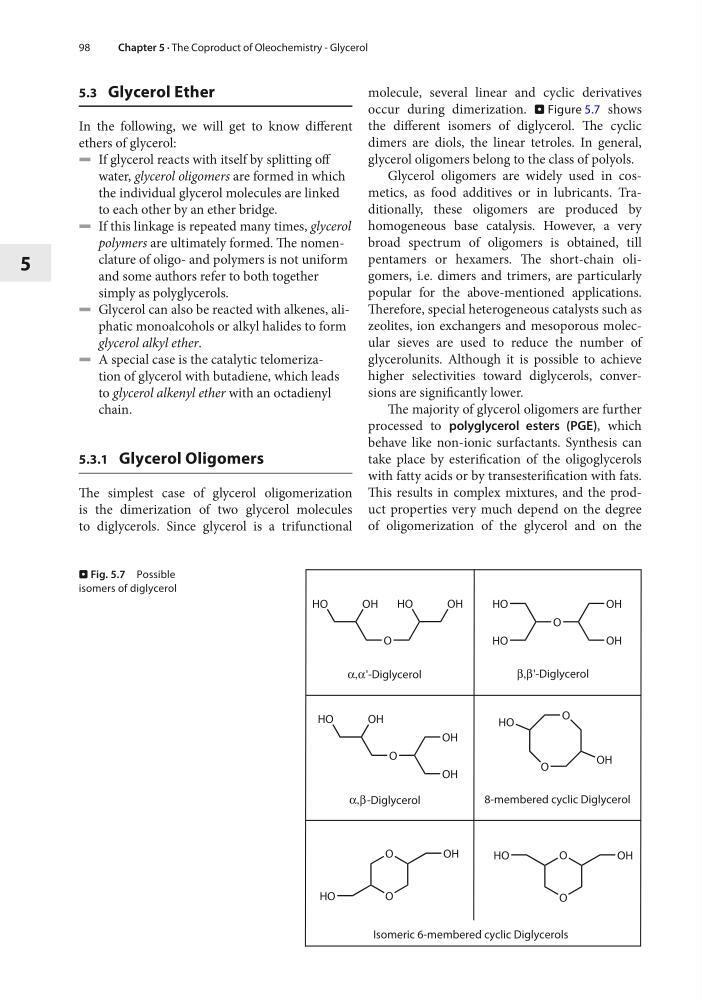
occur during dimerization. . Figure 5.7 shows
the different isomers of diglycerol. The cyclic
dimers are diols, the linear tetroles. In general,
glycerol oligomers belong to the class of polyols.
Glycerol oligomers are widely used in cosmetics, as food additives or in lubricants. Traditionally, these oligomers are produced by
homogeneous base catalysis. However, a very
broad spectrum of oligomers is obtained, till
pentamers or hexamers. The short-chain oligomers, i.e. dimers and trimers, are particularly
popular for the above-mentioned applications.
Therefore, special heterogeneous catalysts such as
zeolites, ion exchangers and mesoporous molecular sieves are used to reduce the number of
glycerolunits. Although it is possible to achieve
higher selectivities toward diglycerols, conversions are significantly lower.
The majority of glycerol oligomers are further
processed to polyglycerol esters (PGE), which
behave like non-ionic surfactants. Synthesis can
take place by esterification of the oligoglycerols
with fatty acids or by transesterification with fats.
This results in complex mixtures, and the product properties very much depend on the degree
of oligomerization of the glycerol and on the
5.3 Glycerol Ether
In the following, we will get to know different
ethers of glycerol:
5 If glycerol reacts with itself by splitting off
water, glycerol oligomers are formed in which
the individual glycerol molecules are linked
to each other by an ether bridge.
5 If this linkage is repeated many times, glycerol
polymers are ultimately formed. The nomenclature of oligo- and polymers is not uniform
and some authors refer to both together
simply as polyglycerols.
5 Glycerol can also be reacted with alkenes, aliphatic monoalcohols or alkyl halides to form
glycerol alkyl ether.
5 A special case is the catalytic telomerization of glycerol with butadiene, which leads
to glycerol alkenyl ether with an octadienyl
chain.
5.3.1 Glycerol Oligomers
The simplest case of glycerol oligomerization
is the dimerization of two glycerol molecules
to diglycerols. Since glycerol is a trifunctional
. Fig. 5.7 Possible
isomers of diglycerol
HO
OH
O
HO
OH
HO
OH
O
OH
OH
O
O
HO
OH
O
O
OH
HO
O
O
HO
OH
HO
O
OH
OH
HO
'-Diglycerol
-Diglycerol
8-membered cyclic Diglycerol
'-Diglycerol
Isomeric 6-membered cyclic Diglycerols
β,β
α,α
α,β
Chapter 5 · The Coproduct of Oleochemistry - Glycerol
5
molecule, several linear and cyclic derivatives
occur during dimerization. . Figure 5.7 shows
the different isomers of diglycerol. The cyclic
dimers are diols, the linear tetroles. In general,
glycerol oligomers belong to the class of polyols.
Glycerol oligomers are widely used in cosmetics, as food additives or in lubricants. Traditionally, these oligomers are produced by
homogeneous base catalysis. However, a very
broad spectrum of oligomers is obtained, till
pentamers or hexamers. The short-chain oligomers, i.e. dimers and trimers, are particularly
popular for the above-mentioned applications.
Therefore, special heterogeneous catalysts such as
zeolites, ion exchangers and mesoporous molecular sieves are used to reduce the number of
glycerolunits. Although it is possible to achieve
higher selectivities toward diglycerols, conversions are significantly lower.
The majority of glycerol oligomers are further
processed to polyglycerol esters (PGE), which
behave like non-ionic surfactants. Synthesis can
take place by esterification of the oligoglycerols
with fatty acids or by transesterification with fats.
This results in complex mixtures, and the product properties very much depend on the degree
of oligomerization of the glycerol and on the
5.3 Glycerol Ether
In the following, we will get to know different
ethers of glycerol:
5 If glycerol reacts with itself by splitting off
water, glycerol oligomers are formed in which
the individual glycerol molecules are linked
to each other by an ether bridge.
5 If this linkage is repeated many times, glycerol
polymers are ultimately formed. The nomenclature of oligo- and polymers is not uniform
and some authors refer to both together
simply as polyglycerols.
5 Glycerol can also be reacted with alkenes, aliphatic monoalcohols or alkyl halides to form
glycerol alkyl ether.
5 A special case is the catalytic telomerization of glycerol with butadiene, which leads
to glycerol alkenyl ether with an octadienyl
chain.
5.3.1 Glycerol Oligomers
The simplest case of glycerol oligomerization
is the dimerization of two glycerol molecules
to diglycerols. Since glycerol is a trifunctional
. Fig. 5.7 Possible
isomers of diglycerol
HO
OH
O
HO
OH
HO
OH
O
OH
OH
O
O
HO
OH
O
O
OH
HO
O
O
HO
OH
HO
O
OH
OH
HO
'-Diglycerol
-Diglycerol
8-membered cyclic Diglycerol
'-Diglycerol
Isomeric 6-membered cyclic Diglycerols
β,β
α,α
α,β