

99
5
5.3.3 Glycerol Alkyl Ether
The synthesis of glycerol alkyl ether can be performed according to three methods:
5 by acid-catalyzed reaction of glycerol with
alkenes, especially with isobutene
5 by Williamson synthesis of sodium glycerolate with an alkyl halide
5 by condensation of glycerol with aliphatic
alcohols underwater elimination.
A very elegant method is the conversion
with isobutene, which leads to glycerol tertiary butyl ether (GTBE). The monoether
m-GTBE are produced along with the di- and
triether, from which the latter two are summarized under the term “higher ether” (h-GTBE)
(. Fig. 5.9). m-GTBE are soluble in polar solvents, h-GTBE only in non-polar solvents such
as hydrocarbons.
number of esterified hydroxyl groups. PGE are
used in cosmetics such as hair gels, baby creams
and skin cleansers, as emulsifiers and for viscosity control. Especially, important products are
diglyceroldiisostearate,
diglycerolmonolaurate
and diglycerolmonooleate.
5.3.2 Glycerol Polymers
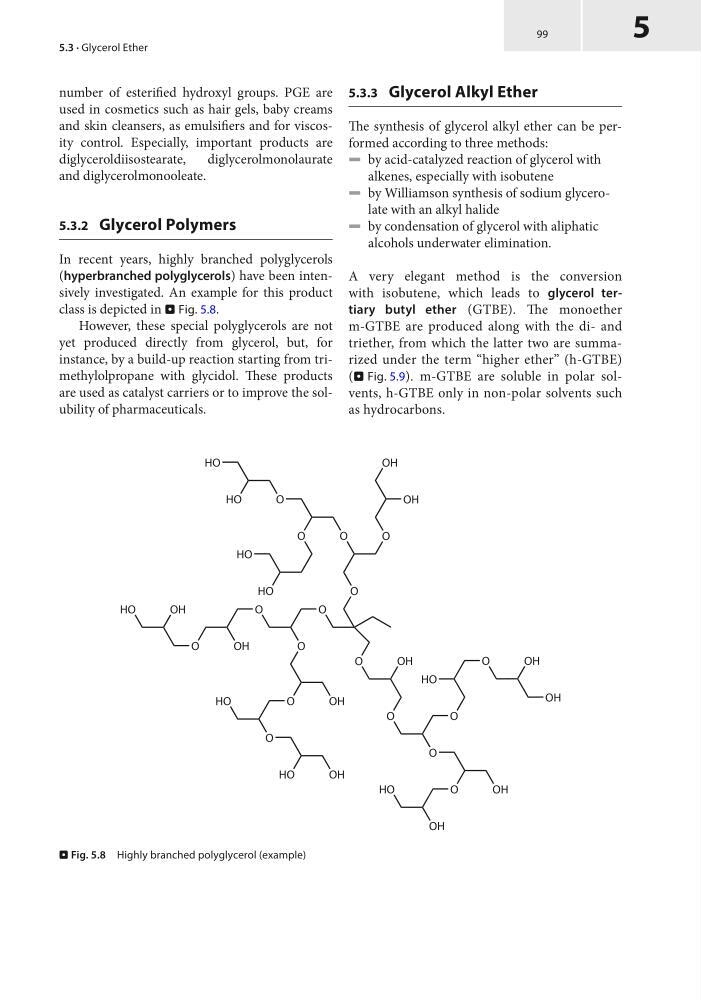
In recent years, highly branched polyglycerols
(hyperbranched polyglycerols) have been intensively investigated. An example for this product
class is depicted in . Fig. 5.8.
However, these special polyglycerols are not
yet produced directly from glycerol, but, for
instance, by a build-up reaction starting from trimethylolpropane with glycidol. These products
are used as catalyst carriers or to improve the solubility of pharmaceuticals.
HO
HO
O
O
O
HO
HO
O
O
OH
OH
O
O
O
OH
O
HO
O
OH
O
HO
HO
OH
O
OH
O
O
O
O
OH
OH
HO
HO
O
OH
OH
OH
. Fig. 5.8 Highly branched polyglycerol (example)
5.3 · Glycerol Ether
5
5.3.3 Glycerol Alkyl Ether
The synthesis of glycerol alkyl ether can be performed according to three methods:
5 by acid-catalyzed reaction of glycerol with
alkenes, especially with isobutene
5 by Williamson synthesis of sodium glycerolate with an alkyl halide
5 by condensation of glycerol with aliphatic
alcohols underwater elimination.
A very elegant method is the conversion
with isobutene, which leads to glycerol tertiary butyl ether (GTBE). The monoether
m-GTBE are produced along with the di- and
triether, from which the latter two are summarized under the term “higher ether” (h-GTBE)
(. Fig. 5.9). m-GTBE are soluble in polar solvents, h-GTBE only in non-polar solvents such
as hydrocarbons.
number of esterified hydroxyl groups. PGE are
used in cosmetics such as hair gels, baby creams
and skin cleansers, as emulsifiers and for viscosity control. Especially, important products are
diglyceroldiisostearate,
diglycerolmonolaurate
and diglycerolmonooleate.
5.3.2 Glycerol Polymers
In recent years, highly branched polyglycerols
(hyperbranched polyglycerols) have been intensively investigated. An example for this product
class is depicted in . Fig. 5.8.
However, these special polyglycerols are not
yet produced directly from glycerol, but, for
instance, by a build-up reaction starting from trimethylolpropane with glycidol. These products
are used as catalyst carriers or to improve the solubility of pharmaceuticals.
HO
HO
O
O
O
HO
HO
O
O
OH
OH
O
O
O
OH
O
HO
O
OH
O
HO
HO
OH
O
OH
O
O
O
O
OH
OH
HO
HO
O
OH
OH
OH
. Fig. 5.8 Highly branched polyglycerol (example)
5.3 · Glycerol Ether