

97
5
Glycerol carbonate is a colorless protic-polar
liquid and soluble in both water and organic
solvents. In water, it is stable at pH values below
pH 5. These properties result in various fields of
application:
5 Glycerol carbonate (and its esters) can
be used as a solvent: They can be used in
the manufacture of paints and varnishes,
adhesives, cosmetics and pharmaceuticals.
Glycerol carbonate dissolves nitrocellulose,
cellulose acetates, nylons and polyacrylonitrile.
5 Its use as an extracting agent or lubricant is
also being discussed.
5 As a monomer, it is used for the production
of branched polymers. The French company
Condat has developed the synthesis of glycerol polycarbonates and glycerol carbonate
polyesters.
5 Glycerol carbonate can also be converted into
glycidol (. Fig. 5.2) releasing CO 2 . Glycidol
can be converted into numerous downstream
products.
BOX: Anything Is Good, if It Is Made of Chocolate
Triesters with a defined
composition of certain fatty
acids also play a major role
in chocolate production.
Chocolate essentially consists
of dry cocoa mass, cocoa butter
and sugar (sucrose). Cocoa
butter is the fat of the cocoa
bean. The cocoa butter melts
slowly in the mouth and leaves
a cooling impression. This
particularly pleasant melting
behavior is only observed with
special triglyceride structures:
Cocoa butter consists of 50%
oleopalmitostearin and 25%
oleodistearin; the rest are
palmitodiolein and stearodiolein.
By selective esterifications of
glycerol, it is possible to mimic
the characteristic triglyceride
structure of cocoa butter and
thus to produce low-cost cocoa
butter substitutes.
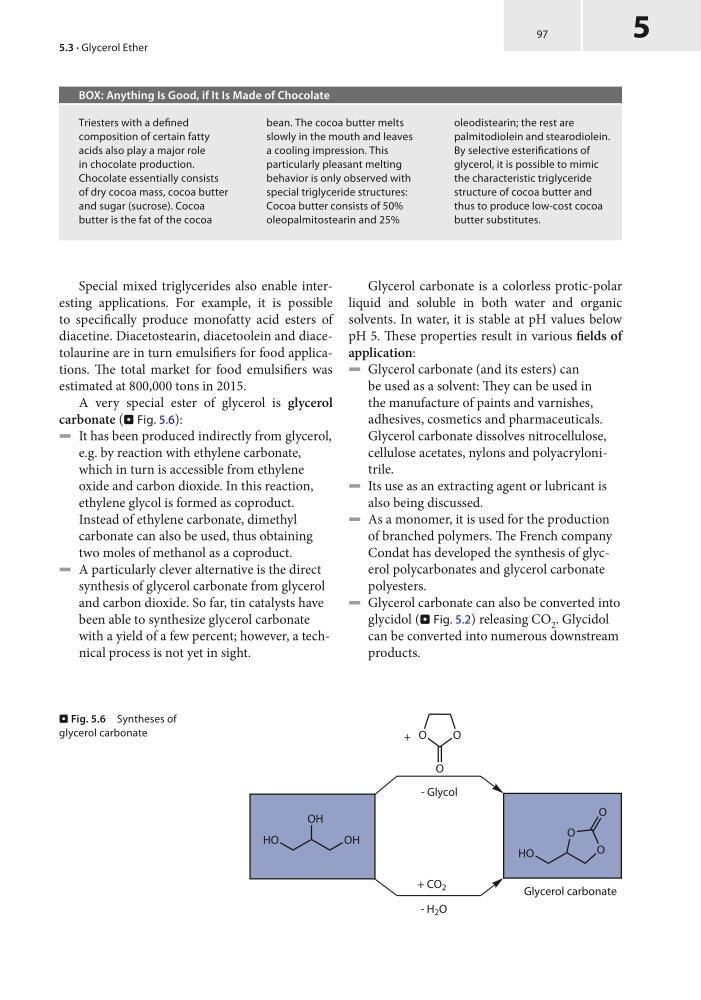
. Fig. 5.6 Syntheses of
glycerol carbonate
HO
OH
OH
HO
Glycerol carbonate
O
O
O
+ CO 2
- H 2 O
O
O
O
+
- Glycol
5.3 · Glycerol Ether
Special mixed triglycerides also enable interesting applications. For example, it is possible
to specifically produce monofatty acid esters of
diacetine. Diacetostearin, diacetoolein and diacetolaurine are in turn emulsifiers for food applications. The total market for food emulsifiers was
estimated at 800,000 tons in 2015.
A very special ester of glycerol is glycerol
carbonate (. Fig. 5.6):
5 It has been produced indirectly from glycerol,
e.g. by reaction with ethylene carbonate,
which in turn is accessible from ethylene
oxide and carbon dioxide. In this reaction,
ethylene glycol is formed as coproduct.
Instead of ethylene carbonate, dimethyl
carbonate can also be used, thus obtaining
two moles of methanol as a coproduct.
5 A particularly clever alternative is the direct
synthesis of glycerol carbonate from glycerol
and carbon dioxide. So far, tin catalysts have
been able to synthesize glycerol carbonate
with a yield of a few percent; however, a technical process is not yet in sight.
5
Glycerol carbonate is a colorless protic-polar
liquid and soluble in both water and organic
solvents. In water, it is stable at pH values below
pH 5. These properties result in various fields of
application:
5 Glycerol carbonate (and its esters) can
be used as a solvent: They can be used in
the manufacture of paints and varnishes,
adhesives, cosmetics and pharmaceuticals.
Glycerol carbonate dissolves nitrocellulose,
cellulose acetates, nylons and polyacrylonitrile.
5 Its use as an extracting agent or lubricant is
also being discussed.
5 As a monomer, it is used for the production
of branched polymers. The French company
Condat has developed the synthesis of glycerol polycarbonates and glycerol carbonate
polyesters.
5 Glycerol carbonate can also be converted into
glycidol (. Fig. 5.2) releasing CO 2 . Glycidol
can be converted into numerous downstream
products.
BOX: Anything Is Good, if It Is Made of Chocolate
Triesters with a defined
composition of certain fatty
acids also play a major role
in chocolate production.
Chocolate essentially consists
of dry cocoa mass, cocoa butter
and sugar (sucrose). Cocoa
butter is the fat of the cocoa
bean. The cocoa butter melts
slowly in the mouth and leaves
a cooling impression. This
particularly pleasant melting
behavior is only observed with
special triglyceride structures:
Cocoa butter consists of 50%
oleopalmitostearin and 25%
oleodistearin; the rest are
palmitodiolein and stearodiolein.
By selective esterifications of
glycerol, it is possible to mimic
the characteristic triglyceride
structure of cocoa butter and
thus to produce low-cost cocoa
butter substitutes.
. Fig. 5.6 Syntheses of
glycerol carbonate
HO
OH
OH
HO
Glycerol carbonate
O
O
O
+ CO 2
- H 2 O
O
O
O
+
- Glycol
5.3 · Glycerol Ether
Special mixed triglycerides also enable interesting applications. For example, it is possible
to specifically produce monofatty acid esters of
diacetine. Diacetostearin, diacetoolein and diacetolaurine are in turn emulsifiers for food applications. The total market for food emulsifiers was
estimated at 800,000 tons in 2015.
A very special ester of glycerol is glycerol
carbonate (. Fig. 5.6):
5 It has been produced indirectly from glycerol,
e.g. by reaction with ethylene carbonate,
which in turn is accessible from ethylene
oxide and carbon dioxide. In this reaction,
ethylene glycol is formed as coproduct.
Instead of ethylene carbonate, dimethyl
carbonate can also be used, thus obtaining
two moles of methanol as a coproduct.
5 A particularly clever alternative is the direct
synthesis of glycerol carbonate from glycerol
and carbon dioxide. So far, tin catalysts have
been able to synthesize glycerol carbonate
with a yield of a few percent; however, a technical process is not yet in sight.