

96
Chapter 5 · The Coproduct of Oleochemistry - Glycerol
5
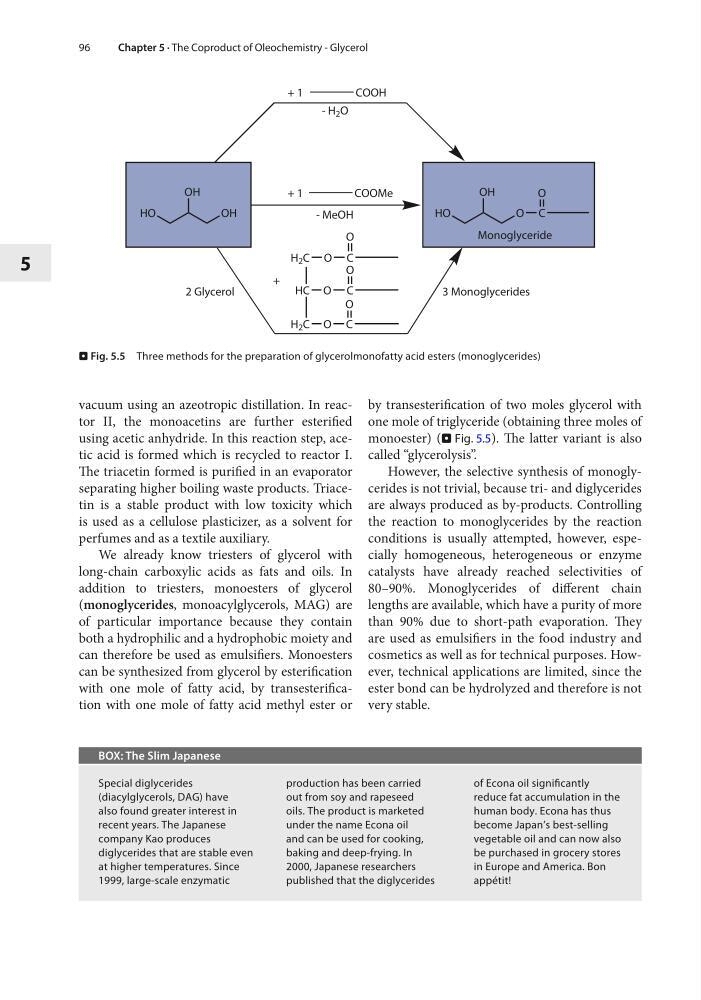
by transesterification of two moles glycerol with
one mole of triglyceride (obtaining three moles of
monoester) (. Fig. 5.5). The latter variant is also
called “glycerolysis”.
However, the selective synthesis of monoglycerides is not trivial, because tri- and diglycerides
are always produced as by-products. Controlling
the reaction to monoglycerides by the reaction
conditions is usually attempted, however, especially homogeneous, heterogeneous or enzyme
catalysts have already reached selectivities of
80–90%. Monoglycerides of different chain
lengths are available, which have a purity of more
than 90% due to short-path evaporation. They
are used as emulsifiers in the food industry and
cosmetics as well as for technical purposes. However, technical applications are limited, since the
ester bond can be hydrolyzed and therefore is not
very stable.
vacuum using an azeotropic distillation. In reactor II, the monoacetins are further esterified
using acetic anhydride. In this reaction step, acetic acid is formed which is recycled to reactor I.
The triacetin formed is purified in an evaporator
separating higher boiling waste products. Triacetin is a stable product with low toxicity which
is used as a cellulose plasticizer, as a solvent for
perfumes and as a textile auxiliary.
We already know triesters of glycerol with
long-chain carboxylic acids as fats and oils. In
addition to triesters, monoesters of glycerol
(monoglycerides, monoacylglycerols, MAG) are
of particular importance because they contain
both a hydrophilic and a hydrophobic moiety and
can therefore be used as emulsifiers. Monoesters
can be synthesized from glycerol by esterification
with one mole of fatty acid, by transesterification with one mole of fatty acid methyl ester or
HO
OH
OH
HO
O
OH
C
O
- H 2 O
- MeOH
Monoglyceride
3 Monoglycerides
2 Glycerol
H 2 C
HC
O
H 2 C O
O
C
O
C
O
C
O
+
+ 1
COOH
+ 1
COOMe
. Fig. 5.5 Three methods for the preparation of glycerolmonofatty acid esters (monoglycerides)
BOX: The Slim Japanese
Special diglycerides
(diacylglycerols, DAG) have
also found greater interest in
recent years. The Japanese
company Kao produces
diglycerides that are stable even
at higher temperatures. Since
1999, large-scale enzymatic
production has been carried
out from soy and rapeseed
oils. The product is marketed
under the name Econa oil
and can be used for cooking,
baking and deep-frying. In
2000, Japanese researchers
published that the diglycerides
of Econa oil significantly
reduce fat accumulation in the
human body. Econa has thus
become Japan’s best-selling
vegetable oil and can now also
be purchased in grocery stores
in Europe and America. Bon
appétit!
Chapter 5 · The Coproduct of Oleochemistry - Glycerol
5
by transesterification of two moles glycerol with
one mole of triglyceride (obtaining three moles of
monoester) (. Fig. 5.5). The latter variant is also
called “glycerolysis”.
However, the selective synthesis of monoglycerides is not trivial, because tri- and diglycerides
are always produced as by-products. Controlling
the reaction to monoglycerides by the reaction
conditions is usually attempted, however, especially homogeneous, heterogeneous or enzyme
catalysts have already reached selectivities of
80–90%. Monoglycerides of different chain
lengths are available, which have a purity of more
than 90% due to short-path evaporation. They
are used as emulsifiers in the food industry and
cosmetics as well as for technical purposes. However, technical applications are limited, since the
ester bond can be hydrolyzed and therefore is not
very stable.
vacuum using an azeotropic distillation. In reactor II, the monoacetins are further esterified
using acetic anhydride. In this reaction step, acetic acid is formed which is recycled to reactor I.
The triacetin formed is purified in an evaporator
separating higher boiling waste products. Triacetin is a stable product with low toxicity which
is used as a cellulose plasticizer, as a solvent for
perfumes and as a textile auxiliary.
We already know triesters of glycerol with
long-chain carboxylic acids as fats and oils. In
addition to triesters, monoesters of glycerol
(monoglycerides, monoacylglycerols, MAG) are
of particular importance because they contain
both a hydrophilic and a hydrophobic moiety and
can therefore be used as emulsifiers. Monoesters
can be synthesized from glycerol by esterification
with one mole of fatty acid, by transesterification with one mole of fatty acid methyl ester or
HO
OH
OH
HO
O
OH
C
O
- H 2 O
- MeOH
Monoglyceride
3 Monoglycerides
2 Glycerol
H 2 C
HC
O
H 2 C O
O
C
O
C
O
C
O
+
+ 1
COOH
+ 1
COOMe
. Fig. 5.5 Three methods for the preparation of glycerolmonofatty acid esters (monoglycerides)
BOX: The Slim Japanese
Special diglycerides
(diacylglycerols, DAG) have
also found greater interest in
recent years. The Japanese
company Kao produces
diglycerides that are stable even
at higher temperatures. Since
1999, large-scale enzymatic
production has been carried
out from soy and rapeseed
oils. The product is marketed
under the name Econa oil
and can be used for cooking,
baking and deep-frying. In
2000, Japanese researchers
published that the diglycerides
of Econa oil significantly
reduce fat accumulation in the
human body. Econa has thus
become Japan’s best-selling
vegetable oil and can now also
be purchased in grocery stores
in Europe and America. Bon
appétit!