

timely controlling according to wave conditions), thus greatly improving the system
performance.
Oscillating water column wave energy devices usually use air as secondary
energy transfer medium. Due to the limitation of conditions, the experiments are
generally divided into wave energy, air kinetic energy conversion, air kinetic
energy, mechanical energy, electric energy conversion, and other processes for
simulation. The model of each subsystem can be established by the experiment of
each process, such as the static pool model. Then, the system model can be obtained
by synthesizing each subsystem. The system model can be used to simulate, analyze, and select parameters.
Test value
Calculated value
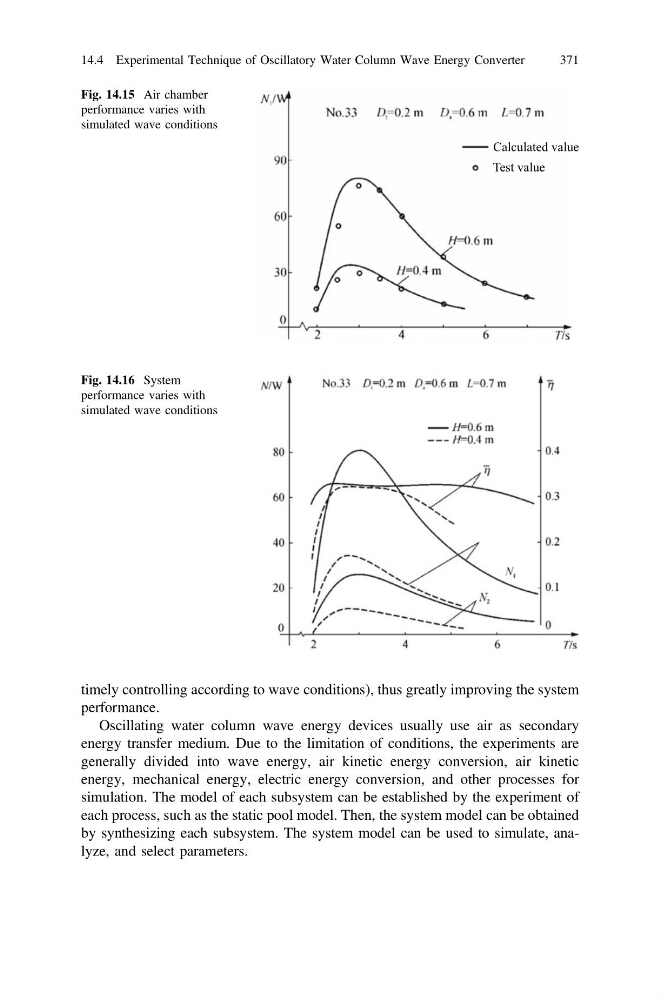
Fig. 14.15 Air chamber
performance varies with
simulated wave conditions
Fig. 14.16 System
performance varies with
simulated wave conditions
14.4 Experimental Technique of Oscillatory Water Column Wave Energy Converter
371
performance.
Oscillating water column wave energy devices usually use air as secondary
energy transfer medium. Due to the limitation of conditions, the experiments are
generally divided into wave energy, air kinetic energy conversion, air kinetic
energy, mechanical energy, electric energy conversion, and other processes for
simulation. The model of each subsystem can be established by the experiment of
each process, such as the static pool model. Then, the system model can be obtained
by synthesizing each subsystem. The system model can be used to simulate, analyze, and select parameters.
Test value
Calculated value
Fig. 14.15 Air chamber
performance varies with
simulated wave conditions
Fig. 14.16 System
performance varies with
simulated wave conditions
14.4 Experimental Technique of Oscillatory Water Column Wave Energy Converter
371