

of the chamber height and draft depth. The main influence is draft depth, followed
by chamber height. In fact, the influence of chamber height on performance is
caused by the compressibility of air. In wave energy system, the compressibility of
air caused by pressure and velocity is very small and can be omitted.
(2) Symmetrical Wing Turbine
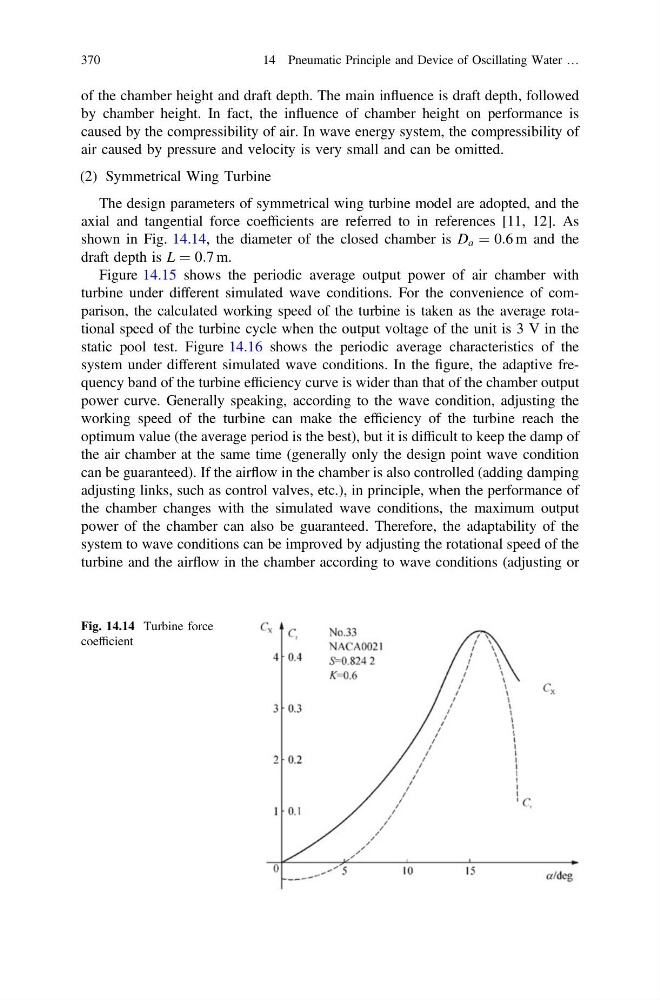
The design parameters of symmetrical wing turbine model are adopted, and the
axial and tangential force coefficients are referred to in references [11, 12]. As
shown in Fig. 14.14, the diameter of the closed chamber is D a ¼ 0:6 m and the
draft depth is L ¼ 0:7 m.
Figure 14.15 shows the periodic average output power of air chamber with
turbine under different simulated wave conditions. For the convenience of comparison, the calculated working speed of the turbine is taken as the average rotational speed of the turbine cycle when the output voltage of the unit is 3 V in the
static pool test. Figure 14.16 shows the periodic average characteristics of the
system under different simulated wave conditions. In the figure, the adaptive frequency band of the turbine efficiency curve is wider than that of the chamber output
power curve. Generally speaking, according to the wave condition, adjusting the
working speed of the turbine can make the efficiency of the turbine reach the
optimum value (the average period is the best), but it is difficult to keep the damp of
the air chamber at the same time (generally only the design point wave condition
can be guaranteed). If the airflow in the chamber is also controlled (adding damping
adjusting links, such as control valves, etc.), in principle, when the performance of
the chamber changes with the simulated wave conditions, the maximum output
power of the chamber can also be guaranteed. Therefore, the adaptability of the
system to wave conditions can be improved by adjusting the rotational speed of the
turbine and the airflow in the chamber according to wave conditions (adjusting or
Fig. 14.14 Turbine force
coefficient
370
14 Pneumatic Principle and Device of Oscillating Water …
by chamber height. In fact, the influence of chamber height on performance is
caused by the compressibility of air. In wave energy system, the compressibility of
air caused by pressure and velocity is very small and can be omitted.
(2) Symmetrical Wing Turbine
The design parameters of symmetrical wing turbine model are adopted, and the
axial and tangential force coefficients are referred to in references [11, 12]. As
shown in Fig. 14.14, the diameter of the closed chamber is D a ¼ 0:6 m and the
draft depth is L ¼ 0:7 m.
Figure 14.15 shows the periodic average output power of air chamber with
turbine under different simulated wave conditions. For the convenience of comparison, the calculated working speed of the turbine is taken as the average rotational speed of the turbine cycle when the output voltage of the unit is 3 V in the
static pool test. Figure 14.16 shows the periodic average characteristics of the
system under different simulated wave conditions. In the figure, the adaptive frequency band of the turbine efficiency curve is wider than that of the chamber output
power curve. Generally speaking, according to the wave condition, adjusting the
working speed of the turbine can make the efficiency of the turbine reach the
optimum value (the average period is the best), but it is difficult to keep the damp of
the air chamber at the same time (generally only the design point wave condition
can be guaranteed). If the airflow in the chamber is also controlled (adding damping
adjusting links, such as control valves, etc.), in principle, when the performance of
the chamber changes with the simulated wave conditions, the maximum output
power of the chamber can also be guaranteed. Therefore, the adaptability of the
system to wave conditions can be improved by adjusting the rotational speed of the
turbine and the airflow in the chamber according to wave conditions (adjusting or
Fig. 14.14 Turbine force
coefficient
370
14 Pneumatic Principle and Device of Oscillating Water …