

13.2.4 Test Results
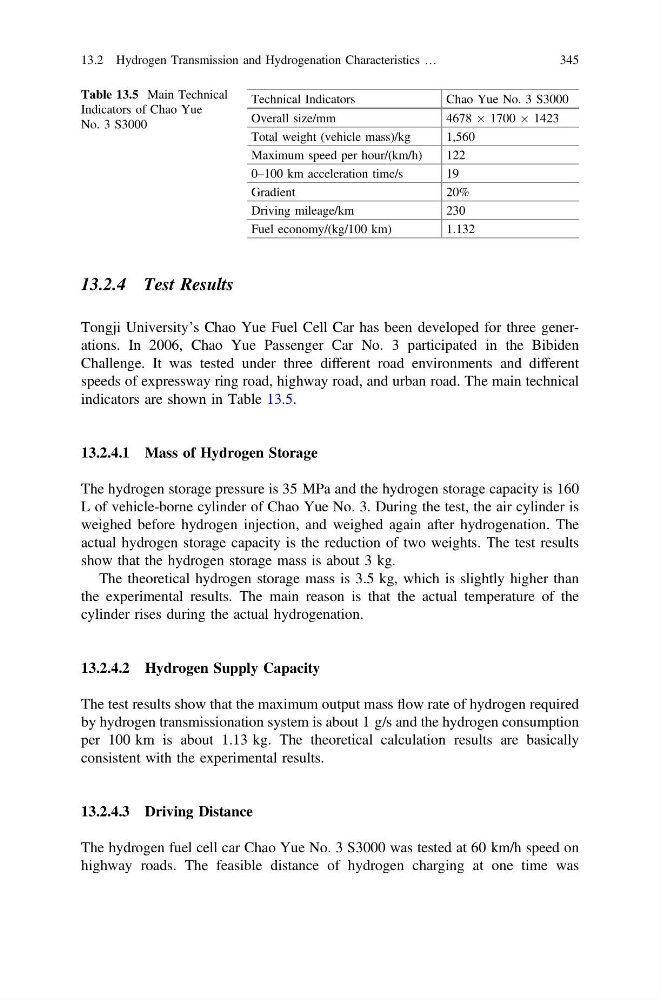
Tongji University’s Chao Yue Fuel Cell Car has been developed for three generations. In 2006, Chao Yue Passenger Car No. 3 participated in the Bibiden
Challenge. It was tested under three different road environments and different
speeds of expressway ring road, highway road, and urban road. The main technical
indicators are shown in Table 13.5.
13.2.4.1 Mass of Hydrogen Storage
The hydrogen storage pressure is 35 MPa and the hydrogen storage capacity is 160
L of vehicle-borne cylinder of Chao Yue No. 3. During the test, the air cylinder is
weighed before hydrogen injection, and weighed again after hydrogenation. The
actual hydrogen storage capacity is the reduction of two weights. The test results
show that the hydrogen storage mass is about 3 kg.
The theoretical hydrogen storage mass is 3.5 kg, which is slightly higher than
the experimental results. The main reason is that the actual temperature of the
cylinder rises during the actual hydrogenation.
13.2.4.2 Hydrogen Supply Capacity
The test results show that the maximum output mass flow rate of hydrogen required
by hydrogen transmissionation system is about 1 g/s and the hydrogen consumption
per 100 km is about 1.13 kg. The theoretical calculation results are basically
consistent with the experimental results.
13.2.4.3 Driving Distance
The hydrogen fuel cell car Chao Yue No. 3 S3000 was tested at 60 km/h speed on
highway roads. The feasible distance of hydrogen charging at one time was
Table 13.5 Main Technical
Indicators of Chao Yue
No. 3 S3000
Technical Indicators
Chao Yue No. 3 S3000
Overall size/mm
4678 Â 1700 Â 1423
Total weight (vehicle mass)/kg
1,560
Maximum speed per hour/(km/h)
122
0–100 km acceleration time/s
19
Gradient
20%
Driving mileage/km
230
Fuel economy/(kg/100 km)
1.132
13.2 Hydrogen Transmission and Hydrogenation Characteristics …
345
Tongji University’s Chao Yue Fuel Cell Car has been developed for three generations. In 2006, Chao Yue Passenger Car No. 3 participated in the Bibiden
Challenge. It was tested under three different road environments and different
speeds of expressway ring road, highway road, and urban road. The main technical
indicators are shown in Table 13.5.
13.2.4.1 Mass of Hydrogen Storage
The hydrogen storage pressure is 35 MPa and the hydrogen storage capacity is 160
L of vehicle-borne cylinder of Chao Yue No. 3. During the test, the air cylinder is
weighed before hydrogen injection, and weighed again after hydrogenation. The
actual hydrogen storage capacity is the reduction of two weights. The test results
show that the hydrogen storage mass is about 3 kg.
The theoretical hydrogen storage mass is 3.5 kg, which is slightly higher than
the experimental results. The main reason is that the actual temperature of the
cylinder rises during the actual hydrogenation.
13.2.4.2 Hydrogen Supply Capacity
The test results show that the maximum output mass flow rate of hydrogen required
by hydrogen transmissionation system is about 1 g/s and the hydrogen consumption
per 100 km is about 1.13 kg. The theoretical calculation results are basically
consistent with the experimental results.
13.2.4.3 Driving Distance
The hydrogen fuel cell car Chao Yue No. 3 S3000 was tested at 60 km/h speed on
highway roads. The feasible distance of hydrogen charging at one time was
Table 13.5 Main Technical
Indicators of Chao Yue
No. 3 S3000
Technical Indicators
Chao Yue No. 3 S3000
Overall size/mm
4678 Â 1700 Â 1423
Total weight (vehicle mass)/kg
1,560
Maximum speed per hour/(km/h)
122
0–100 km acceleration time/s
19
Gradient
20%
Driving mileage/km
230
Fuel economy/(kg/100 km)
1.132
13.2 Hydrogen Transmission and Hydrogenation Characteristics …
345