

where
T A Temperature of gas source (K).
13.2.3.2 Analysis of Simulation Results
In the process of hydrogenation at hydrogenation station, the inlet pressure p i of
fixed throttle port is the gas source pressure of hydrogenation station, and keeps a
certain level. Its pressure is 35 MPa and 70 MPa, respectively. The outlet pressure
p o of fixed throttle port is equal to cylinder pressure p. In order to meet the
requirement of rapid hydrogenation, the hydrogenation time is generally controlled
in 3-5 min. The hydrogenation time is related to the fixed throttle area. The larger
the throttle area is, the shorter the hydrogenation time is. In order to meet the
requirement of hydrogenation time, the fixed throttle area S o was initially selected
as 1 mm
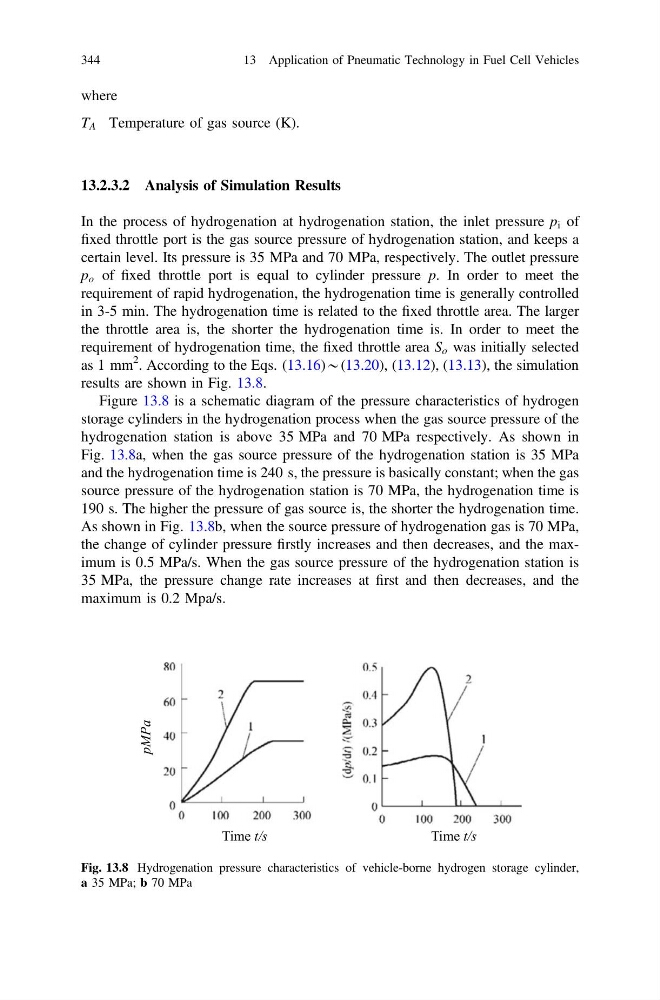
2 . According to the Eqs. (13.16)*(13.20), (13.12), (13.13), the simulation
results are shown in Fig. 13.8.
Figure 13.8 is a schematic diagram of the pressure characteristics of hydrogen
storage cylinders in the hydrogenation process when the gas source pressure of the
hydrogenation station is above 35 MPa and 70 MPa respectively. As shown in
Fig. 13.8a, when the gas source pressure of the hydrogenation station is 35 MPa
and the hydrogenation time is 240 s, the pressure is basically constant; when the gas
source pressure of the hydrogenation station is 70 MPa, the hydrogenation time is
190 s. The higher the pressure of gas source is, the shorter the hydrogenation time.
As shown in Fig. 13.8b, when the source pressure of hydrogenation gas is 70 MPa,
the change of cylinder pressure firstly increases and then decreases, and the maximum is 0.5 MPa/s. When the gas source pressure of the hydrogenation station is
35 MPa, the pressure change rate increases at first and then decreases, and the
maximum is 0.2 Mpa/s.
pMPa
Time t/s
Time t/s
Fig. 13.8 Hydrogenation pressure characteristics of vehicle-borne hydrogen storage cylinder,
a 35 MPa; b 70 MPa
344
13 Application of Pneumatic Technology in Fuel Cell Vehicles
T A Temperature of gas source (K).
13.2.3.2 Analysis of Simulation Results
In the process of hydrogenation at hydrogenation station, the inlet pressure p i of
fixed throttle port is the gas source pressure of hydrogenation station, and keeps a
certain level. Its pressure is 35 MPa and 70 MPa, respectively. The outlet pressure
p o of fixed throttle port is equal to cylinder pressure p. In order to meet the
requirement of rapid hydrogenation, the hydrogenation time is generally controlled
in 3-5 min. The hydrogenation time is related to the fixed throttle area. The larger
the throttle area is, the shorter the hydrogenation time is. In order to meet the
requirement of hydrogenation time, the fixed throttle area S o was initially selected
as 1 mm
2 . According to the Eqs. (13.16)*(13.20), (13.12), (13.13), the simulation
results are shown in Fig. 13.8.
Figure 13.8 is a schematic diagram of the pressure characteristics of hydrogen
storage cylinders in the hydrogenation process when the gas source pressure of the
hydrogenation station is above 35 MPa and 70 MPa respectively. As shown in
Fig. 13.8a, when the gas source pressure of the hydrogenation station is 35 MPa
and the hydrogenation time is 240 s, the pressure is basically constant; when the gas
source pressure of the hydrogenation station is 70 MPa, the hydrogenation time is
190 s. The higher the pressure of gas source is, the shorter the hydrogenation time.
As shown in Fig. 13.8b, when the source pressure of hydrogenation gas is 70 MPa,
the change of cylinder pressure firstly increases and then decreases, and the maximum is 0.5 MPa/s. When the gas source pressure of the hydrogenation station is
35 MPa, the pressure change rate increases at first and then decreases, and the
maximum is 0.2 Mpa/s.
pMPa
Time t/s
Time t/s
Fig. 13.8 Hydrogenation pressure characteristics of vehicle-borne hydrogen storage cylinder,
a 35 MPa; b 70 MPa
344
13 Application of Pneumatic Technology in Fuel Cell Vehicles