

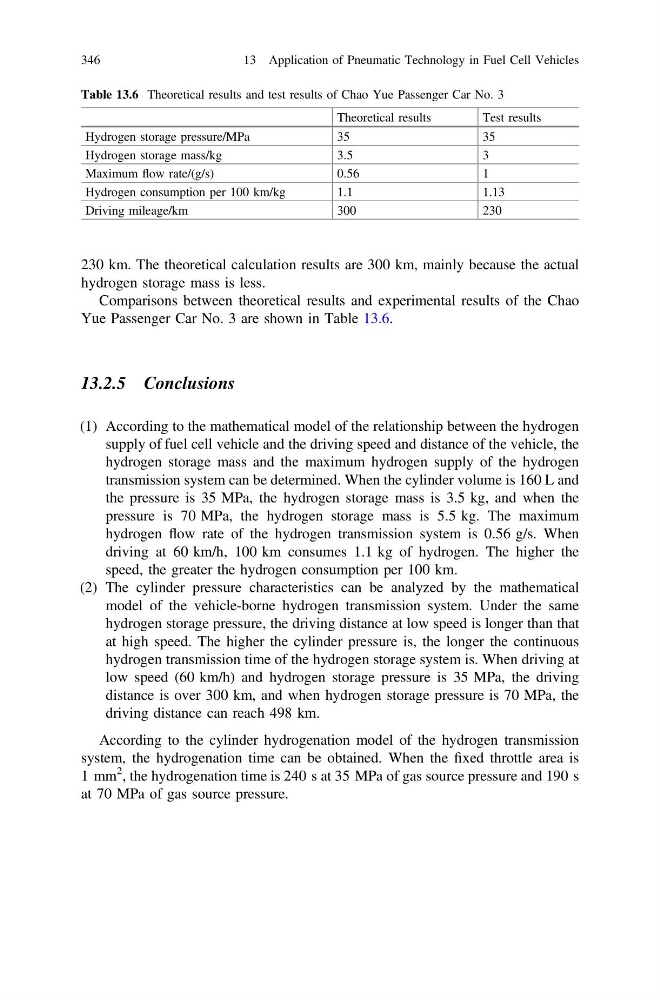
230 km. The theoretical calculation results are 300 km, mainly because the actual
hydrogen storage mass is less.
Comparisons between theoretical results and experimental results of the Chao
Yue Passenger Car No. 3 are shown in Table 13.6.
13.2.5 Conclusions
(1) According to the mathematical model of the relationship between the hydrogen
supply of fuel cell vehicle and the driving speed and distance of the vehicle, the
hydrogen storage mass and the maximum hydrogen supply of the hydrogen
transmission system can be determined. When the cylinder volume is 160 L and
the pressure is 35 MPa, the hydrogen storage mass is 3.5 kg, and when the
pressure is 70 MPa, the hydrogen storage mass is 5.5 kg. The maximum
hydrogen flow rate of the hydrogen transmission system is 0.56 g/s. When
driving at 60 km/h, 100 km consumes 1.1 kg of hydrogen. The higher the
speed, the greater the hydrogen consumption per 100 km.
(2) The cylinder pressure characteristics can be analyzed by the mathematical
model of the vehicle-borne hydrogen transmission system. Under the same
hydrogen storage pressure, the driving distance at low speed is longer than that
at high speed. The higher the cylinder pressure is, the longer the continuous
hydrogen transmission time of the hydrogen storage system is. When driving at
low speed (60 km/h) and hydrogen storage pressure is 35 MPa, the driving
distance is over 300 km, and when hydrogen storage pressure is 70 MPa, the
driving distance can reach 498 km.
According to the cylinder hydrogenation model of the hydrogen transmission
system, the hydrogenation time can be obtained. When the fixed throttle area is
1 mm
2 , the hydrogenation time is 240 s at 35 MPa of gas source pressure and 190 s
at 70 MPa of gas source pressure.
Table 13.6 Theoretical results and test results of Chao Yue Passenger Car No. 3
Theoretical results
Test results
Hydrogen storage pressure/MPa
35
35
Hydrogen storage mass/kg
3.5
3
Maximum flow rate/(g/s)
0.56
1
Hydrogen consumption per 100 km/kg
1.1
1.13
Driving mileage/km
300
230
346
13 Application of Pneumatic Technology in Fuel Cell Vehicles
hydrogen storage mass is less.
Comparisons between theoretical results and experimental results of the Chao
Yue Passenger Car No. 3 are shown in Table 13.6.
13.2.5 Conclusions
(1) According to the mathematical model of the relationship between the hydrogen
supply of fuel cell vehicle and the driving speed and distance of the vehicle, the
hydrogen storage mass and the maximum hydrogen supply of the hydrogen
transmission system can be determined. When the cylinder volume is 160 L and
the pressure is 35 MPa, the hydrogen storage mass is 3.5 kg, and when the
pressure is 70 MPa, the hydrogen storage mass is 5.5 kg. The maximum
hydrogen flow rate of the hydrogen transmission system is 0.56 g/s. When
driving at 60 km/h, 100 km consumes 1.1 kg of hydrogen. The higher the
speed, the greater the hydrogen consumption per 100 km.
(2) The cylinder pressure characteristics can be analyzed by the mathematical
model of the vehicle-borne hydrogen transmission system. Under the same
hydrogen storage pressure, the driving distance at low speed is longer than that
at high speed. The higher the cylinder pressure is, the longer the continuous
hydrogen transmission time of the hydrogen storage system is. When driving at
low speed (60 km/h) and hydrogen storage pressure is 35 MPa, the driving
distance is over 300 km, and when hydrogen storage pressure is 70 MPa, the
driving distance can reach 498 km.
According to the cylinder hydrogenation model of the hydrogen transmission
system, the hydrogenation time can be obtained. When the fixed throttle area is
1 mm
2 , the hydrogenation time is 240 s at 35 MPa of gas source pressure and 190 s
at 70 MPa of gas source pressure.
Table 13.6 Theoretical results and test results of Chao Yue Passenger Car No. 3
Theoretical results
Test results
Hydrogen storage pressure/MPa
35
35
Hydrogen storage mass/kg
3.5
3
Maximum flow rate/(g/s)
0.56
1
Hydrogen consumption per 100 km/kg
1.1
1.13
Driving mileage/km
300
230
346
13 Application of Pneumatic Technology in Fuel Cell Vehicles