

of the fuel cell vehicle prototypes launched by major automobile companies in the
world use high-pressure gaseous hydrogen storage.
In August 2005, the first fuel cell hybrid car “Chao Yue No. 1” developed by
China passed the acceptance of “863” project. The car uses reinforced carbon fiber
wound aluminum alloy inner liner with cylinder pressure of 30 MPa. The maximum speed is 110 km per hour, and it can drive 210 km continuously. In 2004, the
863 fuel cell city bus developed by Tsinghua University used the high-pressure
cylinder developed by Space 625 Research Institute to store hydrogen. The cylinder
is an aluminum container, the outer layer is strengthened with carbon fibers, and the
inner liner is polymer material resistant to hydrogen embrittlement. The working
pressure is 20 MPa and 9 cylinders with volume of 100 L were used. In addition,
the city bus is equipped with hydrogen supply safety system, vehicle hydrogen
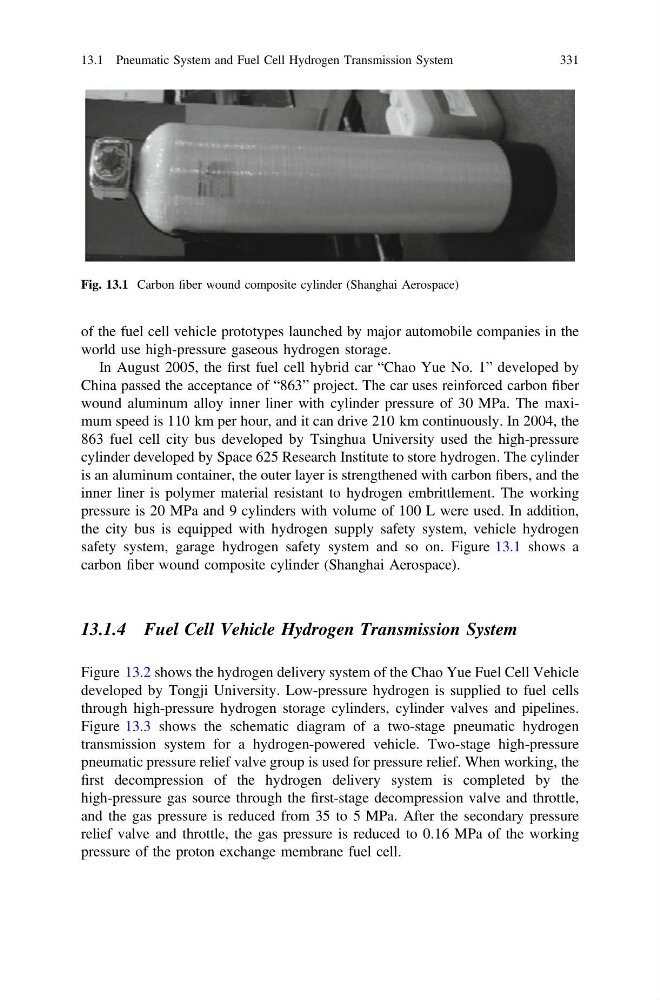
safety system, garage hydrogen safety system and so on. Figure 13.1 shows a
carbon fiber wound composite cylinder (Shanghai Aerospace).
13.1.4 Fuel Cell Vehicle Hydrogen Transmission System
Figure 13.2 shows the hydrogen delivery system of the Chao Yue Fuel Cell Vehicle
developed by Tongji University. Low-pressure hydrogen is supplied to fuel cells
through high-pressure hydrogen storage cylinders, cylinder valves and pipelines.
Figure 13.3 shows the schematic diagram of a two-stage pneumatic hydrogen
transmission system for a hydrogen-powered vehicle. Two-stage high-pressure
pneumatic pressure relief valve group is used for pressure relief. When working, the
first decompression of the hydrogen delivery system is completed by the
high-pressure gas source through the first-stage decompression valve and throttle,
and the gas pressure is reduced from 35 to 5 MPa. After the secondary pressure
relief valve and throttle, the gas pressure is reduced to 0.16 MPa of the working
pressure of the proton exchange membrane fuel cell.
Fig. 13.1 Carbon fiber wound composite cylinder (Shanghai Aerospace)
13.1 Pneumatic System and Fuel Cell Hydrogen Transmission System
331
world use high-pressure gaseous hydrogen storage.
In August 2005, the first fuel cell hybrid car “Chao Yue No. 1” developed by
China passed the acceptance of “863” project. The car uses reinforced carbon fiber
wound aluminum alloy inner liner with cylinder pressure of 30 MPa. The maximum speed is 110 km per hour, and it can drive 210 km continuously. In 2004, the
863 fuel cell city bus developed by Tsinghua University used the high-pressure
cylinder developed by Space 625 Research Institute to store hydrogen. The cylinder
is an aluminum container, the outer layer is strengthened with carbon fibers, and the
inner liner is polymer material resistant to hydrogen embrittlement. The working
pressure is 20 MPa and 9 cylinders with volume of 100 L were used. In addition,
the city bus is equipped with hydrogen supply safety system, vehicle hydrogen
safety system, garage hydrogen safety system and so on. Figure 13.1 shows a
carbon fiber wound composite cylinder (Shanghai Aerospace).
13.1.4 Fuel Cell Vehicle Hydrogen Transmission System
Figure 13.2 shows the hydrogen delivery system of the Chao Yue Fuel Cell Vehicle
developed by Tongji University. Low-pressure hydrogen is supplied to fuel cells
through high-pressure hydrogen storage cylinders, cylinder valves and pipelines.
Figure 13.3 shows the schematic diagram of a two-stage pneumatic hydrogen
transmission system for a hydrogen-powered vehicle. Two-stage high-pressure
pneumatic pressure relief valve group is used for pressure relief. When working, the
first decompression of the hydrogen delivery system is completed by the
high-pressure gas source through the first-stage decompression valve and throttle,
and the gas pressure is reduced from 35 to 5 MPa. After the secondary pressure
relief valve and throttle, the gas pressure is reduced to 0.16 MPa of the working
pressure of the proton exchange membrane fuel cell.
Fig. 13.1 Carbon fiber wound composite cylinder (Shanghai Aerospace)
13.1 Pneumatic System and Fuel Cell Hydrogen Transmission System
331