

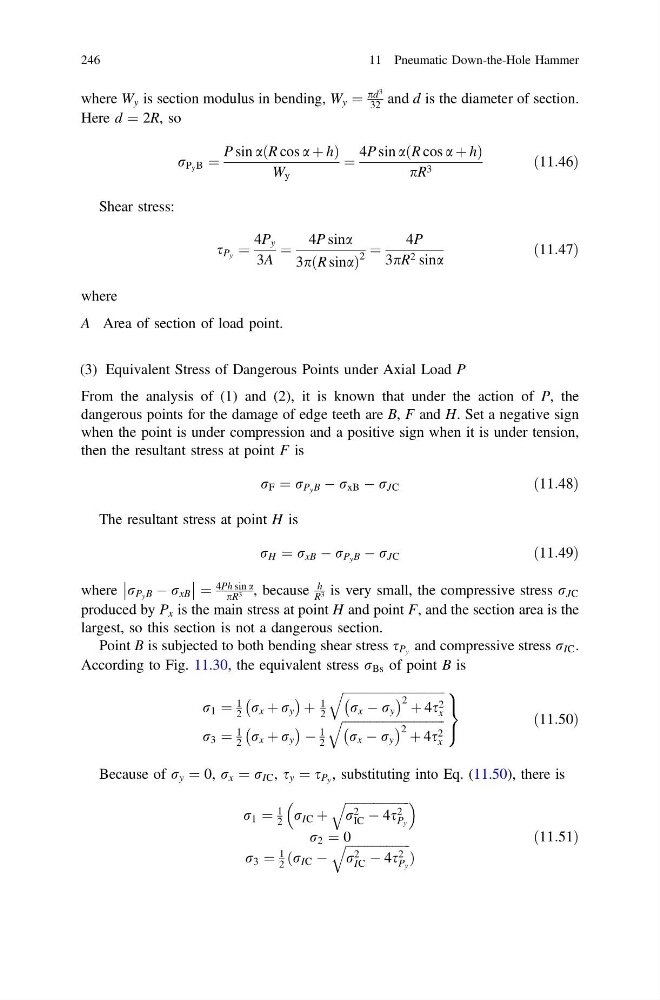
where W y is section modulus in bending, W y ¼
pd
3
32 and d is the diameter of section.
Here d ¼ 2R, so
r P y B ¼
P sin a R cos a þ h
ð
Þ
W y
¼
4P sin a R cos a þ h
ð
Þ
pR 3
ð11:46Þ
Shear stress:
s P y ¼
4P y
3A
¼
4P sina
3p R sina
ð
Þ
2
¼
4P
3pR 2 sina
ð11:47Þ
where
A Area of section of load point.
(3) Equivalent Stress of Dangerous Points under Axial Load P
From the analysis of (1) and (2), it is known that under the action of P, the
dangerous points for the damage of edge teeth are B, F and H. Set a negative sign
when the point is under compression and a positive sign when it is under tension,
then the resultant stress at point F is
r F ¼ r P y B À r xB À r JC
ð11:48Þ
The resultant stress at point H is
r H ¼ r xB À r P y B À r JC
ð11:49Þ
where r P y B À r xB
¼
4Ph sin a
pR 3 , because
h
R 3 is very small, the compressive stress r JC
produced by P x is the main stress at point H and point F, and the section area is the
largest, so this section is not a dangerous section.
Point B is subjected to both bending shear stress s P y and compressive stress r IC .
According to Fig. 11.30, the equivalent stress r Bs of point B is
r 1 ¼
1
2 r x þ r y
À
Á þ
1
2
ffiffiffiffiffiffiffiffiffiffiffiffiffiffiffiffiffiffiffiffiffiffiffiffiffiffiffiffiffiffiffiffiffi
r x À r y
À
Á 2 þ 4s 2
x
q
r 3 ¼
1
2 r x þ r y
À
Á À
1
2
ffiffiffiffiffiffiffiffiffiffiffiffiffiffiffiffiffiffiffiffiffiffiffiffiffiffiffiffiffiffiffiffiffi
r x À r y
À
Á 2 þ 4s 2
x
q
9
=
;
ð11:50Þ
Because of r y ¼ 0, r x ¼ r IC , s y ¼ s P y , substituting into Eq. (11.50), there is
r 1 ¼
1
2 r IC þ
ffiffiffiffiffiffiffiffiffiffiffiffiffiffiffiffiffiffiffiffi ffi
r 2
IC À 4s 2
P y
q
r 2 ¼ 0
r 3 ¼
1
2 ðr IC À
ffiffiffiffiffiffiffiffiffiffiffiffiffiffiffiffiffiffiffiffi ffi
r 2
IC À 4s 2
P y
q
Þ
ð11:51Þ
246
11 Pneumatic Down-the-Hole Hammer
pd
3
32 and d is the diameter of section.
Here d ¼ 2R, so
r P y B ¼
P sin a R cos a þ h
ð
Þ
W y
¼
4P sin a R cos a þ h
ð
Þ
pR 3
ð11:46Þ
Shear stress:
s P y ¼
4P y
3A
¼
4P sina
3p R sina
ð
Þ
2
¼
4P
3pR 2 sina
ð11:47Þ
where
A Area of section of load point.
(3) Equivalent Stress of Dangerous Points under Axial Load P
From the analysis of (1) and (2), it is known that under the action of P, the
dangerous points for the damage of edge teeth are B, F and H. Set a negative sign
when the point is under compression and a positive sign when it is under tension,
then the resultant stress at point F is
r F ¼ r P y B À r xB À r JC
ð11:48Þ
The resultant stress at point H is
r H ¼ r xB À r P y B À r JC
ð11:49Þ
where r P y B À r xB
¼
4Ph sin a
pR 3 , because
h
R 3 is very small, the compressive stress r JC
produced by P x is the main stress at point H and point F, and the section area is the
largest, so this section is not a dangerous section.
Point B is subjected to both bending shear stress s P y and compressive stress r IC .
According to Fig. 11.30, the equivalent stress r Bs of point B is
r 1 ¼
1
2 r x þ r y
À
Á þ
1
2
ffiffiffiffiffiffiffiffiffiffiffiffiffiffiffiffiffiffiffiffiffiffiffiffiffiffiffiffiffiffiffiffiffi
r x À r y
À
Á 2 þ 4s 2
x
q
r 3 ¼
1
2 r x þ r y
À
Á À
1
2
ffiffiffiffiffiffiffiffiffiffiffiffiffiffiffiffiffiffiffiffiffiffiffiffiffiffiffiffiffiffiffiffiffi
r x À r y
À
Á 2 þ 4s 2
x
q
9
=
;
ð11:50Þ
Because of r y ¼ 0, r x ¼ r IC , s y ¼ s P y , substituting into Eq. (11.50), there is
r 1 ¼
1
2 r IC þ
ffiffiffiffiffiffiffiffiffiffiffiffiffiffiffiffiffiffiffiffi ffi
r 2
IC À 4s 2
P y
q
r 2 ¼ 0
r 3 ¼
1
2 ðr IC À
ffiffiffiffiffiffiffiffiffiffiffiffiffiffiffiffiffiffiffiffi ffi
r 2
IC À 4s 2
P y
q
Þ
ð11:51Þ
246
11 Pneumatic Down-the-Hole Hammer