

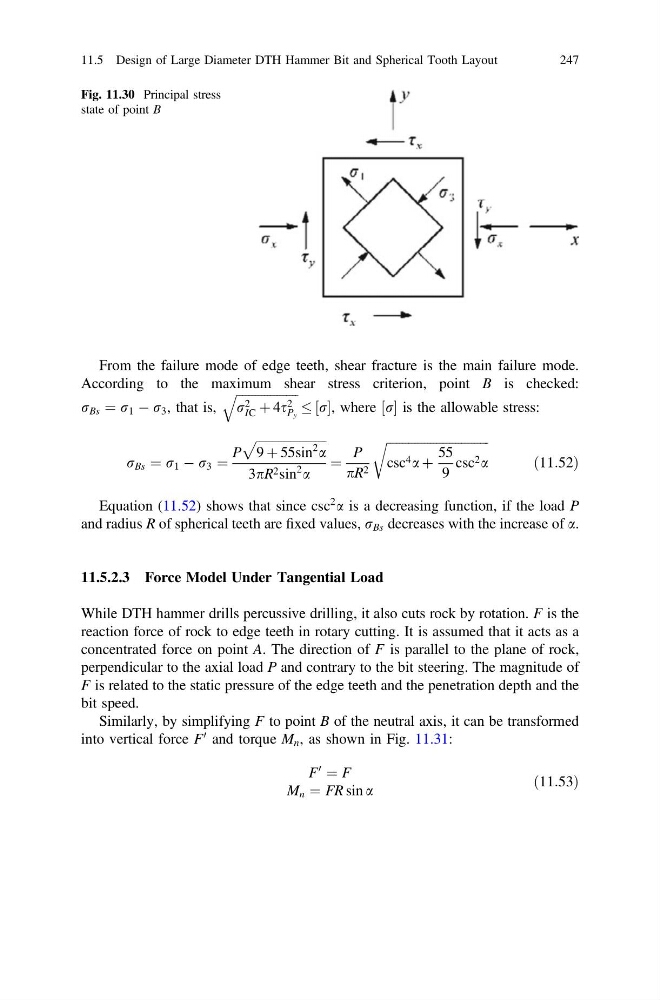
From the failure mode of edge teeth, shear fracture is the main failure mode.
According to the maximum shear stress criterion, point B is checked:
r Bs ¼ r 1 À r 3 , that is,
ffiffiffiffiffiffiffiffiffiffiffiffiffiffiffiffiffiffiffiffi
r 2
IC þ 4s 2
P y
q
r
½ , where r
½ is the allowable stress:
r Bs ¼ r 1 À r 3 ¼
P
ffiffiffiffiffiffiffiffiffiffiffiffiffiffiffiffiffiffiffiffiffiffi ffi
9 þ 55sin
2
a
p
3pR 2 sin
2
a
¼
P
pR 2
ffiffiffiffiffiffiffiffiffiffiffiffiffiffiffiffiffiffiffiffiffiffiffiffiffiffiffiffiffiffiffiffi ffi
csc 4 a þ
55
9
csc 2 a
r
ð11:52Þ
Equation (11.52) shows that since csc
2
a is a decreasing function, if the load P
and radius R of spherical teeth are fixed values, r Bs decreases with the increase of a.
11.5.2.3 Force Model Under Tangential Load
While DTH hammer drills percussive drilling, it also cuts rock by rotation. F is the
reaction force of rock to edge teeth in rotary cutting. It is assumed that it acts as a
concentrated force on point A. The direction of F is parallel to the plane of rock,
perpendicular to the axial load P and contrary to the bit steering. The magnitude of
F is related to the static pressure of the edge teeth and the penetration depth and the
bit speed.
Similarly, by simplifying F to point B of the neutral axis, it can be transformed
into vertical force F
0 and torque M n , as shown in Fig. 11.31:
F
0
¼ F
M n ¼ FR sin a
ð11:53Þ
Fig. 11.30 Principal stress
state of point B
11.5 Design of Large Diameter DTH Hammer Bit and Spherical Tooth Layout
247
According to the maximum shear stress criterion, point B is checked:
r Bs ¼ r 1 À r 3 , that is,
ffiffiffiffiffiffiffiffiffiffiffiffiffiffiffiffiffiffiffiffi
r 2
IC þ 4s 2
P y
q
r
½ , where r
½ is the allowable stress:
r Bs ¼ r 1 À r 3 ¼
P
ffiffiffiffiffiffiffiffiffiffiffiffiffiffiffiffiffiffiffiffiffiffi ffi
9 þ 55sin
2
a
p
3pR 2 sin
2
a
¼
P
pR 2
ffiffiffiffiffiffiffiffiffiffiffiffiffiffiffiffiffiffiffiffiffiffiffiffiffiffiffiffiffiffiffiffi ffi
csc 4 a þ
55
9
csc 2 a
r
ð11:52Þ
Equation (11.52) shows that since csc
2
a is a decreasing function, if the load P
and radius R of spherical teeth are fixed values, r Bs decreases with the increase of a.
11.5.2.3 Force Model Under Tangential Load
While DTH hammer drills percussive drilling, it also cuts rock by rotation. F is the
reaction force of rock to edge teeth in rotary cutting. It is assumed that it acts as a
concentrated force on point A. The direction of F is parallel to the plane of rock,
perpendicular to the axial load P and contrary to the bit steering. The magnitude of
F is related to the static pressure of the edge teeth and the penetration depth and the
bit speed.
Similarly, by simplifying F to point B of the neutral axis, it can be transformed
into vertical force F
0 and torque M n , as shown in Fig. 11.31:
F
0
¼ F
M n ¼ FR sin a
ð11:53Þ
Fig. 11.30 Principal stress
state of point B
11.5 Design of Large Diameter DTH Hammer Bit and Spherical Tooth Layout
247