

11.5.2.2 Force Model Under Axial Load
When DTH hammer bit drills rock, rock reacts on the bit, which makes the bit bear
a reverse impact load. It is observed that the curvature of the bottom of the hole
basically coincides with the curvature of the end of the bit after the ball tooth bit is
drilled into the rock in normal drilling. The tougher the rock is, the better the
coincidence degree is. It can be inferred that the axial impact stress is uniformly
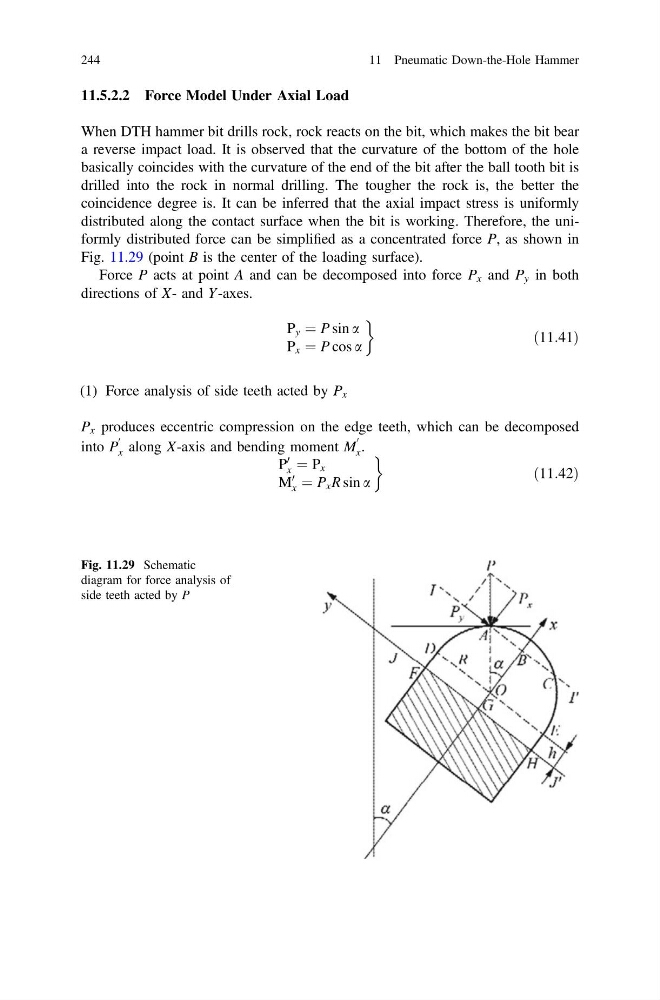
distributed along the contact surface when the bit is working. Therefore, the uniformly distributed force can be simplified as a concentrated force P, as shown in
Fig. 11.29 (point B is the center of the loading surface).
Force P acts at point A and can be decomposed into force P x and P y in both
directions of X- and Y-axes.
P y ¼ P sin a
P x ¼ P cos a
'
ð11:41Þ
(1) Force analysis of side teeth acted by P x
P x produces eccentric compression on the edge teeth, which can be decomposed
into P
0
x along X-axis and bending moment M
0
x .
P
0
x ¼ P x
M
0
x ¼ P x R sin a
'
ð11:42Þ
Fig. 11.29 Schematic
diagram for force analysis of
side teeth acted by P
244
11 Pneumatic Down-the-Hole Hammer
When DTH hammer bit drills rock, rock reacts on the bit, which makes the bit bear
a reverse impact load. It is observed that the curvature of the bottom of the hole
basically coincides with the curvature of the end of the bit after the ball tooth bit is
drilled into the rock in normal drilling. The tougher the rock is, the better the
coincidence degree is. It can be inferred that the axial impact stress is uniformly
distributed along the contact surface when the bit is working. Therefore, the uniformly distributed force can be simplified as a concentrated force P, as shown in
Fig. 11.29 (point B is the center of the loading surface).
Force P acts at point A and can be decomposed into force P x and P y in both
directions of X- and Y-axes.
P y ¼ P sin a
P x ¼ P cos a
'
ð11:41Þ
(1) Force analysis of side teeth acted by P x
P x produces eccentric compression on the edge teeth, which can be decomposed
into P
0
x along X-axis and bending moment M
0
x .
P
0
x ¼ P x
M
0
x ¼ P x R sin a
'
ð11:42Þ
Fig. 11.29 Schematic
diagram for force analysis of
side teeth acted by P
244
11 Pneumatic Down-the-Hole Hammer