

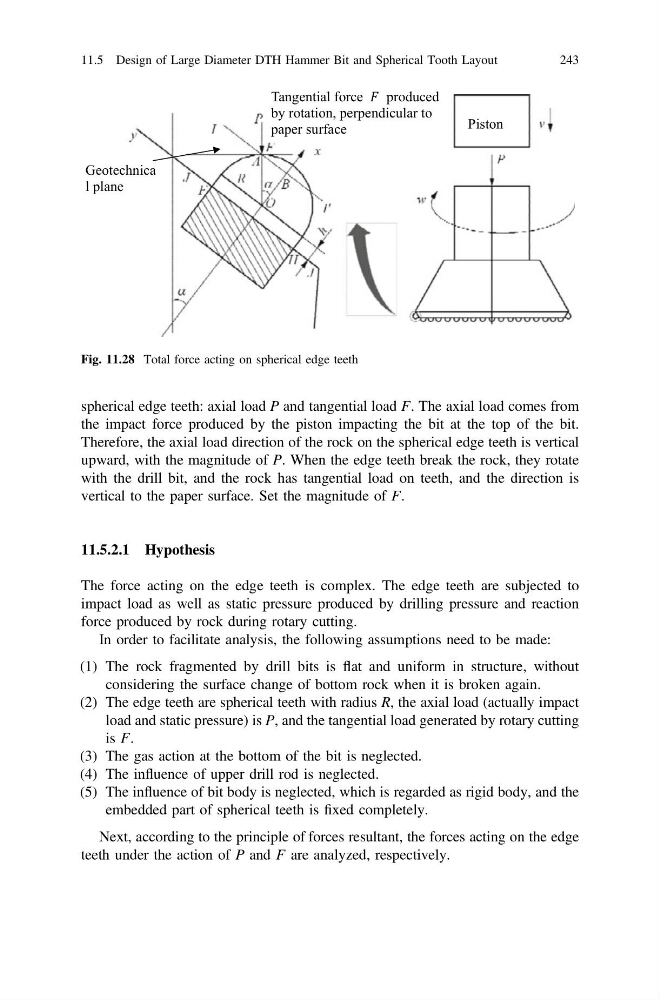
spherical edge teeth: axial load P and tangential load F. The axial load comes from
the impact force produced by the piston impacting the bit at the top of the bit.
Therefore, the axial load direction of the rock on the spherical edge teeth is vertical
upward, with the magnitude of P. When the edge teeth break the rock, they rotate
with the drill bit, and the rock has tangential load on teeth, and the direction is
vertical to the paper surface. Set the magnitude of F.
11.5.2.1 Hypothesis
The force acting on the edge teeth is complex. The edge teeth are subjected to
impact load as well as static pressure produced by drilling pressure and reaction
force produced by rock during rotary cutting.
In order to facilitate analysis, the following assumptions need to be made:
(1) The rock fragmented by drill bits is flat and uniform in structure, without
considering the surface change of bottom rock when it is broken again.
(2) The edge teeth are spherical teeth with radius R, the axial load (actually impact
load and static pressure) is P, and the tangential load generated by rotary cutting
is F.
(3) The gas action at the bottom of the bit is neglected.
(4) The influence of upper drill rod is neglected.
(5) The influence of bit body is neglected, which is regarded as rigid body, and the
embedded part of spherical teeth is fixed completely.
Next, according to the principle of forces resultant, the forces acting on the edge
teeth under the action of P and F are analyzed, respectively.
Piston
Geotechnica
l plane
Tangential force
produced
by rotation, perpendicular to
paper surface
Fig. 11.28 Total force acting on spherical edge teeth
11.5 Design of Large Diameter DTH Hammer Bit and Spherical Tooth Layout
243
the impact force produced by the piston impacting the bit at the top of the bit.
Therefore, the axial load direction of the rock on the spherical edge teeth is vertical
upward, with the magnitude of P. When the edge teeth break the rock, they rotate
with the drill bit, and the rock has tangential load on teeth, and the direction is
vertical to the paper surface. Set the magnitude of F.
11.5.2.1 Hypothesis
The force acting on the edge teeth is complex. The edge teeth are subjected to
impact load as well as static pressure produced by drilling pressure and reaction
force produced by rock during rotary cutting.
In order to facilitate analysis, the following assumptions need to be made:
(1) The rock fragmented by drill bits is flat and uniform in structure, without
considering the surface change of bottom rock when it is broken again.
(2) The edge teeth are spherical teeth with radius R, the axial load (actually impact
load and static pressure) is P, and the tangential load generated by rotary cutting
is F.
(3) The gas action at the bottom of the bit is neglected.
(4) The influence of upper drill rod is neglected.
(5) The influence of bit body is neglected, which is regarded as rigid body, and the
embedded part of spherical teeth is fixed completely.
Next, according to the principle of forces resultant, the forces acting on the edge
teeth under the action of P and F are analyzed, respectively.
Piston
Geotechnica
l plane
Tangential force
produced
by rotation, perpendicular to
paper surface
Fig. 11.28 Total force acting on spherical edge teeth
11.5 Design of Large Diameter DTH Hammer Bit and Spherical Tooth Layout
243