

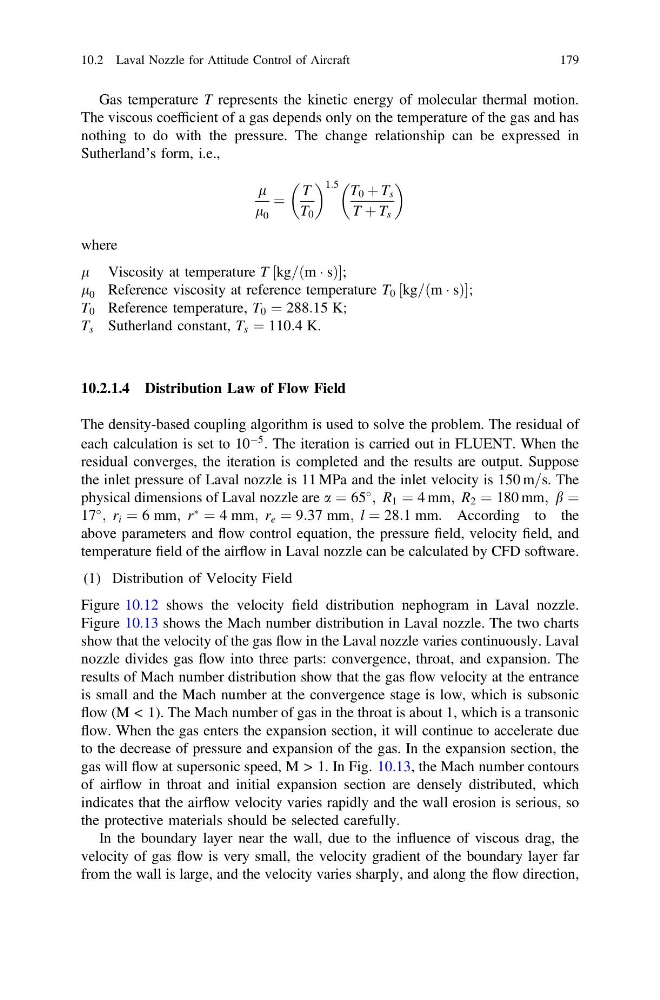
Gas temperature T represents the kinetic energy of molecular thermal motion.
The viscous coefficient of a gas depends only on the temperature of the gas and has
nothing to do with the pressure. The change relationship can be expressed in
Sutherland’s form, i.e.,
l
l 0
¼
T
T 0
1:5 T 0 þ T s
T þ T s
where
l Viscosity at temperature T kg= m Á s
ð
Þ
½
;
l 0 Reference viscosity at reference temperature T 0 kg= m Á s
ð
Þ
½
;
T 0 Reference temperature, T 0 ¼ 288:15 K;
T s Sutherland constant, T s ¼ 110:4 K.
10.2.1.4 Distribution Law of Flow Field
The density-based coupling algorithm is used to solve the problem. The residual of
each calculation is set to 10
À5 . The iteration is carried out in FLUENT. When the
residual converges, the iteration is completed and the results are output. Suppose
the inlet pressure of Laval nozzle is 11 MPa and the inlet velocity is 150 m=s. The
physical dimensions of Laval nozzle are a ¼ 65
; R 1 ¼ 4 mm; R 2 ¼ 180 mm; b ¼
17
; r i ¼ 6 mm; r
Ã
¼ 4 mm; r e ¼ 9:37 mm; l ¼ 28:1 mm: According to the
above parameters and flow control equation, the pressure field, velocity field, and
temperature field of the airflow in Laval nozzle can be calculated by CFD software.
(1) Distribution of Velocity Field
Figure 10.12 shows the velocity field distribution nephogram in Laval nozzle.
Figure 10.13 shows the Mach number distribution in Laval nozzle. The two charts
show that the velocity of the gas flow in the Laval nozzle varies continuously. Laval
nozzle divides gas flow into three parts: convergence, throat, and expansion. The
results of Mach number distribution show that the gas flow velocity at the entrance
is small and the Mach number at the convergence stage is low, which is subsonic
flow (M < 1). The Mach number of gas in the throat is about 1, which is a transonic
flow. When the gas enters the expansion section, it will continue to accelerate due
to the decrease of pressure and expansion of the gas. In the expansion section, the
gas will flow at supersonic speed, M > 1. In Fig. 10.13, the Mach number contours
of airflow in throat and initial expansion section are densely distributed, which
indicates that the airflow velocity varies rapidly and the wall erosion is serious, so
the protective materials should be selected carefully.
In the boundary layer near the wall, due to the influence of viscous drag, the
velocity of gas flow is very small, the velocity gradient of the boundary layer far
from the wall is large, and the velocity varies sharply, and along the flow direction,
10.2 Laval Nozzle for Attitude Control of Aircraft
179
The viscous coefficient of a gas depends only on the temperature of the gas and has
nothing to do with the pressure. The change relationship can be expressed in
Sutherland’s form, i.e.,
l
l 0
¼
T
T 0
1:5 T 0 þ T s
T þ T s
where
l Viscosity at temperature T kg= m Á s
ð
Þ
½
;
l 0 Reference viscosity at reference temperature T 0 kg= m Á s
ð
Þ
½
;
T 0 Reference temperature, T 0 ¼ 288:15 K;
T s Sutherland constant, T s ¼ 110:4 K.
10.2.1.4 Distribution Law of Flow Field
The density-based coupling algorithm is used to solve the problem. The residual of
each calculation is set to 10
À5 . The iteration is carried out in FLUENT. When the
residual converges, the iteration is completed and the results are output. Suppose
the inlet pressure of Laval nozzle is 11 MPa and the inlet velocity is 150 m=s. The
physical dimensions of Laval nozzle are a ¼ 65
; R 1 ¼ 4 mm; R 2 ¼ 180 mm; b ¼
17
; r i ¼ 6 mm; r
Ã
¼ 4 mm; r e ¼ 9:37 mm; l ¼ 28:1 mm: According to the
above parameters and flow control equation, the pressure field, velocity field, and
temperature field of the airflow in Laval nozzle can be calculated by CFD software.
(1) Distribution of Velocity Field
Figure 10.12 shows the velocity field distribution nephogram in Laval nozzle.
Figure 10.13 shows the Mach number distribution in Laval nozzle. The two charts
show that the velocity of the gas flow in the Laval nozzle varies continuously. Laval
nozzle divides gas flow into three parts: convergence, throat, and expansion. The
results of Mach number distribution show that the gas flow velocity at the entrance
is small and the Mach number at the convergence stage is low, which is subsonic
flow (M < 1). The Mach number of gas in the throat is about 1, which is a transonic
flow. When the gas enters the expansion section, it will continue to accelerate due
to the decrease of pressure and expansion of the gas. In the expansion section, the
gas will flow at supersonic speed, M > 1. In Fig. 10.13, the Mach number contours
of airflow in throat and initial expansion section are densely distributed, which
indicates that the airflow velocity varies rapidly and the wall erosion is serious, so
the protective materials should be selected carefully.
In the boundary layer near the wall, due to the influence of viscous drag, the
velocity of gas flow is very small, the velocity gradient of the boundary layer far
from the wall is large, and the velocity varies sharply, and along the flow direction,
10.2 Laval Nozzle for Attitude Control of Aircraft
179