

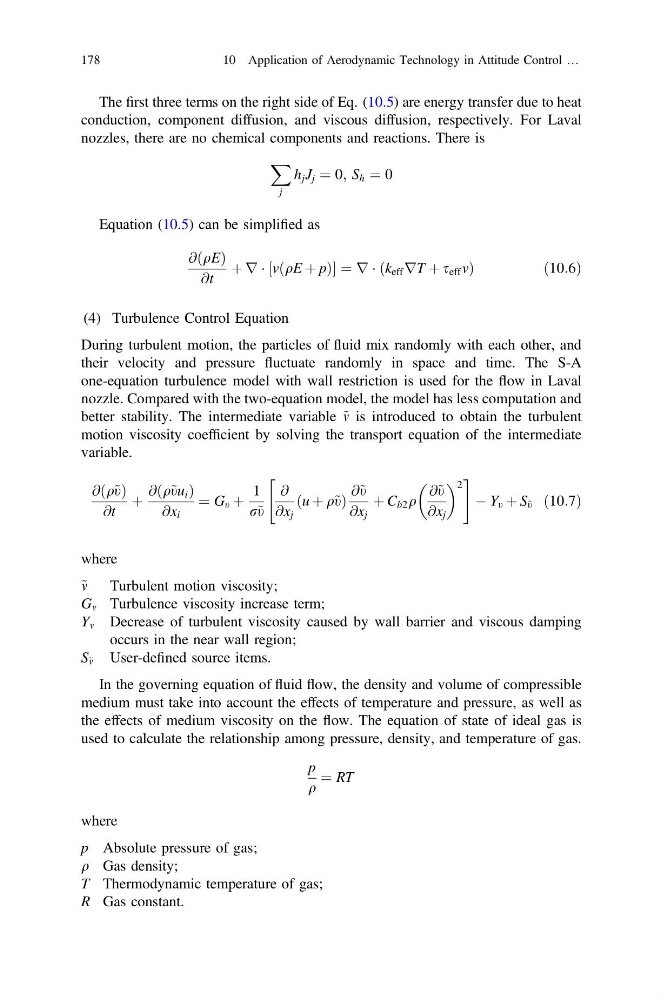
The first three terms on the right side of Eq. (10.5) are energy transfer due to heat
conduction, component diffusion, and viscous diffusion, respectively. For Laval
nozzles, there are no chemical components and reactions. There is
X
j
h j J j ¼ 0; S h ¼ 0
Equation (10.5) can be simplified as
@ qE
ð Þ
@t
þ r Á v qE þ p
ð
Þ
½
¼rÁ k eff rT þ s eff v
ð
Þ
ð 10:6Þ
(4) Turbulence Control Equation
During turbulent motion, the particles of fluid mix randomly with each other, and
their velocity and pressure fluctuate randomly in space and time. The S-A
one-equation turbulence model with wall restriction is used for the flow in Laval
nozzle. Compared with the two-equation model, the model has less computation and
better stability. The intermediate variable ~ m is introduced to obtain the turbulent
motion viscosity coefficient by solving the transport equation of the intermediate
variable.
@ q~ t
ð Þ
@t
þ
@ q~ tu i
ð
Þ
@x i
¼ G t þ
1
r~ t
@
@x j
u þ q~ t
ð
Þ
@~ t
@x j
þ C b2 q
@~ t
@x j
2
"
#
À Y t þ S ~ t ð10:7Þ
where
~ m Turbulent motion viscosity;
G m Turbulence viscosity increase term;
Y m Decrease of turbulent viscosity caused by wall barrier and viscous damping
occurs in the near wall region;
S ~ m User-defined source items.
In the governing equation of fluid flow, the density and volume of compressible
medium must take into account the effects of temperature and pressure, as well as
the effects of medium viscosity on the flow. The equation of state of ideal gas is
used to calculate the relationship among pressure, density, and temperature of gas.
p
q
¼ RT
where
p Absolute pressure of gas;
q Gas density;
T Thermodynamic temperature of gas;
R Gas constant.
178
10 Application of Aerodynamic Technology in Attitude Control …
conduction, component diffusion, and viscous diffusion, respectively. For Laval
nozzles, there are no chemical components and reactions. There is
X
j
h j J j ¼ 0; S h ¼ 0
Equation (10.5) can be simplified as
@ qE
ð Þ
@t
þ r Á v qE þ p
ð
Þ
½
¼rÁ k eff rT þ s eff v
ð
Þ
ð 10:6Þ
(4) Turbulence Control Equation
During turbulent motion, the particles of fluid mix randomly with each other, and
their velocity and pressure fluctuate randomly in space and time. The S-A
one-equation turbulence model with wall restriction is used for the flow in Laval
nozzle. Compared with the two-equation model, the model has less computation and
better stability. The intermediate variable ~ m is introduced to obtain the turbulent
motion viscosity coefficient by solving the transport equation of the intermediate
variable.
@ q~ t
ð Þ
@t
þ
@ q~ tu i
ð
Þ
@x i
¼ G t þ
1
r~ t
@
@x j
u þ q~ t
ð
Þ
@~ t
@x j
þ C b2 q
@~ t
@x j
2
"
#
À Y t þ S ~ t ð10:7Þ
where
~ m Turbulent motion viscosity;
G m Turbulence viscosity increase term;
Y m Decrease of turbulent viscosity caused by wall barrier and viscous damping
occurs in the near wall region;
S ~ m User-defined source items.
In the governing equation of fluid flow, the density and volume of compressible
medium must take into account the effects of temperature and pressure, as well as
the effects of medium viscosity on the flow. The equation of state of ideal gas is
used to calculate the relationship among pressure, density, and temperature of gas.
p
q
¼ RT
where
p Absolute pressure of gas;
q Gas density;
T Thermodynamic temperature of gas;
R Gas constant.
178
10 Application of Aerodynamic Technology in Attitude Control …