

b-lactam antibiotics: They are developed primarily to treat Gram-positive
bacterial infections, but have been repurposed to be used as an anti-TB agent.
Enormous research is being carried out to study the efficacy of b-lactam antibiotics
in combination with b-lactamase inhibitor. Among all the b-lactams, carbapenems
are considered to be more promising as anti-TB agents, as they are more stable to
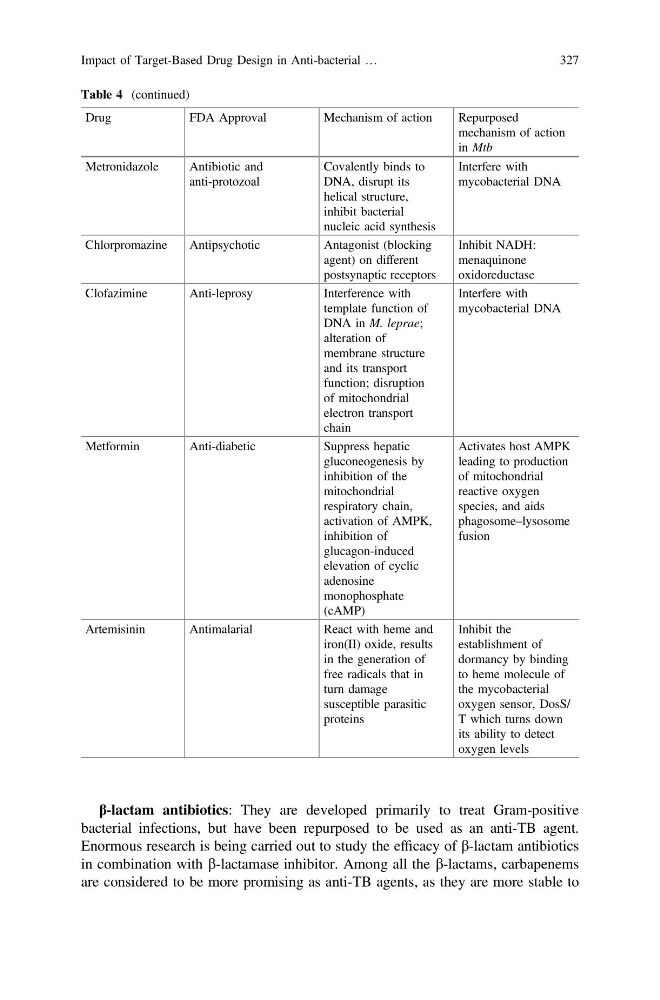
Table 4 (continued)
Drug
FDA Approval
Mechanism of action
Repurposed
mechanism of action
in Mtb
Metronidazole
Antibiotic and
anti-protozoal
Covalently binds to
DNA, disrupt its
helical structure,
inhibit bacterial
nucleic acid synthesis
Interfere with
mycobacterial DNA
Chlorpromazine
Antipsychotic
Antagonist (blocking
agent) on different
postsynaptic receptors
Inhibit NADH:
menaquinone
oxidoreductase
Clofazimine
Anti-leprosy
Interference with
template function of
DNA in M. leprae;
alteration of
membrane structure
and its transport
function; disruption
of mitochondrial
electron transport
chain
Interfere with
mycobacterial DNA
Metformin
Anti-diabetic
Suppress hepatic
gluconeogenesis by
inhibition of the
mitochondrial
respiratory chain,
activation of AMPK,
inhibition of
glucagon-induced
elevation of cyclic
adenosine
monophosphate
(cAMP)
Activates host AMPK
leading to production
of mitochondrial
reactive oxygen
species, and aids
phagosome–lysosome
fusion
Artemisinin
Antimalarial
React with heme and
iron(II) oxide, results
in the generation of
free radicals that in
turn damage
susceptible parasitic
proteins
Inhibit the
establishment of
dormancy by binding
to heme molecule of
the mycobacterial
oxygen sensor, DosS/
T which turns down
its ability to detect
oxygen levels
Impact of Target-Based Drug Design in Anti-bacterial …
327
bacterial infections, but have been repurposed to be used as an anti-TB agent.
Enormous research is being carried out to study the efficacy of b-lactam antibiotics
in combination with b-lactamase inhibitor. Among all the b-lactams, carbapenems
are considered to be more promising as anti-TB agents, as they are more stable to
Table 4 (continued)
Drug
FDA Approval
Mechanism of action
Repurposed
mechanism of action
in Mtb
Metronidazole
Antibiotic and
anti-protozoal
Covalently binds to
DNA, disrupt its
helical structure,
inhibit bacterial
nucleic acid synthesis
Interfere with
mycobacterial DNA
Chlorpromazine
Antipsychotic
Antagonist (blocking
agent) on different
postsynaptic receptors
Inhibit NADH:
menaquinone
oxidoreductase
Clofazimine
Anti-leprosy
Interference with
template function of
DNA in M. leprae;
alteration of
membrane structure
and its transport
function; disruption
of mitochondrial
electron transport
chain
Interfere with
mycobacterial DNA
Metformin
Anti-diabetic
Suppress hepatic
gluconeogenesis by
inhibition of the
mitochondrial
respiratory chain,
activation of AMPK,
inhibition of
glucagon-induced
elevation of cyclic
adenosine
monophosphate
(cAMP)
Activates host AMPK
leading to production
of mitochondrial
reactive oxygen
species, and aids
phagosome–lysosome
fusion
Artemisinin
Antimalarial
React with heme and
iron(II) oxide, results
in the generation of
free radicals that in
turn damage
susceptible parasitic
proteins
Inhibit the
establishment of
dormancy by binding
to heme molecule of
the mycobacterial
oxygen sensor, DosS/
T which turns down
its ability to detect
oxygen levels
Impact of Target-Based Drug Design in Anti-bacterial …
327