

TB drug discovery, and in past years, a number of repurposed TB drugs are being
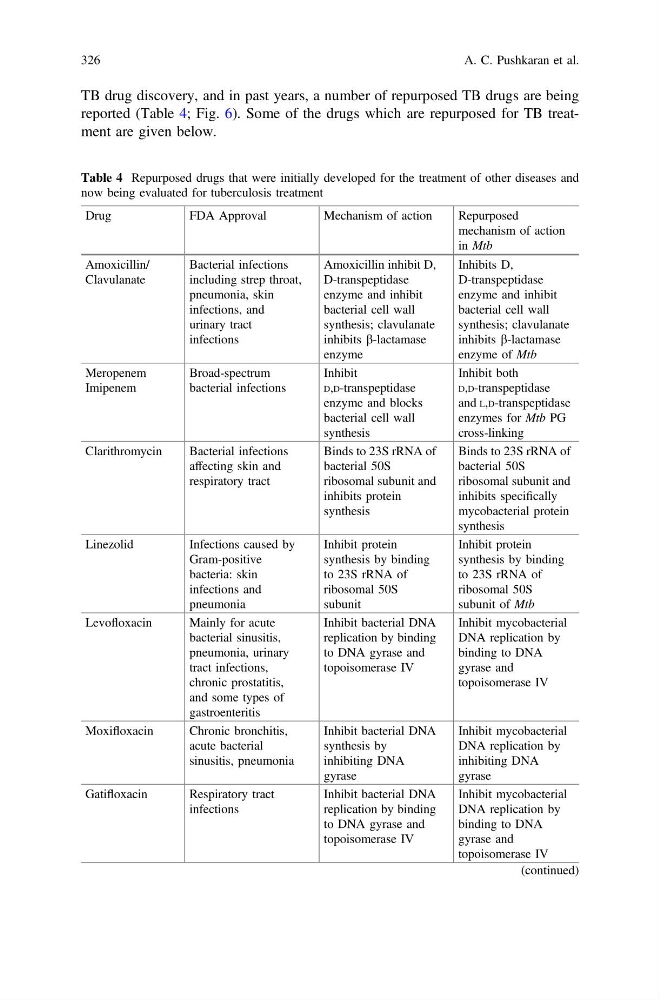
reported (Table 4; Fig. 6). Some of the drugs which are repurposed for TB treatment are given below.
Table 4 Repurposed drugs that were initially developed for the treatment of other diseases and
now being evaluated for tuberculosis treatment
Drug
FDA Approval
Mechanism of action
Repurposed
mechanism of action
in Mtb
Amoxicillin/
Clavulanate
Bacterial infections
including strep throat,
pneumonia, skin
infections, and
urinary tract
infections
Amoxicillin inhibit D,
D-transpeptidase
enzyme and inhibit
bacterial cell wall
synthesis; clavulanate
inhibits b-lactamase
enzyme
Inhibits D,
D-transpeptidase
enzyme and inhibit
bacterial cell wall
synthesis; clavulanate
inhibits b-lactamase
enzyme of Mtb
Meropenem
Imipenem
Broad-spectrum
bacterial infections
Inhibit
D,D-transpeptidase
enzyme and blocks
bacterial cell wall
synthesis
Inhibit both
D,D-transpeptidase
and L,D-transpeptidase
enzymes for Mtb PG
cross-linking
Clarithromycin
Bacterial infections
affecting skin and
respiratory tract
Binds to 23S rRNA of
bacterial 50S
ribosomal subunit and
inhibits protein
synthesis
Binds to 23S rRNA of
bacterial 50S
ribosomal subunit and
inhibits specifically
mycobacterial protein
synthesis
Linezolid
Infections caused by
Gram-positive
bacteria: skin
infections and
pneumonia
Inhibit protein
synthesis by binding
to 23S rRNA of
ribosomal 50S
subunit
Inhibit protein
synthesis by binding
to 23S rRNA of
ribosomal 50S
subunit of Mtb
Levofloxacin
Mainly for acute
bacterial sinusitis,
pneumonia, urinary
tract infections,
chronic prostatitis,
and some types of
gastroenteritis
Inhibit bacterial DNA
replication by binding
to DNA gyrase and
topoisomerase IV
Inhibit mycobacterial
DNA replication by
binding to DNA
gyrase and
topoisomerase IV
Moxifloxacin
Chronic bronchitis,
acute bacterial
sinusitis, pneumonia
Inhibit bacterial DNA
synthesis by
inhibiting DNA
gyrase
Inhibit mycobacterial
DNA replication by
inhibiting DNA
gyrase
Gatifloxacin
Respiratory tract
infections
Inhibit bacterial DNA
replication by binding
to DNA gyrase and
topoisomerase IV
Inhibit mycobacterial
DNA replication by
binding to DNA
gyrase and
topoisomerase IV
(continued)
326
A. C. Pushkaran et al.
reported (Table 4; Fig. 6). Some of the drugs which are repurposed for TB treatment are given below.
Table 4 Repurposed drugs that were initially developed for the treatment of other diseases and
now being evaluated for tuberculosis treatment
Drug
FDA Approval
Mechanism of action
Repurposed
mechanism of action
in Mtb
Amoxicillin/
Clavulanate
Bacterial infections
including strep throat,
pneumonia, skin
infections, and
urinary tract
infections
Amoxicillin inhibit D,
D-transpeptidase
enzyme and inhibit
bacterial cell wall
synthesis; clavulanate
inhibits b-lactamase
enzyme
Inhibits D,
D-transpeptidase
enzyme and inhibit
bacterial cell wall
synthesis; clavulanate
inhibits b-lactamase
enzyme of Mtb
Meropenem
Imipenem
Broad-spectrum
bacterial infections
Inhibit
D,D-transpeptidase
enzyme and blocks
bacterial cell wall
synthesis
Inhibit both
D,D-transpeptidase
and L,D-transpeptidase
enzymes for Mtb PG
cross-linking
Clarithromycin
Bacterial infections
affecting skin and
respiratory tract
Binds to 23S rRNA of
bacterial 50S
ribosomal subunit and
inhibits protein
synthesis
Binds to 23S rRNA of
bacterial 50S
ribosomal subunit and
inhibits specifically
mycobacterial protein
synthesis
Linezolid
Infections caused by
Gram-positive
bacteria: skin
infections and
pneumonia
Inhibit protein
synthesis by binding
to 23S rRNA of
ribosomal 50S
subunit
Inhibit protein
synthesis by binding
to 23S rRNA of
ribosomal 50S
subunit of Mtb
Levofloxacin
Mainly for acute
bacterial sinusitis,
pneumonia, urinary
tract infections,
chronic prostatitis,
and some types of
gastroenteritis
Inhibit bacterial DNA
replication by binding
to DNA gyrase and
topoisomerase IV
Inhibit mycobacterial
DNA replication by
binding to DNA
gyrase and
topoisomerase IV
Moxifloxacin
Chronic bronchitis,
acute bacterial
sinusitis, pneumonia
Inhibit bacterial DNA
synthesis by
inhibiting DNA
gyrase
Inhibit mycobacterial
DNA replication by
inhibiting DNA
gyrase
Gatifloxacin
Respiratory tract
infections
Inhibit bacterial DNA
replication by binding
to DNA gyrase and
topoisomerase IV
Inhibit mycobacterial
DNA replication by
binding to DNA
gyrase and
topoisomerase IV
(continued)
326
A. C. Pushkaran et al.