

bind with the target molecule. Good scoring functions are important for docking
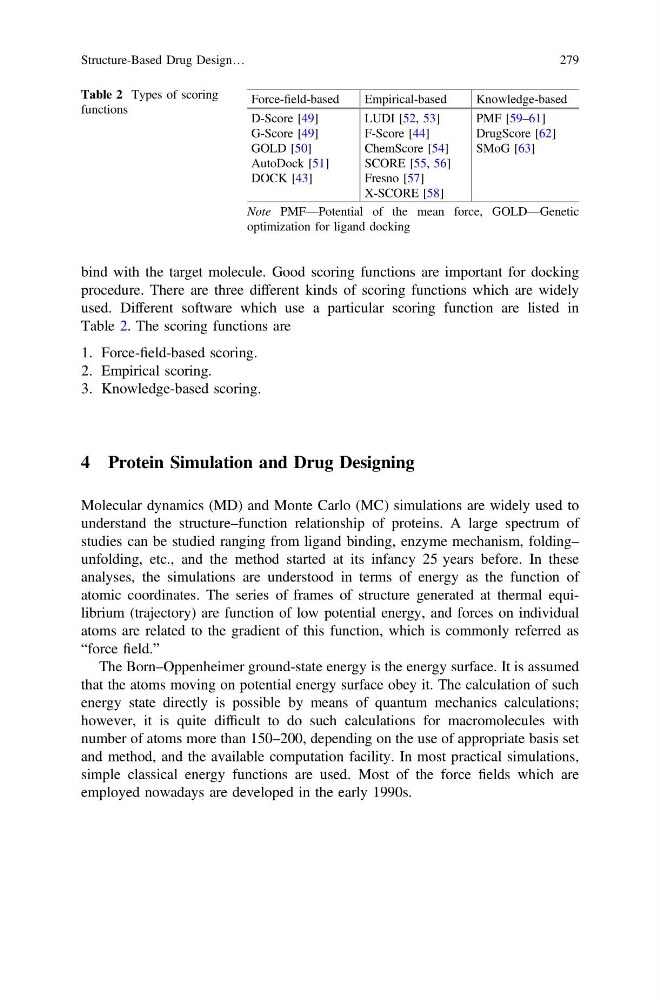
procedure. There are three different kinds of scoring functions which are widely
used. Different software which use a particular scoring function are listed in
Table 2. The scoring functions are
1. Force-field-based scoring.
2. Empirical scoring.
3. Knowledge-based scoring.
4 Protein Simulation and Drug Designing
Molecular dynamics (MD) and Monte Carlo (MC) simulations are widely used to
understand the structure–function relationship of proteins. A large spectrum of
studies can be studied ranging from ligand binding, enzyme mechanism, folding–
unfolding, etc., and the method started at its infancy 25 years before. In these
analyses, the simulations are understood in terms of energy as the function of
atomic coordinates. The series of frames of structure generated at thermal equilibrium (trajectory) are function of low potential energy, and forces on individual
atoms are related to the gradient of this function, which is commonly referred as
“force field.”
The Born–Oppenheimer ground-state energy is the energy surface. It is assumed
that the atoms moving on potential energy surface obey it. The calculation of such
energy state directly is possible by means of quantum mechanics calculations;
however, it is quite difficult to do such calculations for macromolecules with
number of atoms more than 150–200, depending on the use of appropriate basis set
and method, and the available computation facility. In most practical simulations,
simple classical energy functions are used. Most of the force fields which are
employed nowadays are developed in the early 1990s.
Table 2 Types of scoring
functions
Force-field-based
Empirical-based
Knowledge-based
D-Score [49]
G-Score [49]
GOLD [50]
AutoDock [51]
DOCK [43]
LUDI [52, 53]
F-Score [44]
ChemScore [54]
SCORE [55, 56]
Fresno [57]
X-SCORE [58]
PMF [59–61]
DrugScore [62]
SMoG [63]
Note PMF—Potential of the mean force, GOLD—Genetic
optimization for ligand docking
Structure-Based Drug Design…
279
procedure. There are three different kinds of scoring functions which are widely
used. Different software which use a particular scoring function are listed in
Table 2. The scoring functions are
1. Force-field-based scoring.
2. Empirical scoring.
3. Knowledge-based scoring.
4 Protein Simulation and Drug Designing
Molecular dynamics (MD) and Monte Carlo (MC) simulations are widely used to
understand the structure–function relationship of proteins. A large spectrum of
studies can be studied ranging from ligand binding, enzyme mechanism, folding–
unfolding, etc., and the method started at its infancy 25 years before. In these
analyses, the simulations are understood in terms of energy as the function of
atomic coordinates. The series of frames of structure generated at thermal equilibrium (trajectory) are function of low potential energy, and forces on individual
atoms are related to the gradient of this function, which is commonly referred as
“force field.”
The Born–Oppenheimer ground-state energy is the energy surface. It is assumed
that the atoms moving on potential energy surface obey it. The calculation of such
energy state directly is possible by means of quantum mechanics calculations;
however, it is quite difficult to do such calculations for macromolecules with
number of atoms more than 150–200, depending on the use of appropriate basis set
and method, and the available computation facility. In most practical simulations,
simple classical energy functions are used. Most of the force fields which are
employed nowadays are developed in the early 1990s.
Table 2 Types of scoring
functions
Force-field-based
Empirical-based
Knowledge-based
D-Score [49]
G-Score [49]
GOLD [50]
AutoDock [51]
DOCK [43]
LUDI [52, 53]
F-Score [44]
ChemScore [54]
SCORE [55, 56]
Fresno [57]
X-SCORE [58]
PMF [59–61]
DrugScore [62]
SMoG [63]
Note PMF—Potential of the mean force, GOLD—Genetic
optimization for ligand docking
Structure-Based Drug Design…
279