

function is used to evaluate the newly obtained ligand. Monte Carlo and genetic
algorithms are the two most widely used random search algorithms. AutoDock uses
a variant of Monte Carlo algorithm, and DOCK and GOLD use genetic algorithms.
Simulation method is a widely implemented approach with the only limitation
for crossing high-energy barrier within the stipulated time. This allows the ligands
which are trapped in local minima to cross the barrier. Monte Carlo is also added at
times to compliment the simulation method. DOCK and Glide use this method.
Some of the important and widely used search methods are listed in Table 1.
Flexibility of Protein: The methodology applied to introduce flexibility of ligand is well parameterized when compared with the flexibility of protein. There are
algorithms which make a part of the protein flexible, during the docking process.
Monte Carlo simulations, rotamer libraries, and protein ensemble grids help in this
regard [48]. One of the approaches is to generate average potential energy grid for
the ensemble, and the other one is to map different receptors to each grid point and
then score ligand with each of the receptor possible.
Scoring: Generating ligand conformation is achieved, but sorting and ranking
the predicted conformation are more appropriate and the most vital role in choosing
the best ligand. Separating correct pose from the incorrect poses is the crucial step
of docking as this process helps in identification of the reliable ligand which can
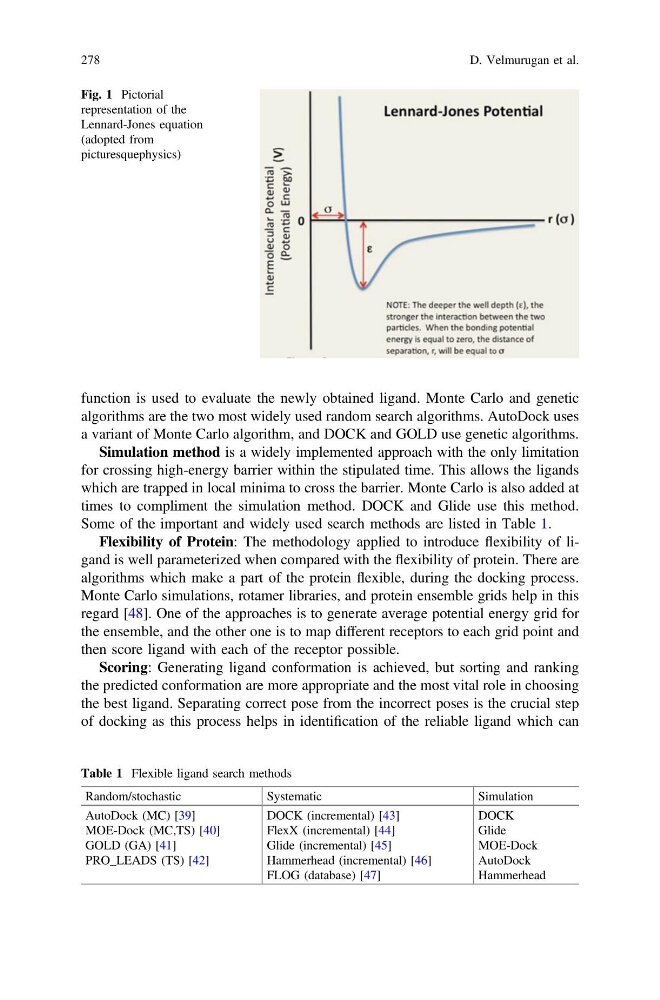
Fig. 1 Pictorial
representation of the
Lennard-Jones equation
(adopted from
picturesquephysics)
Table 1 Flexible ligand search methods
Random/stochastic
Systematic
Simulation
AutoDock (MC) [39]
MOE-Dock (MC,TS) [40]
GOLD (GA) [41]
PRO_LEADS (TS) [42]
DOCK (incremental) [43]
FlexX (incremental) [44]
Glide (incremental) [45]
Hammerhead (incremental) [46]
FLOG (database) [47]
DOCK
Glide
MOE-Dock
AutoDock
Hammerhead
278
D. Velmurugan et al.
algorithms are the two most widely used random search algorithms. AutoDock uses
a variant of Monte Carlo algorithm, and DOCK and GOLD use genetic algorithms.
Simulation method is a widely implemented approach with the only limitation
for crossing high-energy barrier within the stipulated time. This allows the ligands
which are trapped in local minima to cross the barrier. Monte Carlo is also added at
times to compliment the simulation method. DOCK and Glide use this method.
Some of the important and widely used search methods are listed in Table 1.
Flexibility of Protein: The methodology applied to introduce flexibility of ligand is well parameterized when compared with the flexibility of protein. There are
algorithms which make a part of the protein flexible, during the docking process.
Monte Carlo simulations, rotamer libraries, and protein ensemble grids help in this
regard [48]. One of the approaches is to generate average potential energy grid for
the ensemble, and the other one is to map different receptors to each grid point and
then score ligand with each of the receptor possible.
Scoring: Generating ligand conformation is achieved, but sorting and ranking
the predicted conformation are more appropriate and the most vital role in choosing
the best ligand. Separating correct pose from the incorrect poses is the crucial step
of docking as this process helps in identification of the reliable ligand which can
Fig. 1 Pictorial
representation of the
Lennard-Jones equation
(adopted from
picturesquephysics)
Table 1 Flexible ligand search methods
Random/stochastic
Systematic
Simulation
AutoDock (MC) [39]
MOE-Dock (MC,TS) [40]
GOLD (GA) [41]
PRO_LEADS (TS) [42]
DOCK (incremental) [43]
FlexX (incremental) [44]
Glide (incremental) [45]
Hammerhead (incremental) [46]
FLOG (database) [47]
DOCK
Glide
MOE-Dock
AutoDock
Hammerhead
278
D. Velmurugan et al.