

The widely used force field has the potential energy function:
V r
ð Þ ¼
X
bonds
k b b À b 0
ð
Þ
2 þ
X
angles
k h h À h 0
ð
Þ
2 þ
X
torsions
k / cos n/ þ d
ð
Þþ1
½
þ
X
nonbonded
pairs
q i q j
r ij
þ
A ij
r 12
ij
À
C ij
r
6
ij
"
#
ð7Þ
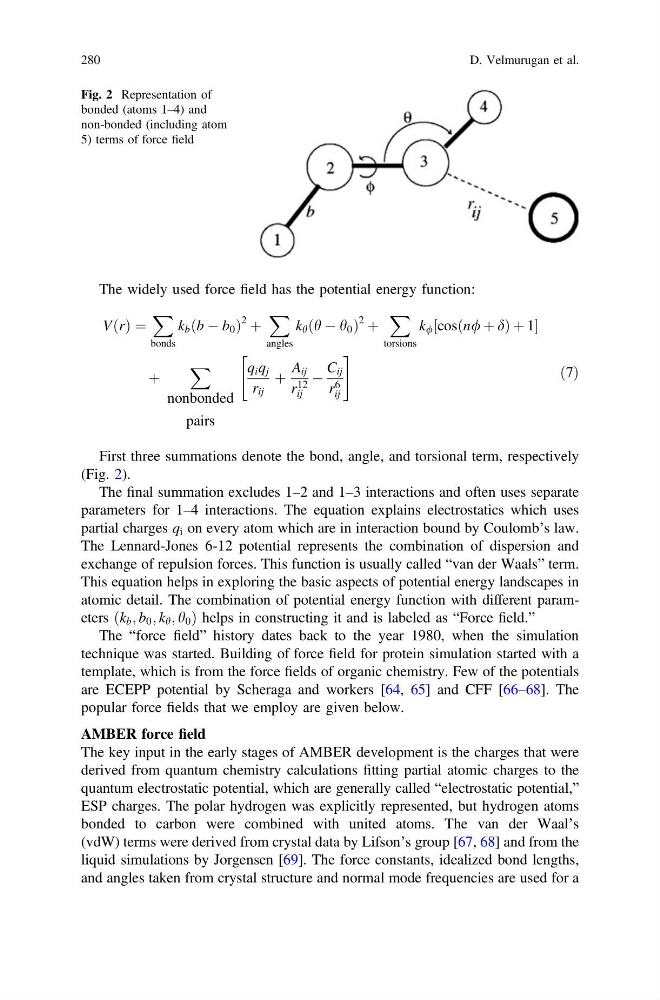
First three summations denote the bond, angle, and torsional term, respectively
(Fig. 2).
The final summation excludes 1–2 and 1–3 interactions and often uses separate
parameters for 1–4 interactions. The equation explains electrostatics which uses
partial charges q i on every atom which are in interaction bound by Coulomb’s law.
The Lennard-Jones 6-12 potential represents the combination of dispersion and
exchange of repulsion forces. This function is usually called “van der Waals” term.
This equation helps in exploring the basic aspects of potential energy landscapes in
atomic detail. The combination of potential energy function with different parameters k b ; b 0 ; k h ; h 0
ð
Þhelps in constructing it and is labeled as “Force field.”
The “force field” history dates back to the year 1980, when the simulation
technique was started. Building of force field for protein simulation started with a
template, which is from the force fields of organic chemistry. Few of the potentials
are ECEPP potential by Scheraga and workers [64, 65] and CFF [66–68]. The
popular force fields that we employ are given below.
AMBER force field
The key input in the early stages of AMBER development is the charges that were
derived from quantum chemistry calculations fitting partial atomic charges to the
quantum electrostatic potential, which are generally called “electrostatic potential,”
ESP charges. The polar hydrogen was explicitly represented, but hydrogen atoms
bonded to carbon were combined with united atoms. The van der Waal’s
(vdW) terms were derived from crystal data by Lifson’s group [67, 68] and from the
liquid simulations by Jorgensen [69]. The force constants, idealized bond lengths,
and angles taken from crystal structure and normal mode frequencies are used for a
Fig. 2 Representation of
bonded (atoms 1–4) and
non-bonded (including atom
5) terms of force field
280
D. Velmurugan et al.
V r
ð Þ ¼
X
bonds
k b b À b 0
ð
Þ
2 þ
X
angles
k h h À h 0
ð
Þ
2 þ
X
torsions
k / cos n/ þ d
ð
Þþ1
½
þ
X
nonbonded
pairs
q i q j
r ij
þ
A ij
r 12
ij
À
C ij
r
6
ij
"
#
ð7Þ
First three summations denote the bond, angle, and torsional term, respectively
(Fig. 2).
The final summation excludes 1–2 and 1–3 interactions and often uses separate
parameters for 1–4 interactions. The equation explains electrostatics which uses
partial charges q i on every atom which are in interaction bound by Coulomb’s law.
The Lennard-Jones 6-12 potential represents the combination of dispersion and
exchange of repulsion forces. This function is usually called “van der Waals” term.
This equation helps in exploring the basic aspects of potential energy landscapes in
atomic detail. The combination of potential energy function with different parameters k b ; b 0 ; k h ; h 0
ð
Þhelps in constructing it and is labeled as “Force field.”
The “force field” history dates back to the year 1980, when the simulation
technique was started. Building of force field for protein simulation started with a
template, which is from the force fields of organic chemistry. Few of the potentials
are ECEPP potential by Scheraga and workers [64, 65] and CFF [66–68]. The
popular force fields that we employ are given below.
AMBER force field
The key input in the early stages of AMBER development is the charges that were
derived from quantum chemistry calculations fitting partial atomic charges to the
quantum electrostatic potential, which are generally called “electrostatic potential,”
ESP charges. The polar hydrogen was explicitly represented, but hydrogen atoms
bonded to carbon were combined with united atoms. The van der Waal’s
(vdW) terms were derived from crystal data by Lifson’s group [67, 68] and from the
liquid simulations by Jorgensen [69]. The force constants, idealized bond lengths,
and angles taken from crystal structure and normal mode frequencies are used for a
Fig. 2 Representation of
bonded (atoms 1–4) and
non-bonded (including atom
5) terms of force field
280
D. Velmurugan et al.