

should be taken to make sure that certain subsystem interactions are not double
counted or in general over-counted (Scheme 1).
QM fragmentation scheme has been employed successfully to compute the
interaction of ligands with various drug targets. Interestingly, certain studies
showed that the computed interaction energy is comparable to that of QM cluster
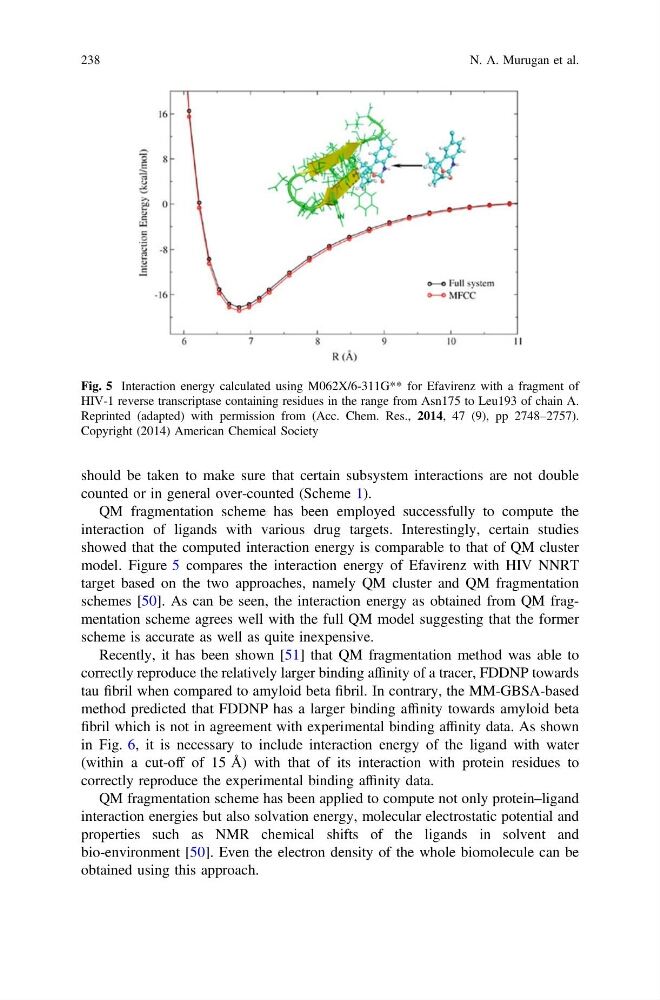
model. Figure 5 compares the interaction energy of Efavirenz with HIV NNRT
target based on the two approaches, namely QM cluster and QM fragmentation
schemes [50]. As can be seen, the interaction energy as obtained from QM fragmentation scheme agrees well with the full QM model suggesting that the former
scheme is accurate as well as quite inexpensive.
Recently, it has been shown [51] that QM fragmentation method was able to
correctly reproduce the relatively larger binding affinity of a tracer, FDDNP towards
tau fibril when compared to amyloid beta fibril. In contrary, the MM-GBSA-based
method predicted that FDDNP has a larger binding affinity towards amyloid beta
fibril which is not in agreement with experimental binding affinity data. As shown
in Fig. 6, it is necessary to include interaction energy of the ligand with water
(within a cut-off of 15 Å) with that of its interaction with protein residues to
correctly reproduce the experimental binding affinity data.
QM fragmentation scheme has been applied to compute not only protein–ligand
interaction energies but also solvation energy, molecular electrostatic potential and
properties such as NMR chemical shifts of the ligands in solvent and
bio-environment [50]. Even the electron density of the whole biomolecule can be
obtained using this approach.
Fig. 5 Interaction energy calculated using M062X/6-311G** for Efavirenz with a fragment of
HIV-1 reverse transcriptase containing residues in the range from Asn175 to Leu193 of chain A.
Reprinted (adapted) with permission from (Acc. Chem. Res., 2014, 47 (9), pp 2748–2757).
Copyright (2014) American Chemical Society
238
N. A. Murugan et al.
counted or in general over-counted (Scheme 1).
QM fragmentation scheme has been employed successfully to compute the
interaction of ligands with various drug targets. Interestingly, certain studies
showed that the computed interaction energy is comparable to that of QM cluster
model. Figure 5 compares the interaction energy of Efavirenz with HIV NNRT
target based on the two approaches, namely QM cluster and QM fragmentation
schemes [50]. As can be seen, the interaction energy as obtained from QM fragmentation scheme agrees well with the full QM model suggesting that the former
scheme is accurate as well as quite inexpensive.
Recently, it has been shown [51] that QM fragmentation method was able to
correctly reproduce the relatively larger binding affinity of a tracer, FDDNP towards
tau fibril when compared to amyloid beta fibril. In contrary, the MM-GBSA-based
method predicted that FDDNP has a larger binding affinity towards amyloid beta
fibril which is not in agreement with experimental binding affinity data. As shown
in Fig. 6, it is necessary to include interaction energy of the ligand with water
(within a cut-off of 15 Å) with that of its interaction with protein residues to
correctly reproduce the experimental binding affinity data.
QM fragmentation scheme has been applied to compute not only protein–ligand
interaction energies but also solvation energy, molecular electrostatic potential and
properties such as NMR chemical shifts of the ligands in solvent and
bio-environment [50]. Even the electron density of the whole biomolecule can be
obtained using this approach.
Fig. 5 Interaction energy calculated using M062X/6-311G** for Efavirenz with a fragment of
HIV-1 reverse transcriptase containing residues in the range from Asn175 to Leu193 of chain A.
Reprinted (adapted) with permission from (Acc. Chem. Res., 2014, 47 (9), pp 2748–2757).
Copyright (2014) American Chemical Society
238
N. A. Murugan et al.