

involves the calculation of trimer (two residues and a ligand), dimer (one residue
and ligand) and monomer energies.
QM fragmentation energies can be further made sophisticated by computing the
individual monomer, dimer, trimer energies with an embedding scheme which
allows the interaction between these fragments with the rest of the protein through
an effective Hamiltonian. This part is methodologically very similar to the
above-discussed QM/MM approach where the QM system interacts with MM
subsystem through electrostatic and van der Waals interaction. However, care
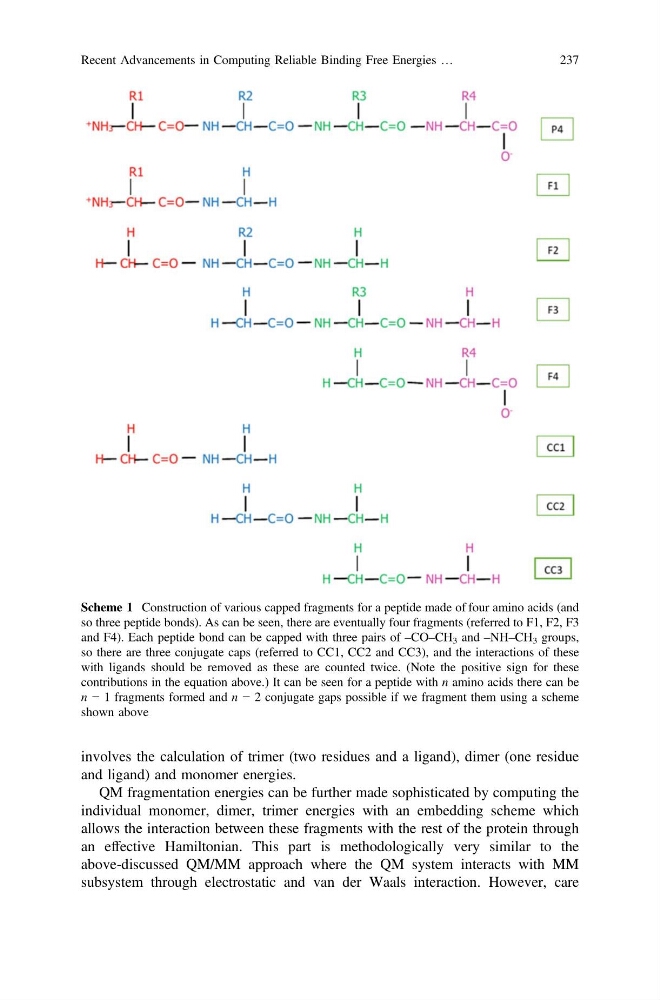
Scheme 1 Construction of various capped fragments for a peptide made of four amino acids (and
so three peptide bonds). As can be seen, there are eventually four fragments (referred to F1, F2, F3
and F4). Each peptide bond can be capped with three pairs of –CO–CH 3 and –NH–CH 3 groups,
so there are three conjugate caps (referred to CC1, CC2 and CC3), and the interactions of these
with ligands should be removed as these are counted twice. (Note the positive sign for these
contributions in the equation above.) It can be seen for a peptide with n amino acids there can be
n − 1 fragments formed and n − 2 conjugate gaps possible if we fragment them using a scheme
shown above
Recent Advancements in Computing Reliable Binding Free Energies …
237
and ligand) and monomer energies.
QM fragmentation energies can be further made sophisticated by computing the
individual monomer, dimer, trimer energies with an embedding scheme which
allows the interaction between these fragments with the rest of the protein through
an effective Hamiltonian. This part is methodologically very similar to the
above-discussed QM/MM approach where the QM system interacts with MM
subsystem through electrostatic and van der Waals interaction. However, care
Scheme 1 Construction of various capped fragments for a peptide made of four amino acids (and
so three peptide bonds). As can be seen, there are eventually four fragments (referred to F1, F2, F3
and F4). Each peptide bond can be capped with three pairs of –CO–CH 3 and –NH–CH 3 groups,
so there are three conjugate caps (referred to CC1, CC2 and CC3), and the interactions of these
with ligands should be removed as these are counted twice. (Note the positive sign for these
contributions in the equation above.) It can be seen for a peptide with n amino acids there can be
n − 1 fragments formed and n − 2 conjugate gaps possible if we fragment them using a scheme
shown above
Recent Advancements in Computing Reliable Binding Free Energies …
237