

6 Entropic Contributions in the QM-Based Free
Energy Calculations
So far in all the electronic structure theory-based approaches, we have only seen
how to compute the interaction energies between a receptor and a ligand. However,
the quantity of interest is the free energy of binding and not the interaction energy.
For this, we also need to add the entropic contributions. The translational, rotational
and vibrational contributions to the entropies are computed from the translational,
rotational and vibrational partition functions as given in the reference by Yu et al.
[52]. The translational and rotational contributions to the protein–ligand association
are usually positive, while the vibrational contributions favour the association
process. The vibrational contribution has been often reported to be much smaller in
quantity when compared to the translational and rotational contributions. In some
cases, we have noticed that the addition of translational and rotational contributions
to total interaction energy yielded positive binding free energies. The computation
of absolute free energy (including all these different entropic contributions) still
remains as a challenge as there are no detailed benchmarking studies on the estimation of the translational and rotational contributions and their relative contributions to binding free energies.
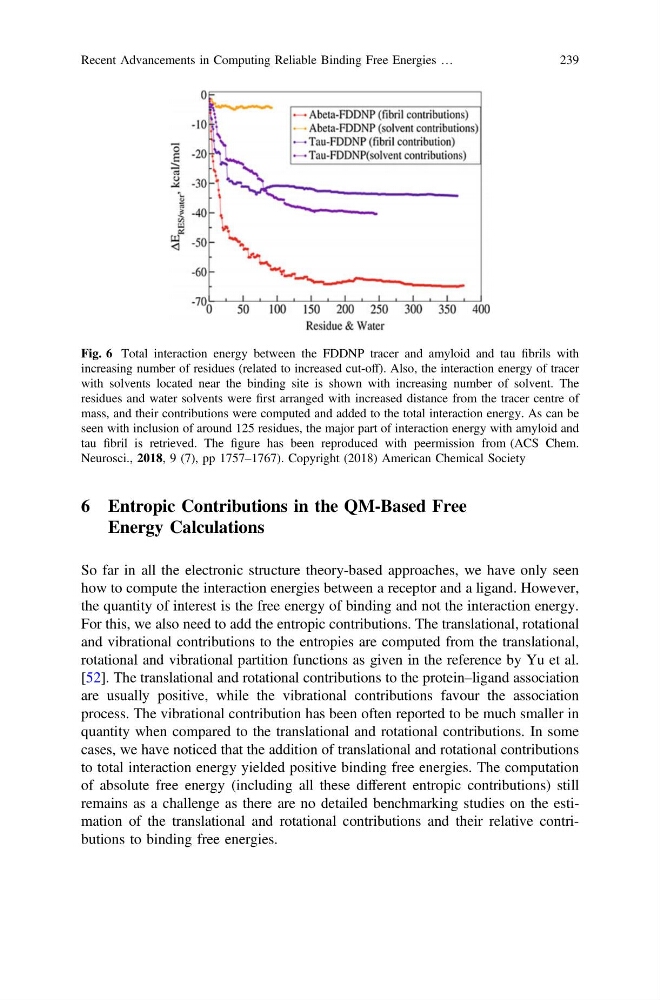
Fig. 6 Total interaction energy between the FDDNP tracer and amyloid and tau fibrils with
increasing number of residues (related to increased cut-off). Also, the interaction energy of tracer
with solvents located near the binding site is shown with increasing number of solvent. The
residues and water solvents were first arranged with increased distance from the tracer centre of
mass, and their contributions were computed and added to the total interaction energy. As can be
seen with inclusion of around 125 residues, the major part of interaction energy with amyloid and
tau fibril is retrieved. The figure has been reproduced with peermission from (ACS Chem.
Neurosci., 2018, 9 (7), pp 1757–1767). Copyright (2018) American Chemical Society
Recent Advancements in Computing Reliable Binding Free Energies …
239
Energy Calculations
So far in all the electronic structure theory-based approaches, we have only seen
how to compute the interaction energies between a receptor and a ligand. However,
the quantity of interest is the free energy of binding and not the interaction energy.
For this, we also need to add the entropic contributions. The translational, rotational
and vibrational contributions to the entropies are computed from the translational,
rotational and vibrational partition functions as given in the reference by Yu et al.
[52]. The translational and rotational contributions to the protein–ligand association
are usually positive, while the vibrational contributions favour the association
process. The vibrational contribution has been often reported to be much smaller in
quantity when compared to the translational and rotational contributions. In some
cases, we have noticed that the addition of translational and rotational contributions
to total interaction energy yielded positive binding free energies. The computation
of absolute free energy (including all these different entropic contributions) still
remains as a challenge as there are no detailed benchmarking studies on the estimation of the translational and rotational contributions and their relative contributions to binding free energies.
Fig. 6 Total interaction energy between the FDDNP tracer and amyloid and tau fibrils with
increasing number of residues (related to increased cut-off). Also, the interaction energy of tracer
with solvents located near the binding site is shown with increasing number of solvent. The
residues and water solvents were first arranged with increased distance from the tracer centre of
mass, and their contributions were computed and added to the total interaction energy. As can be
seen with inclusion of around 125 residues, the major part of interaction energy with amyloid and
tau fibril is retrieved. The figure has been reproduced with peermission from (ACS Chem.
Neurosci., 2018, 9 (7), pp 1757–1767). Copyright (2018) American Chemical Society
Recent Advancements in Computing Reliable Binding Free Energies …
239