

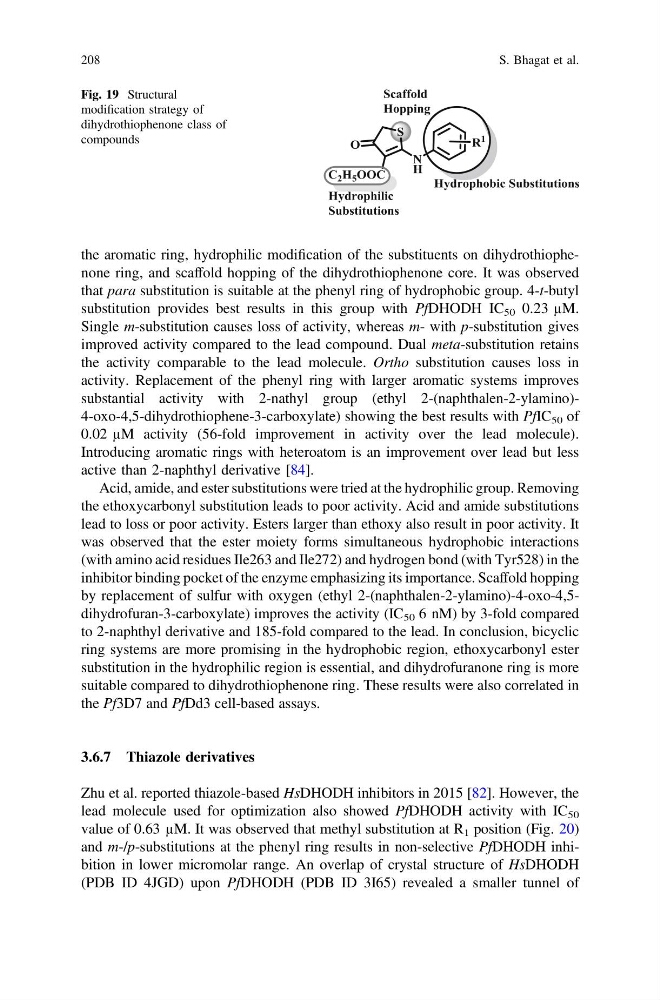
the aromatic ring, hydrophilic modification of the substituents on dihydrothiophenone ring, and scaffold hopping of the dihydrothiophenone core. It was observed
that para substitution is suitable at the phenyl ring of hydrophobic group. 4-t-butyl
substitution provides best results in this group with PfDHODH IC 50 0.23 µM.
Single m-substitution causes loss of activity, whereas m- with p-substitution gives
improved activity compared to the lead compound. Dual meta-substitution retains
the activity comparable to the lead molecule. Ortho substitution causes loss in
activity. Replacement of the phenyl ring with larger aromatic systems improves
substantial activity with 2-nathyl group (ethyl 2-(naphthalen-2-ylamino)4-oxo-4,5-dihydrothiophene-3-carboxylate) showing the best results with PfIC 50 of
0.02 µM activity (56-fold improvement in activity over the lead molecule).
Introducing aromatic rings with heteroatom is an improvement over lead but less
active than 2-naphthyl derivative [84].
Acid, amide, and ester substitutions were tried at the hydrophilic group. Removing
the ethoxycarbonyl substitution leads to poor activity. Acid and amide substitutions
lead to loss or poor activity. Esters larger than ethoxy also result in poor activity. It
was observed that the ester moiety forms simultaneous hydrophobic interactions
(with amino acid residues Ile263 and Ile272) and hydrogen bond (with Tyr528) in the
inhibitor binding pocket of the enzyme emphasizing its importance. Scaffold hopping
by replacement of sulfur with oxygen (ethyl 2-(naphthalen-2-ylamino)-4-oxo-4,5dihydrofuran-3-carboxylate) improves the activity (IC 50 6 nM) by 3-fold compared
to 2-naphthyl derivative and 185-fold compared to the lead. In conclusion, bicyclic
ring systems are more promising in the hydrophobic region, ethoxycarbonyl ester
substitution in the hydrophilic region is essential, and dihydrofuranone ring is more
suitable compared to dihydrothiophenone ring. These results were also correlated in
the Pf3D7 and PfDd3 cell-based assays.
3.6.7 Thiazole derivatives
Zhu et al. reported thiazole-based HsDHODH inhibitors in 2015 [82]. However, the
lead molecule used for optimization also showed PfDHODH activity with IC 50
value of 0.63 µM. It was observed that methyl substitution at R 1 position (Fig. 20)
and m-/p-substitutions at the phenyl ring results in non-selective PfDHODH inhibition in lower micromolar range. An overlap of crystal structure of HsDHODH
(PDB ID 4JGD) upon PfDHODH (PDB ID 3I65) revealed a smaller tunnel of
Fig. 19 Structural
modification strategy of
dihydrothiophenone class of
compounds
208
S. Bhagat et al.
that para substitution is suitable at the phenyl ring of hydrophobic group. 4-t-butyl
substitution provides best results in this group with PfDHODH IC 50 0.23 µM.
Single m-substitution causes loss of activity, whereas m- with p-substitution gives
improved activity compared to the lead compound. Dual meta-substitution retains
the activity comparable to the lead molecule. Ortho substitution causes loss in
activity. Replacement of the phenyl ring with larger aromatic systems improves
substantial activity with 2-nathyl group (ethyl 2-(naphthalen-2-ylamino)4-oxo-4,5-dihydrothiophene-3-carboxylate) showing the best results with PfIC 50 of
0.02 µM activity (56-fold improvement in activity over the lead molecule).
Introducing aromatic rings with heteroatom is an improvement over lead but less
active than 2-naphthyl derivative [84].
Acid, amide, and ester substitutions were tried at the hydrophilic group. Removing
the ethoxycarbonyl substitution leads to poor activity. Acid and amide substitutions
lead to loss or poor activity. Esters larger than ethoxy also result in poor activity. It
was observed that the ester moiety forms simultaneous hydrophobic interactions
(with amino acid residues Ile263 and Ile272) and hydrogen bond (with Tyr528) in the
inhibitor binding pocket of the enzyme emphasizing its importance. Scaffold hopping
by replacement of sulfur with oxygen (ethyl 2-(naphthalen-2-ylamino)-4-oxo-4,5dihydrofuran-3-carboxylate) improves the activity (IC 50 6 nM) by 3-fold compared
to 2-naphthyl derivative and 185-fold compared to the lead. In conclusion, bicyclic
ring systems are more promising in the hydrophobic region, ethoxycarbonyl ester
substitution in the hydrophilic region is essential, and dihydrofuranone ring is more
suitable compared to dihydrothiophenone ring. These results were also correlated in
the Pf3D7 and PfDd3 cell-based assays.
3.6.7 Thiazole derivatives
Zhu et al. reported thiazole-based HsDHODH inhibitors in 2015 [82]. However, the
lead molecule used for optimization also showed PfDHODH activity with IC 50
value of 0.63 µM. It was observed that methyl substitution at R 1 position (Fig. 20)
and m-/p-substitutions at the phenyl ring results in non-selective PfDHODH inhibition in lower micromolar range. An overlap of crystal structure of HsDHODH
(PDB ID 4JGD) upon PfDHODH (PDB ID 3I65) revealed a smaller tunnel of
Fig. 19 Structural
modification strategy of
dihydrothiophenone class of
compounds
208
S. Bhagat et al.