

3.6.5 N-Substituted Salicylamides
This class of compounds was reported by Fritzson et al. in 2011 [81]. It was
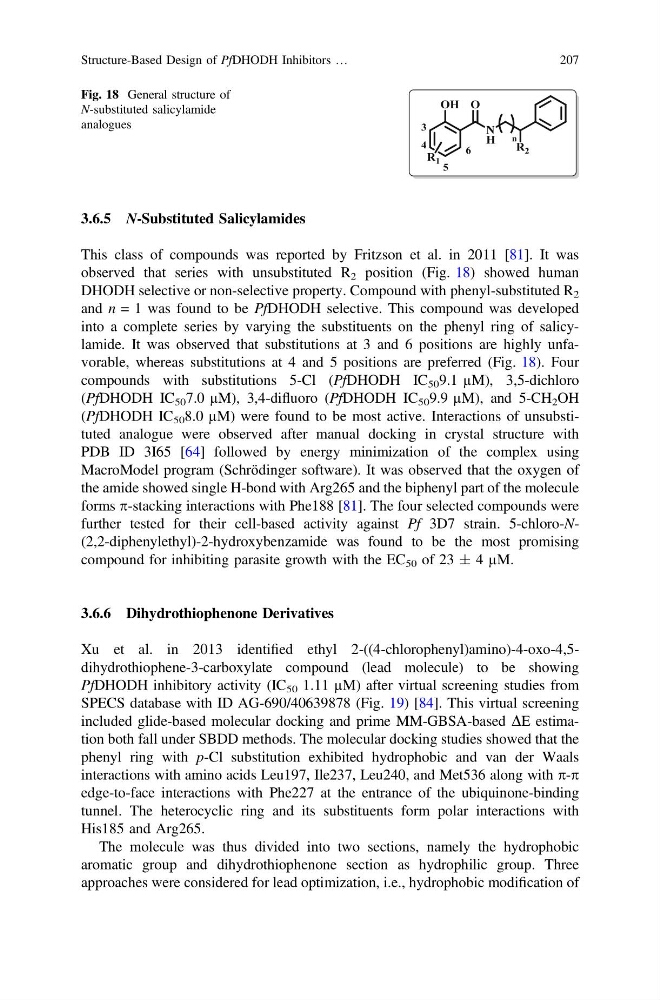
observed that series with unsubstituted R 2 position (Fig. 18) showed human
DHODH selective or non-selective property. Compound with phenyl-substituted R 2
and n = 1 was found to be PfDHODH selective. This compound was developed
into a complete series by varying the substituents on the phenyl ring of salicylamide. It was observed that substitutions at 3 and 6 positions are highly unfavorable, whereas substitutions at 4 and 5 positions are preferred (Fig. 18). Four
compounds with substitutions 5-Cl (PfDHODH IC 50 9.1 µM), 3,5-dichloro
(PfDHODH IC 50 7.0 µM), 3,4-difluoro (PfDHODH IC 50 9.9 µM), and 5-CH 2 OH
(PfDHODH IC 50 8.0 µM) were found to be most active. Interactions of unsubstituted analogue were observed after manual docking in crystal structure with
PDB ID 3I65 [64] followed by energy minimization of the complex using
MacroModel program (Schrödinger software). It was observed that the oxygen of
the amide showed single H-bond with Arg265 and the biphenyl part of the molecule
forms p-stacking interactions with Phe188 [81]. The four selected compounds were
further tested for their cell-based activity against Pf 3D7 strain. 5-chloro-N(2,2-diphenylethyl)-2-hydroxybenzamide was found to be the most promising
compound for inhibiting parasite growth with the EC 50 of 23 ± 4 µM.
3.6.6 Dihydrothiophenone Derivatives
Xu et al. in 2013 identified ethyl 2-((4-chlorophenyl)amino)-4-oxo-4,5dihydrothiophene-3-carboxylate compound (lead molecule) to be showing
PfDHODH inhibitory activity (IC 50 1.11 µM) after virtual screening studies from
SPECS database with ID AG-690/40639878 (Fig. 19) [84]. This virtual screening
included glide-based molecular docking and prime MM-GBSA-based DE estimation both fall under SBDD methods. The molecular docking studies showed that the
phenyl ring with p-Cl substitution exhibited hydrophobic and van der Waals
interactions with amino acids Leu197, Ile237, Leu240, and Met536 along with p-p
edge-to-face interactions with Phe227 at the entrance of the ubiquinone-binding
tunnel. The heterocyclic ring and its substituents form polar interactions with
His185 and Arg265.
The molecule was thus divided into two sections, namely the hydrophobic
aromatic group and dihydrothiophenone section as hydrophilic group. Three
approaches were considered for lead optimization, i.e., hydrophobic modification of
Fig. 18 General structure of
N-substituted salicylamide
analogues
Structure-Based Design of PfDHODH Inhibitors …
207
This class of compounds was reported by Fritzson et al. in 2011 [81]. It was
observed that series with unsubstituted R 2 position (Fig. 18) showed human
DHODH selective or non-selective property. Compound with phenyl-substituted R 2
and n = 1 was found to be PfDHODH selective. This compound was developed
into a complete series by varying the substituents on the phenyl ring of salicylamide. It was observed that substitutions at 3 and 6 positions are highly unfavorable, whereas substitutions at 4 and 5 positions are preferred (Fig. 18). Four
compounds with substitutions 5-Cl (PfDHODH IC 50 9.1 µM), 3,5-dichloro
(PfDHODH IC 50 7.0 µM), 3,4-difluoro (PfDHODH IC 50 9.9 µM), and 5-CH 2 OH
(PfDHODH IC 50 8.0 µM) were found to be most active. Interactions of unsubstituted analogue were observed after manual docking in crystal structure with
PDB ID 3I65 [64] followed by energy minimization of the complex using
MacroModel program (Schrödinger software). It was observed that the oxygen of
the amide showed single H-bond with Arg265 and the biphenyl part of the molecule
forms p-stacking interactions with Phe188 [81]. The four selected compounds were
further tested for their cell-based activity against Pf 3D7 strain. 5-chloro-N(2,2-diphenylethyl)-2-hydroxybenzamide was found to be the most promising
compound for inhibiting parasite growth with the EC 50 of 23 ± 4 µM.
3.6.6 Dihydrothiophenone Derivatives
Xu et al. in 2013 identified ethyl 2-((4-chlorophenyl)amino)-4-oxo-4,5dihydrothiophene-3-carboxylate compound (lead molecule) to be showing
PfDHODH inhibitory activity (IC 50 1.11 µM) after virtual screening studies from
SPECS database with ID AG-690/40639878 (Fig. 19) [84]. This virtual screening
included glide-based molecular docking and prime MM-GBSA-based DE estimation both fall under SBDD methods. The molecular docking studies showed that the
phenyl ring with p-Cl substitution exhibited hydrophobic and van der Waals
interactions with amino acids Leu197, Ile237, Leu240, and Met536 along with p-p
edge-to-face interactions with Phe227 at the entrance of the ubiquinone-binding
tunnel. The heterocyclic ring and its substituents form polar interactions with
His185 and Arg265.
The molecule was thus divided into two sections, namely the hydrophobic
aromatic group and dihydrothiophenone section as hydrophilic group. Three
approaches were considered for lead optimization, i.e., hydrophobic modification of
Fig. 18 General structure of
N-substituted salicylamide
analogues
Structure-Based Design of PfDHODH Inhibitors …
207