

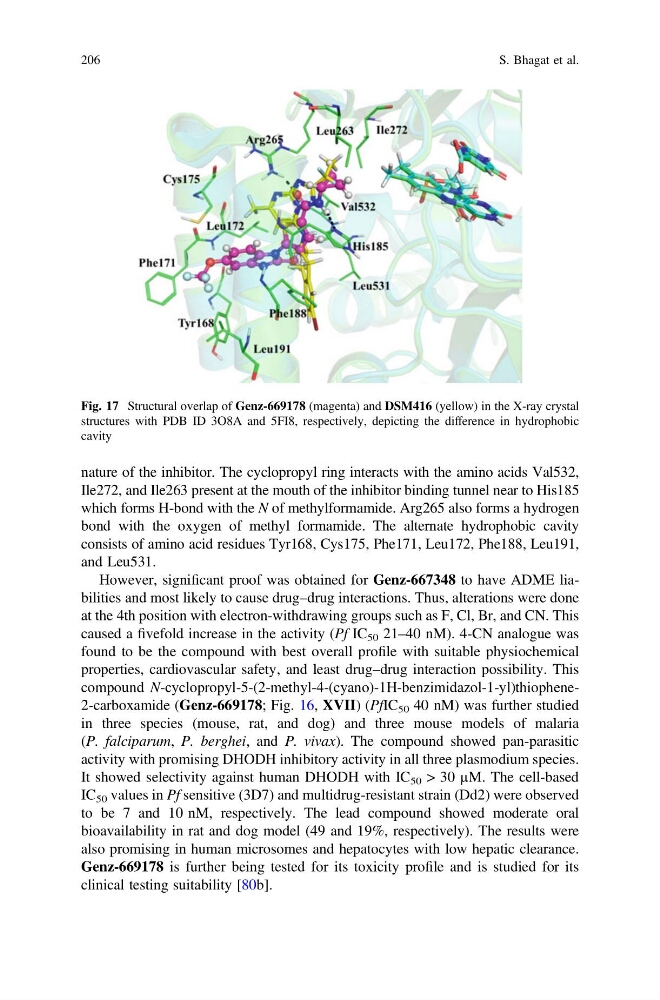
nature of the inhibitor. The cyclopropyl ring interacts with the amino acids Val532,
Ile272, and Ile263 present at the mouth of the inhibitor binding tunnel near to His185
which forms H-bond with the N of methylformamide. Arg265 also forms a hydrogen
bond with the oxygen of methyl formamide. The alternate hydrophobic cavity
consists of amino acid residues Tyr168, Cys175, Phe171, Leu172, Phe188, Leu191,
and Leu531.
However, significant proof was obtained for Genz-667348 to have ADME liabilities and most likely to cause drug–drug interactions. Thus, alterations were done
at the 4th position with electron-withdrawing groups such as F, Cl, Br, and CN. This
caused a fivefold increase in the activity (Pf IC 50 21–40 nM). 4-CN analogue was
found to be the compound with best overall profile with suitable physiochemical
properties, cardiovascular safety, and least drug–drug interaction possibility. This
compound N-cyclopropyl-5-(2-methyl-4-(cyano)-1H-benzimidazol-1-yl)thiophene2-carboxamide (Genz-669178; Fig. 16, XVII) (PfIC 50 40 nM) was further studied
in three species (mouse, rat, and dog) and three mouse models of malaria
(P. falciparum, P. berghei, and P. vivax). The compound showed pan-parasitic
activity with promising DHODH inhibitory activity in all three plasmodium species.
It showed selectivity against human DHODH with IC 50 > 30 µM. The cell-based
IC 50 values in Pf sensitive (3D7) and multidrug-resistant strain (Dd2) were observed
to be 7 and 10 nM, respectively. The lead compound showed moderate oral
bioavailability in rat and dog model (49 and 19%, respectively). The results were
also promising in human microsomes and hepatocytes with low hepatic clearance.
Genz-669178 is further being tested for its toxicity profile and is studied for its
clinical testing suitability [80b].
Fig. 17 Structural overlap of Genz-669178 (magenta) and DSM416 (yellow) in the X-ray crystal
structures with PDB ID 3O8A and 5FI8, respectively, depicting the difference in hydrophobic
cavity
206
S. Bhagat et al.
Ile272, and Ile263 present at the mouth of the inhibitor binding tunnel near to His185
which forms H-bond with the N of methylformamide. Arg265 also forms a hydrogen
bond with the oxygen of methyl formamide. The alternate hydrophobic cavity
consists of amino acid residues Tyr168, Cys175, Phe171, Leu172, Phe188, Leu191,
and Leu531.
However, significant proof was obtained for Genz-667348 to have ADME liabilities and most likely to cause drug–drug interactions. Thus, alterations were done
at the 4th position with electron-withdrawing groups such as F, Cl, Br, and CN. This
caused a fivefold increase in the activity (Pf IC 50 21–40 nM). 4-CN analogue was
found to be the compound with best overall profile with suitable physiochemical
properties, cardiovascular safety, and least drug–drug interaction possibility. This
compound N-cyclopropyl-5-(2-methyl-4-(cyano)-1H-benzimidazol-1-yl)thiophene2-carboxamide (Genz-669178; Fig. 16, XVII) (PfIC 50 40 nM) was further studied
in three species (mouse, rat, and dog) and three mouse models of malaria
(P. falciparum, P. berghei, and P. vivax). The compound showed pan-parasitic
activity with promising DHODH inhibitory activity in all three plasmodium species.
It showed selectivity against human DHODH with IC 50 > 30 µM. The cell-based
IC 50 values in Pf sensitive (3D7) and multidrug-resistant strain (Dd2) were observed
to be 7 and 10 nM, respectively. The lead compound showed moderate oral
bioavailability in rat and dog model (49 and 19%, respectively). The results were
also promising in human microsomes and hepatocytes with low hepatic clearance.
Genz-669178 is further being tested for its toxicity profile and is studied for its
clinical testing suitability [80b].
Fig. 17 Structural overlap of Genz-669178 (magenta) and DSM416 (yellow) in the X-ray crystal
structures with PDB ID 3O8A and 5FI8, respectively, depicting the difference in hydrophobic
cavity
206
S. Bhagat et al.