

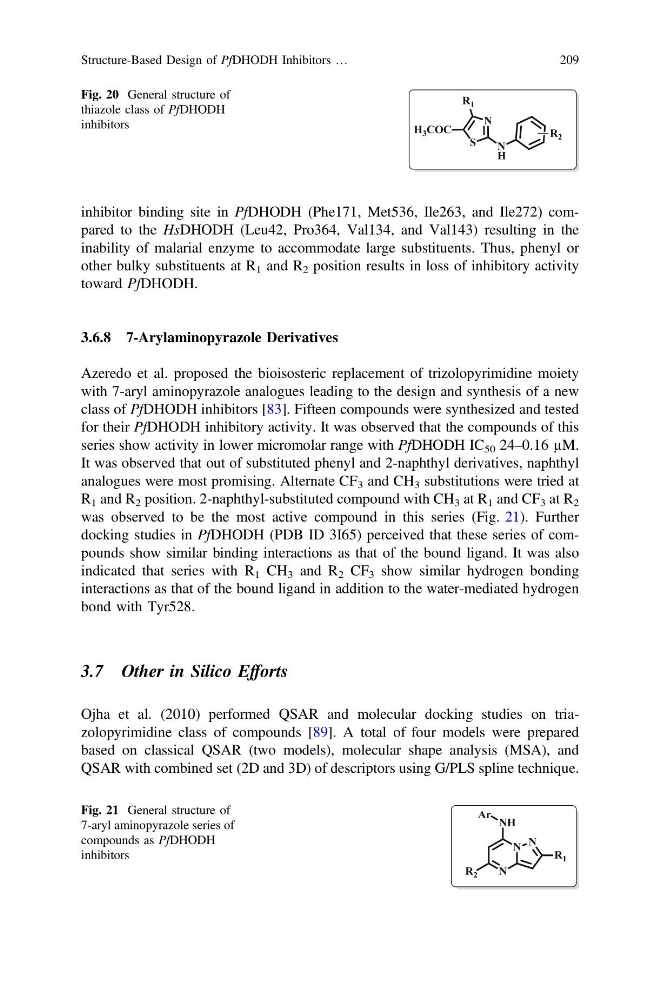
inhibitor binding site in PfDHODH (Phe171, Met536, Ile263, and Ile272) compared to the HsDHODH (Leu42, Pro364, Val134, and Val143) resulting in the
inability of malarial enzyme to accommodate large substituents. Thus, phenyl or
other bulky substituents at R 1 and R 2 position results in loss of inhibitory activity
toward PfDHODH.
3.6.8 7-Arylaminopyrazole Derivatives
Azeredo et al. proposed the bioisosteric replacement of trizolopyrimidine moiety
with 7-aryl aminopyrazole analogues leading to the design and synthesis of a new
class of PfDHODH inhibitors [83]. Fifteen compounds were synthesized and tested
for their PfDHODH inhibitory activity. It was observed that the compounds of this
series show activity in lower micromolar range with PfDHODH IC 50 24–0.16 µM.
It was observed that out of substituted phenyl and 2-naphthyl derivatives, naphthyl
analogues were most promising. Alternate CF 3 and CH 3 substitutions were tried at
R 1 and R 2 position. 2-naphthyl-substituted compound with CH 3 at R 1 and CF 3 at R 2
was observed to be the most active compound in this series (Fig. 21). Further
docking studies in PfDHODH (PDB ID 3I65) perceived that these series of compounds show similar binding interactions as that of the bound ligand. It was also
indicated that series with R 1 CH 3 and R 2 CF 3 show similar hydrogen bonding
interactions as that of the bound ligand in addition to the water-mediated hydrogen
bond with Tyr528.
3.7 Other in Silico Efforts
Ojha et al. (2010) performed QSAR and molecular docking studies on triazolopyrimidine class of compounds [89]. A total of four models were prepared
based on classical QSAR (two models), molecular shape analysis (MSA), and
QSAR with combined set (2D and 3D) of descriptors using G/PLS spline technique.
Fig. 20 General structure of
thiazole class of PfDHODH
inhibitors
Fig. 21 General structure of
7-aryl aminopyrazole series of
compounds as PfDHODH
inhibitors
Structure-Based Design of PfDHODH Inhibitors …
209
inability of malarial enzyme to accommodate large substituents. Thus, phenyl or
other bulky substituents at R 1 and R 2 position results in loss of inhibitory activity
toward PfDHODH.
3.6.8 7-Arylaminopyrazole Derivatives
Azeredo et al. proposed the bioisosteric replacement of trizolopyrimidine moiety
with 7-aryl aminopyrazole analogues leading to the design and synthesis of a new
class of PfDHODH inhibitors [83]. Fifteen compounds were synthesized and tested
for their PfDHODH inhibitory activity. It was observed that the compounds of this
series show activity in lower micromolar range with PfDHODH IC 50 24–0.16 µM.
It was observed that out of substituted phenyl and 2-naphthyl derivatives, naphthyl
analogues were most promising. Alternate CF 3 and CH 3 substitutions were tried at
R 1 and R 2 position. 2-naphthyl-substituted compound with CH 3 at R 1 and CF 3 at R 2
was observed to be the most active compound in this series (Fig. 21). Further
docking studies in PfDHODH (PDB ID 3I65) perceived that these series of compounds show similar binding interactions as that of the bound ligand. It was also
indicated that series with R 1 CH 3 and R 2 CF 3 show similar hydrogen bonding
interactions as that of the bound ligand in addition to the water-mediated hydrogen
bond with Tyr528.
3.7 Other in Silico Efforts
Ojha et al. (2010) performed QSAR and molecular docking studies on triazolopyrimidine class of compounds [89]. A total of four models were prepared
based on classical QSAR (two models), molecular shape analysis (MSA), and
QSAR with combined set (2D and 3D) of descriptors using G/PLS spline technique.
Fig. 20 General structure of
thiazole class of PfDHODH
inhibitors
Fig. 21 General structure of
7-aryl aminopyrazole series of
compounds as PfDHODH
inhibitors
Structure-Based Design of PfDHODH Inhibitors …
209