

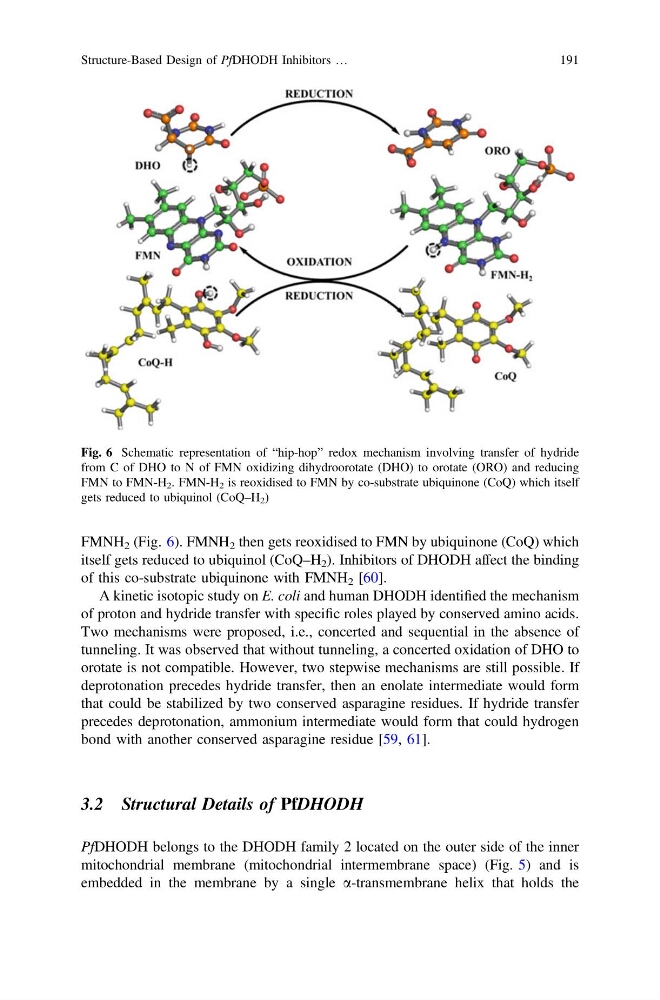
FMNH 2 (Fig. 6). FMNH 2 then gets reoxidised to FMN by ubiquinone (CoQ) which
itself gets reduced to ubiquinol (CoQ–H 2 ). Inhibitors of DHODH affect the binding
of this co-substrate ubiquinone with FMNH 2 [60].
A kinetic isotopic study on E. coli and human DHODH identified the mechanism
of proton and hydride transfer with specific roles played by conserved amino acids.
Two mechanisms were proposed, i.e., concerted and sequential in the absence of
tunneling. It was observed that without tunneling, a concerted oxidation of DHO to
orotate is not compatible. However, two stepwise mechanisms are still possible. If
deprotonation precedes hydride transfer, then an enolate intermediate would form
that could be stabilized by two conserved asparagine residues. If hydride transfer
precedes deprotonation, ammonium intermediate would form that could hydrogen
bond with another conserved asparagine residue [59, 61].
3.2 Structural Details of PfDHODH
PfDHODH belongs to the DHODH family 2 located on the outer side of the inner
mitochondrial membrane (mitochondrial intermembrane space) (Fig. 5) and is
embedded in the membrane by a single a-transmembrane helix that holds the
Fig. 6 Schematic representation of “hip-hop” redox mechanism involving transfer of hydride
from C of DHO to N of FMN oxidizing dihydroorotate (DHO) to orotate (ORO) and reducing
FMN to FMN-H 2 . FMN-H 2 is reoxidised to FMN by co-substrate ubiquinone (CoQ) which itself
gets reduced to ubiquinol (CoQ–H 2 )
Structure-Based Design of PfDHODH Inhibitors …
191
itself gets reduced to ubiquinol (CoQ–H 2 ). Inhibitors of DHODH affect the binding
of this co-substrate ubiquinone with FMNH 2 [60].
A kinetic isotopic study on E. coli and human DHODH identified the mechanism
of proton and hydride transfer with specific roles played by conserved amino acids.
Two mechanisms were proposed, i.e., concerted and sequential in the absence of
tunneling. It was observed that without tunneling, a concerted oxidation of DHO to
orotate is not compatible. However, two stepwise mechanisms are still possible. If
deprotonation precedes hydride transfer, then an enolate intermediate would form
that could be stabilized by two conserved asparagine residues. If hydride transfer
precedes deprotonation, ammonium intermediate would form that could hydrogen
bond with another conserved asparagine residue [59, 61].
3.2 Structural Details of PfDHODH
PfDHODH belongs to the DHODH family 2 located on the outer side of the inner
mitochondrial membrane (mitochondrial intermembrane space) (Fig. 5) and is
embedded in the membrane by a single a-transmembrane helix that holds the
Fig. 6 Schematic representation of “hip-hop” redox mechanism involving transfer of hydride
from C of DHO to N of FMN oxidizing dihydroorotate (DHO) to orotate (ORO) and reducing
FMN to FMN-H 2 . FMN-H 2 is reoxidised to FMN by co-substrate ubiquinone (CoQ) which itself
gets reduced to ubiquinol (CoQ–H 2 )
Structure-Based Design of PfDHODH Inhibitors …
191