

from ammonia (derived from L-Gln), bicarbonate, and L-asp, or by salvaging
preformed pyrimidine base. Plasmodium species lack pyrimidine salvage enzymes
and the de novo pathway provides the only source of pyrimidines for cell growth. In
contrast, human cells are able to utilize both pathways. Inhibition of de novo
pyrimidine synthesis in humans leads to immunosuppression and bone marrow
depression. Immunosuppression is desirable in rheumatoid arthritis and organ
transplant. However, immunosuppression and bone marrow depression during
malaria may lead to life threatening situations which necessitate selective inhibition
of parasite DHODH to be of utmost importance [57]. Pyrimidine biosynthesis
requires six enzymes that are essential for the synthesis of UMP which is further
utilized in generation of UTP, CTP, dTMP, and other metabolites of these
nucleotides required by the cell. Enzymes involved are bifunctional glutamine
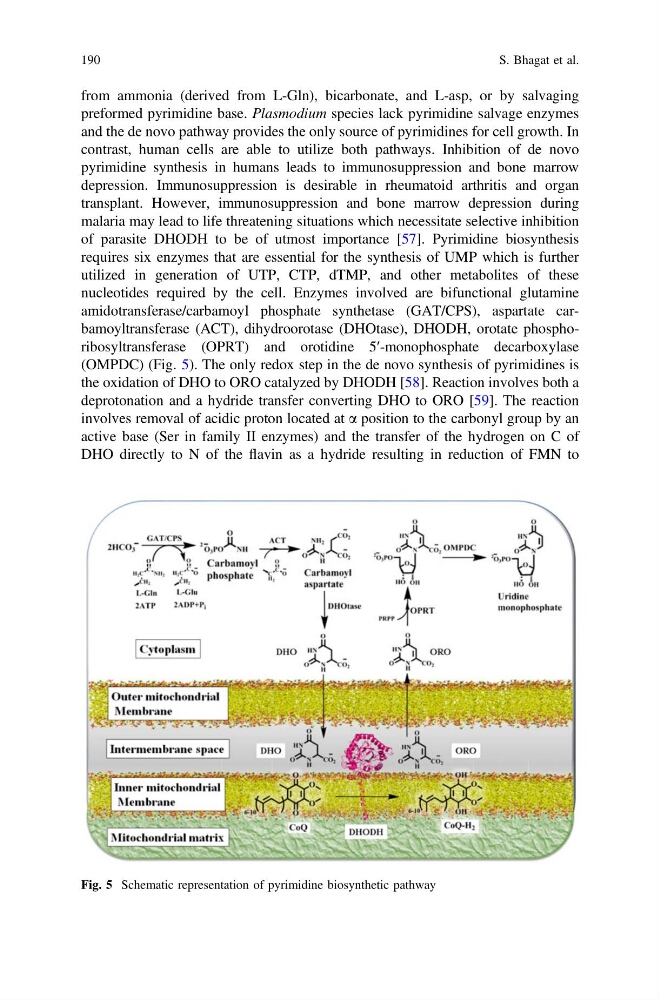
amidotransferase/carbamoyl phosphate synthetase (GAT/CPS), aspartate carbamoyltransferase (ACT), dihydroorotase (DHOtase), DHODH, orotate phosphoribosyltransferase (OPRT) and orotidine 5′-monophosphate decarboxylase
(OMPDC) (Fig. 5). The only redox step in the de novo synthesis of pyrimidines is
the oxidation of DHO to ORO catalyzed by DHODH [58]. Reaction involves both a
deprotonation and a hydride transfer converting DHO to ORO [59]. The reaction
involves removal of acidic proton located at a position to the carbonyl group by an
active base (Ser in family II enzymes) and the transfer of the hydrogen on C of
DHO directly to N of the flavin as a hydride resulting in reduction of FMN to
Fig. 5 Schematic representation of pyrimidine biosynthetic pathway
190
S. Bhagat et al.
preformed pyrimidine base. Plasmodium species lack pyrimidine salvage enzymes
and the de novo pathway provides the only source of pyrimidines for cell growth. In
contrast, human cells are able to utilize both pathways. Inhibition of de novo
pyrimidine synthesis in humans leads to immunosuppression and bone marrow
depression. Immunosuppression is desirable in rheumatoid arthritis and organ
transplant. However, immunosuppression and bone marrow depression during
malaria may lead to life threatening situations which necessitate selective inhibition
of parasite DHODH to be of utmost importance [57]. Pyrimidine biosynthesis
requires six enzymes that are essential for the synthesis of UMP which is further
utilized in generation of UTP, CTP, dTMP, and other metabolites of these
nucleotides required by the cell. Enzymes involved are bifunctional glutamine
amidotransferase/carbamoyl phosphate synthetase (GAT/CPS), aspartate carbamoyltransferase (ACT), dihydroorotase (DHOtase), DHODH, orotate phosphoribosyltransferase (OPRT) and orotidine 5′-monophosphate decarboxylase
(OMPDC) (Fig. 5). The only redox step in the de novo synthesis of pyrimidines is
the oxidation of DHO to ORO catalyzed by DHODH [58]. Reaction involves both a
deprotonation and a hydride transfer converting DHO to ORO [59]. The reaction
involves removal of acidic proton located at a position to the carbonyl group by an
active base (Ser in family II enzymes) and the transfer of the hydrogen on C of
DHO directly to N of the flavin as a hydride resulting in reduction of FMN to
Fig. 5 Schematic representation of pyrimidine biosynthetic pathway
190
S. Bhagat et al.