

Biodiesel
73
0
5
10
15
20
25
30
35
Brake thermal efficiency (%)
Diesel
B10
B20
B50
B75
B100
Oil
0
100
200
300
400
500
600
700
BMEP (kN/m
2 )
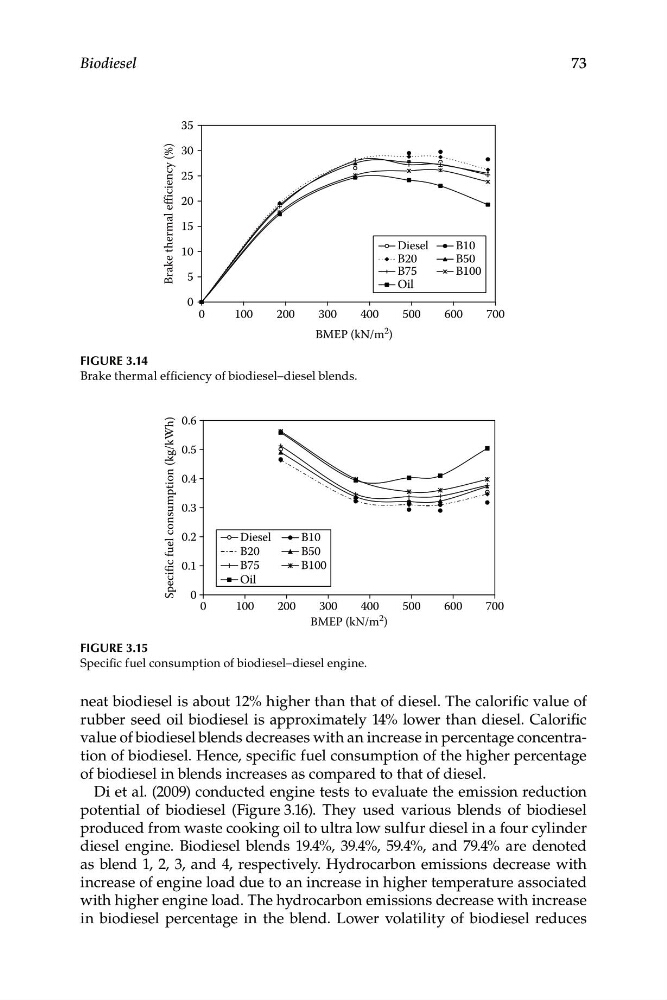
Figure 3.14
Brake thermal efficiency of biodiesel–diesel blends.
0
0.1
0.2
0.3
0.4
0.5
0.6
Specific fuel consumption (kg/kWh)
Diesel
B10
B20
B50
B75
B100
Oil
0
100
200
300
400
500
600
700
BMEP (kN/m 2 )
Figure 3.15
Specific fuel consumption of biodiesel–diesel engine.
neat biodiesel is about 12% higher than that of diesel. The calorific value of
rubber seed oil biodiesel is approximately 14% lower than diesel. Calorific
value of biodiesel blends decreases with an increase in percentage concentration of biodiesel. Hence, specific fuel consumption of the higher percentage
of biodiesel in blends increases as compared to that of diesel.
Di et al. (2009) conducted engine tests to evaluate the emission reduction
potential of biodiesel (Figure 3.16). They used various blends of biodiesel
produced from waste cooking oil to ultra low sulfur diesel in a four cylinder
diesel engine. Biodiesel blends 19.4%, 39.4%, 59.4%, and 79.4% are denoted
as blend 1, 2, 3, and 4, respectively. Hydrocarbon emissions decrease with
increase of engine load due to an increase in higher temperature associated
with higher engine load. The hydrocarbon emissions decrease with increase
in biodiesel percentage in the blend. Lower volatility of biodiesel reduces
73
0
5
10
15
20
25
30
35
Brake thermal efficiency (%)
Diesel
B10
B20
B50
B75
B100
Oil
0
100
200
300
400
500
600
700
BMEP (kN/m
2 )
Figure 3.14
Brake thermal efficiency of biodiesel–diesel blends.
0
0.1
0.2
0.3
0.4
0.5
0.6
Specific fuel consumption (kg/kWh)
Diesel
B10
B20
B50
B75
B100
Oil
0
100
200
300
400
500
600
700
BMEP (kN/m 2 )
Figure 3.15
Specific fuel consumption of biodiesel–diesel engine.
neat biodiesel is about 12% higher than that of diesel. The calorific value of
rubber seed oil biodiesel is approximately 14% lower than diesel. Calorific
value of biodiesel blends decreases with an increase in percentage concentration of biodiesel. Hence, specific fuel consumption of the higher percentage
of biodiesel in blends increases as compared to that of diesel.
Di et al. (2009) conducted engine tests to evaluate the emission reduction
potential of biodiesel (Figure 3.16). They used various blends of biodiesel
produced from waste cooking oil to ultra low sulfur diesel in a four cylinder
diesel engine. Biodiesel blends 19.4%, 39.4%, 59.4%, and 79.4% are denoted
as blend 1, 2, 3, and 4, respectively. Hydrocarbon emissions decrease with
increase of engine load due to an increase in higher temperature associated
with higher engine load. The hydrocarbon emissions decrease with increase
in biodiesel percentage in the blend. Lower volatility of biodiesel reduces