

Test Method
ISO, ASTM, EN/
S.No.
Characteristics
Unit
Requirement
IS 1448
1
Density at 15ºC
kg/m 3
860–900
ISO 3675/P 32
2
Kinematic viscosity at 40ºC
cSt
2.5–6.0
ISO 3104/P25
3
Flash point (closed cup),
ºC
120
P21
min
4
Sulfur, max
mg/kg
50
D 5443/P83
5
Carbon residue
%m
0.05
D 4530
(Ramsbottom),max
6
Sulfated ash, max
%m
0.02
ISO 6245/P4
7
Water content, max
mg/kg
500
D 2709/P40
8
Total contamination, max
mg/kg
24
EN 12662
9
Copper corrosion 3 hours
—
1
ISO 2160/P15
@50ºC, max
10
Cetane number, min
—
51
ISO 5156/P9
11
Acid value, max
mg KOH/g
0.50
P1
12
Methanol, max
%m
0.20
EN 14110
13
Ethanol, max
%m
0.20
—
14
Ester content, min
%m
96.5
EN 14103
15
Free glycerol, max
%m
0.02
D 6584
16
Total glycerol, max
%m
0.25
D 6584
17
Phosphorous, max
mg/kg
10.0
D 4951
18
Sodium and potassium,
mg/kg
To report
EN 14108
max
19
Calcium and magnesium,
mg/kg
To report
—
max
20
Iodine value
—
To report
EN 14104
21
Oxidation stability at
Hr
6
EN 14112
110ºC, min
72
Alternative Fuels for Transportation
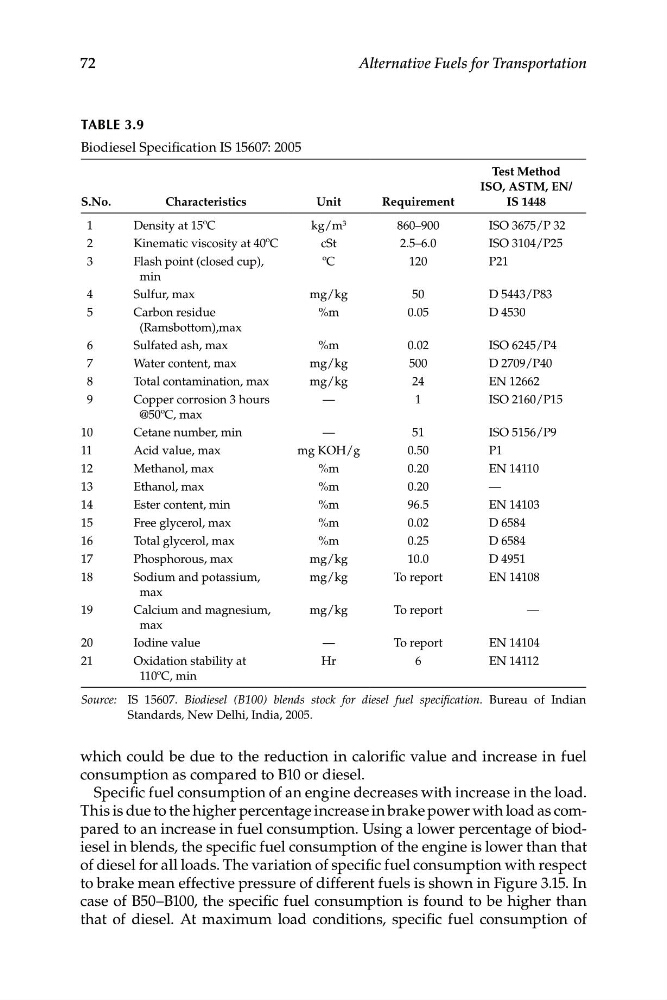
TABLe 3.9
Biodiesel Specification IS 15607: 2005
Source: IS 15607. Biodiesel (B100) blends stock for diesel fuel specification. Bureau of Indian
Standards, New Delhi, India, 2005.
which could be due to the reduction in calorific value and increase in fuel
consumption as compared to B10 or diesel.
Specific fuel consumption of an engine decreases with increase in the load.
This is due to the higher percentage increase in brake power with load as compared to an increase in fuel consumption. Using a lower percentage of biodiesel in blends, the specific fuel consumption of the engine is lower than that
of diesel for all loads. The variation of specific fuel consumption with respect
to brake mean effective pressure of different fuels is shown in Figure 3.15. In
case of B50–B100, the specific fuel consumption is found to be higher than
that of diesel. At maximum load conditions, specific fuel consumption of
ISO, ASTM, EN/
S.No.
Characteristics
Unit
Requirement
IS 1448
1
Density at 15ºC
kg/m 3
860–900
ISO 3675/P 32
2
Kinematic viscosity at 40ºC
cSt
2.5–6.0
ISO 3104/P25
3
Flash point (closed cup),
ºC
120
P21
min
4
Sulfur, max
mg/kg
50
D 5443/P83
5
Carbon residue
%m
0.05
D 4530
(Ramsbottom),max
6
Sulfated ash, max
%m
0.02
ISO 6245/P4
7
Water content, max
mg/kg
500
D 2709/P40
8
Total contamination, max
mg/kg
24
EN 12662
9
Copper corrosion 3 hours
—
1
ISO 2160/P15
@50ºC, max
10
Cetane number, min
—
51
ISO 5156/P9
11
Acid value, max
mg KOH/g
0.50
P1
12
Methanol, max
%m
0.20
EN 14110
13
Ethanol, max
%m
0.20
—
14
Ester content, min
%m
96.5
EN 14103
15
Free glycerol, max
%m
0.02
D 6584
16
Total glycerol, max
%m
0.25
D 6584
17
Phosphorous, max
mg/kg
10.0
D 4951
18
Sodium and potassium,
mg/kg
To report
EN 14108
max
19
Calcium and magnesium,
mg/kg
To report
—
max
20
Iodine value
—
To report
EN 14104
21
Oxidation stability at
Hr
6
EN 14112
110ºC, min
72
Alternative Fuels for Transportation
TABLe 3.9
Biodiesel Specification IS 15607: 2005
Source: IS 15607. Biodiesel (B100) blends stock for diesel fuel specification. Bureau of Indian
Standards, New Delhi, India, 2005.
which could be due to the reduction in calorific value and increase in fuel
consumption as compared to B10 or diesel.
Specific fuel consumption of an engine decreases with increase in the load.
This is due to the higher percentage increase in brake power with load as compared to an increase in fuel consumption. Using a lower percentage of biodiesel in blends, the specific fuel consumption of the engine is lower than that
of diesel for all loads. The variation of specific fuel consumption with respect
to brake mean effective pressure of different fuels is shown in Figure 3.15. In
case of B50–B100, the specific fuel consumption is found to be higher than
that of diesel. At maximum load conditions, specific fuel consumption of