

T
o
3
H
8
130
120
110
100
90
80
70
60
50
0.1
0.2
0.3
otal hydr carbon (C
)/ppm
0.4
0.5
0.6
0.7
BMEP/MPa
ULSD
Blend-1
Blend-2
Blend-3
Blend-4
Biodiesel
74
Alternative Fuels for Transportation
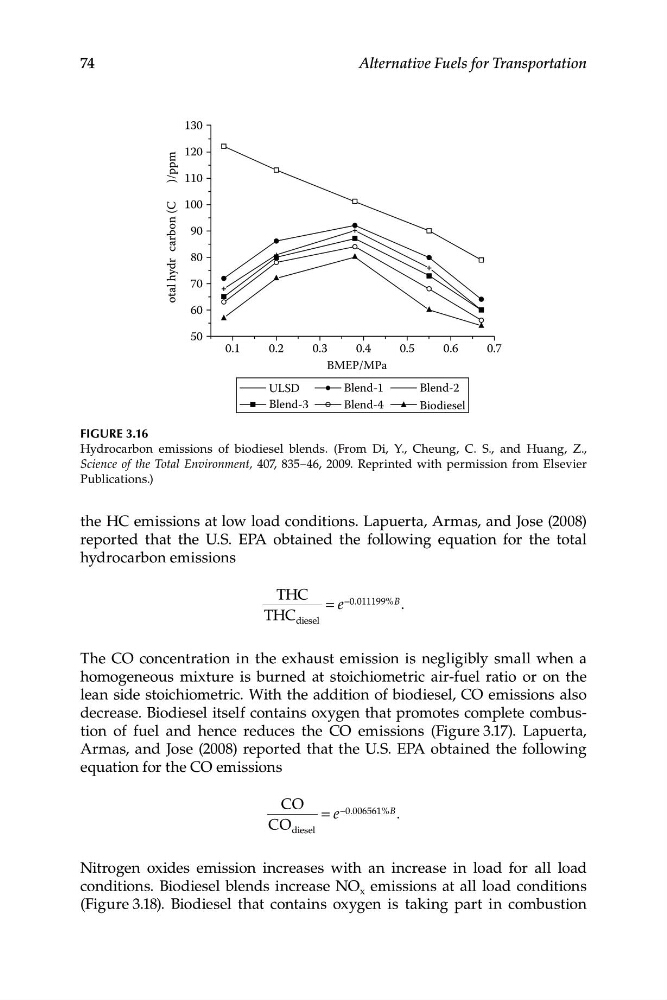
Figure 3.16
Hydrocarbon emissions of biodiesel blends. (From Di, Y., Cheung, C. S., and Huang, Z.,
Science of the Total Environment, 407, 835–46, 2009. Reprinted with permission from Elsevier
Publications.)
the HC emissions at low load conditions. Lapuerta, Armas, and Jose (2008)
reported that the U.S. EPA obtained the following equation for the total
hydrocarbon emissions
THC
0 011199%B
.
= e −
.
THC diesel
The CO concentration in the exhaust emission is negligibly small when a
homogeneous mixture is burned at stoichiometric air-fuel ratio or on the
lean side stoichiometric. With the addition of biodiesel, CO emissions also
decrease. Biodiesel itself contains oxygen that promotes complete combustion of fuel and hence reduces the CO emissions (Figure 3.17). Lapuerta,
Armas, and Jose (2008) reported that the U.S. EPA obtained the following
equation for the CO emissions
CO
0 006561%B
.
= e −
.
CO diesel
Nitrogen oxides emission increases with an increase in load for all load
conditions. Biodiesel blends increase NO x emissions at all load conditions
(Figure 3 .18). Biodiesel that contains oxygen is taking part in combustion
o
3
H
8
130
120
110
100
90
80
70
60
50
0.1
0.2
0.3
otal hydr carbon (C
)/ppm
0.4
0.5
0.6
0.7
BMEP/MPa
ULSD
Blend-1
Blend-2
Blend-3
Blend-4
Biodiesel
74
Alternative Fuels for Transportation
Figure 3.16
Hydrocarbon emissions of biodiesel blends. (From Di, Y., Cheung, C. S., and Huang, Z.,
Science of the Total Environment, 407, 835–46, 2009. Reprinted with permission from Elsevier
Publications.)
the HC emissions at low load conditions. Lapuerta, Armas, and Jose (2008)
reported that the U.S. EPA obtained the following equation for the total
hydrocarbon emissions
THC
0 011199%B
.
= e −
.
THC diesel
The CO concentration in the exhaust emission is negligibly small when a
homogeneous mixture is burned at stoichiometric air-fuel ratio or on the
lean side stoichiometric. With the addition of biodiesel, CO emissions also
decrease. Biodiesel itself contains oxygen that promotes complete combustion of fuel and hence reduces the CO emissions (Figure 3.17). Lapuerta,
Armas, and Jose (2008) reported that the U.S. EPA obtained the following
equation for the CO emissions
CO
0 006561%B
.
= e −
.
CO diesel
Nitrogen oxides emission increases with an increase in load for all load
conditions. Biodiesel blends increase NO x emissions at all load conditions
(Figure 3 .18). Biodiesel that contains oxygen is taking part in combustion