

12
10
8
Oxidation stability in hours
6
4
2
Jatropha
Jatropha - Palm 80:20
Jatropha - Palm 60:40
0
0
25
50
75
100 150 200 300 400
Antioxidant dosage in ppm
Biodiesel
63
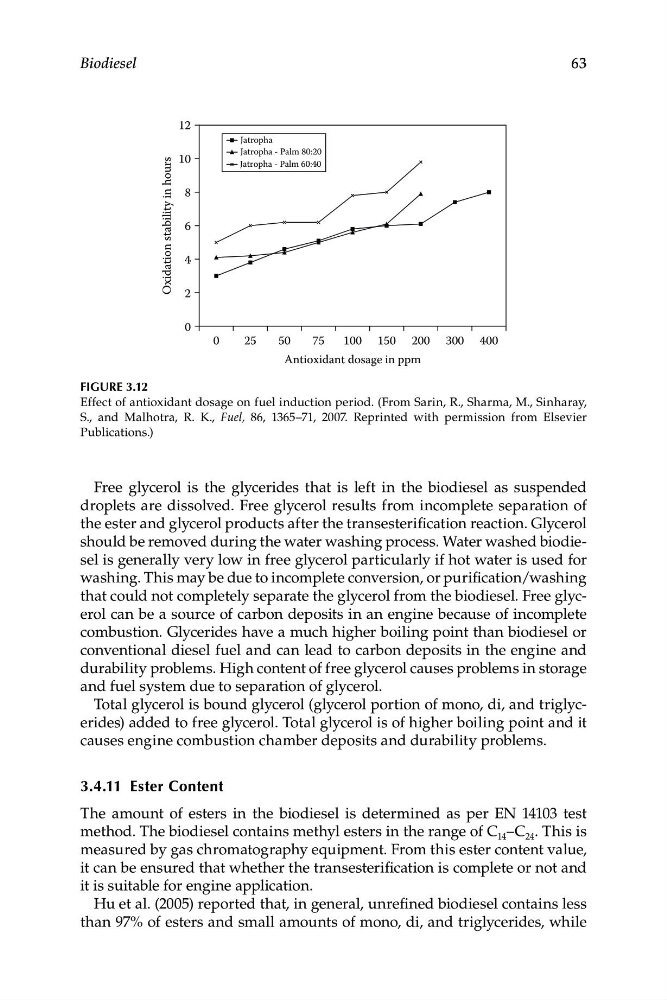
Figure 3.12
Effect of antioxidant dosage on fuel induction period. (From Sarin, R., Sharma, M., Sinharay,
S., and Malhotra, R. K., Fuel, 86, 1365–71, 2007. Reprinted with permission from Elsevier
Publications.)
Free glycerol is the glycerides that is left in the biodiesel as suspended
droplets are dissolved. Free glycerol results from incomplete separation of
the ester and glycerol products after the transesterification reaction. Glycerol
should be removed during the water washing process. Water washed biodiesel is generally very low in free glycerol particularly if hot water is used for
washing. This may be due to incomplete conversion, or purification/washing
that could not completely separate the glycerol from the biodiesel. Free glycerol can be a source of carbon deposits in an engine because of incomplete
combustion. Glycerides have a much higher boiling point than biodiesel or
conventional diesel fuel and can lead to carbon deposits in the engine and
durability problems. High content of free glycerol causes problems in storage
and fuel system due to separation of glycerol.
Total glycerol is bound glycerol (glycerol portion of mono, di, and triglycerides) added to free glycerol. Total glycerol is of higher boiling point and it
causes engine combustion chamber deposits and durability problems.
3.4.11 ester Content
The amount of esters in the biodiesel is determined as per EN 14103 test
method. The biodiesel contains methyl esters in the range of C 14 –C 24 . This is
measured by gas chromatography equipment. From this ester content value,
it can be ensured that whether the transesterification is complete or not and
it is suitable for engine application.
Hu et al. (2005) reported that, in general, unrefined biodiesel contains less
than 97% of esters and small amounts of mono, di, and triglycerides, while
10
8
Oxidation stability in hours
6
4
2
Jatropha
Jatropha - Palm 80:20
Jatropha - Palm 60:40
0
0
25
50
75
100 150 200 300 400
Antioxidant dosage in ppm
Biodiesel
63
Figure 3.12
Effect of antioxidant dosage on fuel induction period. (From Sarin, R., Sharma, M., Sinharay,
S., and Malhotra, R. K., Fuel, 86, 1365–71, 2007. Reprinted with permission from Elsevier
Publications.)
Free glycerol is the glycerides that is left in the biodiesel as suspended
droplets are dissolved. Free glycerol results from incomplete separation of
the ester and glycerol products after the transesterification reaction. Glycerol
should be removed during the water washing process. Water washed biodiesel is generally very low in free glycerol particularly if hot water is used for
washing. This may be due to incomplete conversion, or purification/washing
that could not completely separate the glycerol from the biodiesel. Free glycerol can be a source of carbon deposits in an engine because of incomplete
combustion. Glycerides have a much higher boiling point than biodiesel or
conventional diesel fuel and can lead to carbon deposits in the engine and
durability problems. High content of free glycerol causes problems in storage
and fuel system due to separation of glycerol.
Total glycerol is bound glycerol (glycerol portion of mono, di, and triglycerides) added to free glycerol. Total glycerol is of higher boiling point and it
causes engine combustion chamber deposits and durability problems.
3.4.11 ester Content
The amount of esters in the biodiesel is determined as per EN 14103 test
method. The biodiesel contains methyl esters in the range of C 14 –C 24 . This is
measured by gas chromatography equipment. From this ester content value,
it can be ensured that whether the transesterification is complete or not and
it is suitable for engine application.
Hu et al. (2005) reported that, in general, unrefined biodiesel contains less
than 97% of esters and small amounts of mono, di, and triglycerides, while