

62
Alternative Fuels for Transportation
C 18:3 is three times more unstable than C 18:0 . Poor oxidation stability can
cause fuel thickening, formation of gums, filter clogging, and injector fouling. Moreover, the high iodine number biodiesel increases the danger of
polymerization in the engine oil. Sudden increase in oil viscosity is attributed to oxidation and polymerization of unsaturated fuel entering into oil
through dilution. Moreover, fuel having the higher iodine number tends to
polymerize and forms deposits on injector nozzles, piston rings, and ring
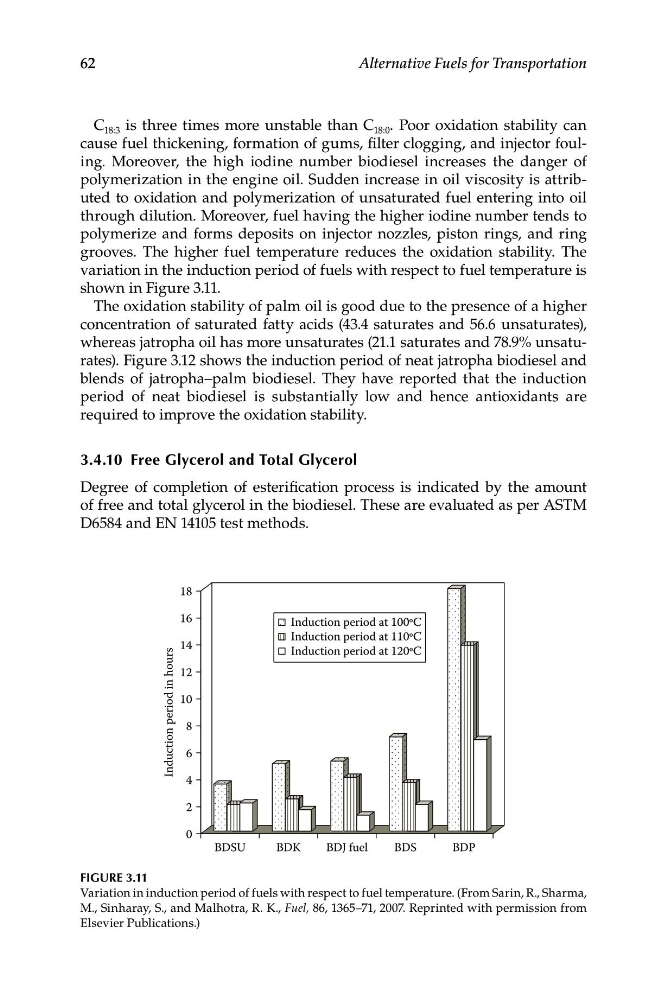
grooves. The higher fuel temperature reduces the oxidation stability. The
variation in the induction period of fuels with respect to fuel temperature is
shown in Figure 3.11.
The oxidation stability of palm oil is good due to the presence of a higher
concentration of saturated fatty acids (43.4 saturates and 56.6 unsaturates),
whereas jatropha oil has more unsaturates (21.1 saturates and 78.9% unsaturates). Figure 3.12 shows the induction period of neat jatropha biodiesel and
blends of jatropha–palm biodiesel. They have reported that the induction
period of neat biodiesel is substantially low and hence antioxidants are
required to improve the oxidation stability.
3.4.10 Free glycerol and Total glycerol
Degree of completion of esterification process is indicated by the amount
of free and total glycerol in the biodiesel. These are evaluated as per ASTM
D6584 and EN 14105 test methods.
0
2
4
6
8
10
12
14
16
18
Induction period in hours
Induction period at 100ºC
Induction period at 110ºC
Induction period at 120ºC
BDSU
BDK
BDJ fuel
BDS
B DP
Figure 3.11
Variation in induction period of fuels with respect to fuel temperature. (From Sarin, R., Sharma,
M., Sinharay, S., and Malhotra, R. K., Fuel, 86, 1365–71, 2007. Reprinted with permission from
Elsevier Publications.)
Alternative Fuels for Transportation
C 18:3 is three times more unstable than C 18:0 . Poor oxidation stability can
cause fuel thickening, formation of gums, filter clogging, and injector fouling. Moreover, the high iodine number biodiesel increases the danger of
polymerization in the engine oil. Sudden increase in oil viscosity is attributed to oxidation and polymerization of unsaturated fuel entering into oil
through dilution. Moreover, fuel having the higher iodine number tends to
polymerize and forms deposits on injector nozzles, piston rings, and ring
grooves. The higher fuel temperature reduces the oxidation stability. The
variation in the induction period of fuels with respect to fuel temperature is
shown in Figure 3.11.
The oxidation stability of palm oil is good due to the presence of a higher
concentration of saturated fatty acids (43.4 saturates and 56.6 unsaturates),
whereas jatropha oil has more unsaturates (21.1 saturates and 78.9% unsaturates). Figure 3.12 shows the induction period of neat jatropha biodiesel and
blends of jatropha–palm biodiesel. They have reported that the induction
period of neat biodiesel is substantially low and hence antioxidants are
required to improve the oxidation stability.
3.4.10 Free glycerol and Total glycerol
Degree of completion of esterification process is indicated by the amount
of free and total glycerol in the biodiesel. These are evaluated as per ASTM
D6584 and EN 14105 test methods.
0
2
4
6
8
10
12
14
16
18
Induction period in hours
Induction period at 100ºC
Induction period at 110ºC
Induction period at 120ºC
BDSU
BDK
BDJ fuel
BDS
B DP
Figure 3.11
Variation in induction period of fuels with respect to fuel temperature. (From Sarin, R., Sharma,
M., Sinharay, S., and Malhotra, R. K., Fuel, 86, 1365–71, 2007. Reprinted with permission from
Elsevier Publications.)