

24
Alternative Fuels for Transportation
2. Chemical properties (chemical structure, acid value, saponification
value, sulfur content, copper corrosion, oxidation resistance, and
thermal degradation, etc.)
3. Thermal properties (distillation temperature, thermal conductivity,
carbon residue, and calorific value, etc.)
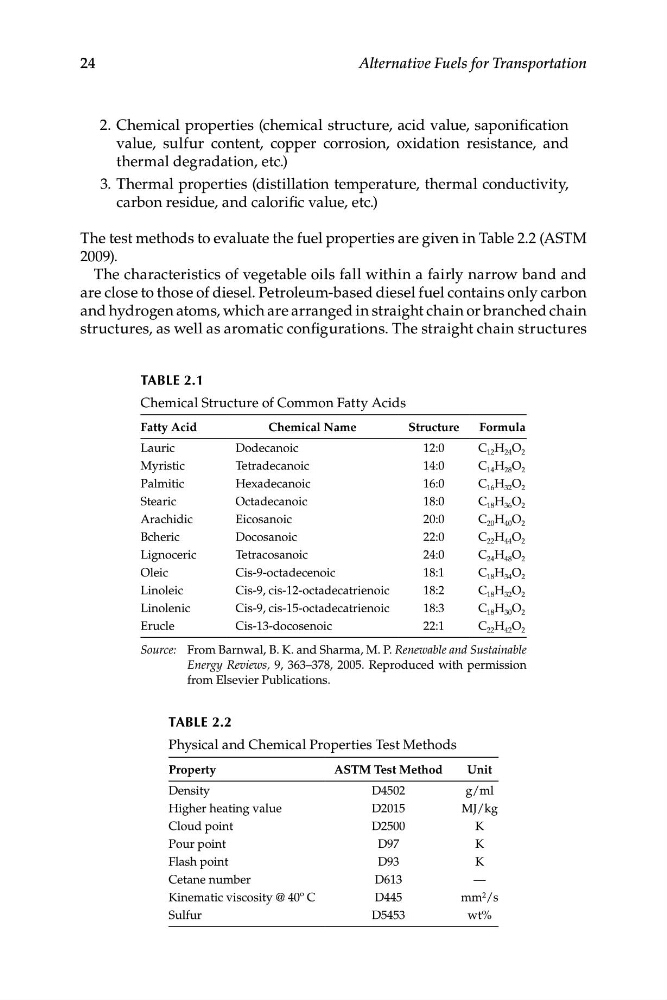
The test methods to evaluate the fuel properties are given in Table 2.2 (ASTM
2009).
The characteristics of vegetable oils fall within a fairly narrow band and
are close to those of diesel. Petroleum-based diesel fuel contains only carbon
and hydrogen atoms, which are arranged in straight chain or branched chain
structures, as well as aromatic configurations. The straight chain structures
TABLe 2.1
Chemical Structure of Common Fatty Acids
Fatty Acid
Chemical Name
Structure
Formula
Lauric
Dodecanoic
12:0
C 12 H 24 O 2
Myristic
Tetradecanoic
14:0
C 14 H 28 O 2
Palmitic
Hexadecanoic
16:0
C 16 H 32 O 2
Stearic
Octadecanoic
18:0
C 18 H 36 O 2
Arachidic
Eicosanoic
20:0
C 20 H 40 O 2
Bcheric
Docosanoic
22:0
C 22 H 44 O 2
Lignoceric
Tetracosanoic
24:0
C 24 H 48 O 2
Oleic
Cis-9-octadecenoic
18:1
C 18 H 34 O 2
Linoleic
Cis-9, cis-12-octadecatrienoic
18:2
C 18 H 32 O 2
Linolenic
Cis-9, cis-15-octadecatrienoic
18:3
C 18 H 30 O 2
Erucle
Cis-13-docosenoic
22:1
C 22 H 42 O 2
Source: From Barnwal, B. K. and Sharma, M. P. Renewable and Sustainable
Energy Reviews, 9, 363–378, 2005. Reproduced with permission
from Elsevier Publications.
TABLe 2.2
Physical and Chemical Properties Test Methods
Property
ASTM Test Method
Unit
Density
D4502
g/ml
Higher heating value
D2015
MJ/kg
Cloud point
D2500
K
Pour point
D97
K
Flash point
D93
K
Cetane number
D613
—
Kinematic viscosity @ 40º C
D445
mm 2 /s
Sulfur
D5453
wt%
Alternative Fuels for Transportation
2. Chemical properties (chemical structure, acid value, saponification
value, sulfur content, copper corrosion, oxidation resistance, and
thermal degradation, etc.)
3. Thermal properties (distillation temperature, thermal conductivity,
carbon residue, and calorific value, etc.)
The test methods to evaluate the fuel properties are given in Table 2.2 (ASTM
2009).
The characteristics of vegetable oils fall within a fairly narrow band and
are close to those of diesel. Petroleum-based diesel fuel contains only carbon
and hydrogen atoms, which are arranged in straight chain or branched chain
structures, as well as aromatic configurations. The straight chain structures
TABLe 2.1
Chemical Structure of Common Fatty Acids
Fatty Acid
Chemical Name
Structure
Formula
Lauric
Dodecanoic
12:0
C 12 H 24 O 2
Myristic
Tetradecanoic
14:0
C 14 H 28 O 2
Palmitic
Hexadecanoic
16:0
C 16 H 32 O 2
Stearic
Octadecanoic
18:0
C 18 H 36 O 2
Arachidic
Eicosanoic
20:0
C 20 H 40 O 2
Bcheric
Docosanoic
22:0
C 22 H 44 O 2
Lignoceric
Tetracosanoic
24:0
C 24 H 48 O 2
Oleic
Cis-9-octadecenoic
18:1
C 18 H 34 O 2
Linoleic
Cis-9, cis-12-octadecatrienoic
18:2
C 18 H 32 O 2
Linolenic
Cis-9, cis-15-octadecatrienoic
18:3
C 18 H 30 O 2
Erucle
Cis-13-docosenoic
22:1
C 22 H 42 O 2
Source: From Barnwal, B. K. and Sharma, M. P. Renewable and Sustainable
Energy Reviews, 9, 363–378, 2005. Reproduced with permission
from Elsevier Publications.
TABLe 2.2
Physical and Chemical Properties Test Methods
Property
ASTM Test Method
Unit
Density
D4502
g/ml
Higher heating value
D2015
MJ/kg
Cloud point
D2500
K
Pour point
D97
K
Flash point
D93
K
Cetane number
D613
—
Kinematic viscosity @ 40º C
D445
mm 2 /s
Sulfur
D5453
wt%