

25
Vegetable Oils
are preferred for better ignition quality as they have a high cetane number.
Diesel fuel contains both saturated and unsaturated hydrocarbons (UHC).
The saturated HC are present in large amounts as compared to unsaturated
hydrocarbon in diesel. The higher saturation reduces the oxidation problem. Also, the aromatics are good oxidation resistant. On the other hand,
resistance to oxidation of vegetable oils is remarkably affected by their fatty
acid composition. The quantity of free fatty acids predominantly affects
the flash point of vegetable oils and hence its ignition characteristics. The
type of fatty acids contained in vegetable oil depends on the plant species and on the growth conditions of the plant. The degree of unsaturation
(number of double bonds) determines the oxidation stability. The oxidation
stability of fuel decreases with increase in unsaturation. Although vegetable oils are of very low volatility in nature, it may quickly produce volatile
combustible compounds upon heating. The olefinic nature of the plant oils
can also give rise to thermal and oxidative polymerization reactions. These
polymers can no longer volatilize, but may deposit on available surfaces
and, upon further heating, char to form coke-like substances. Fatty acid
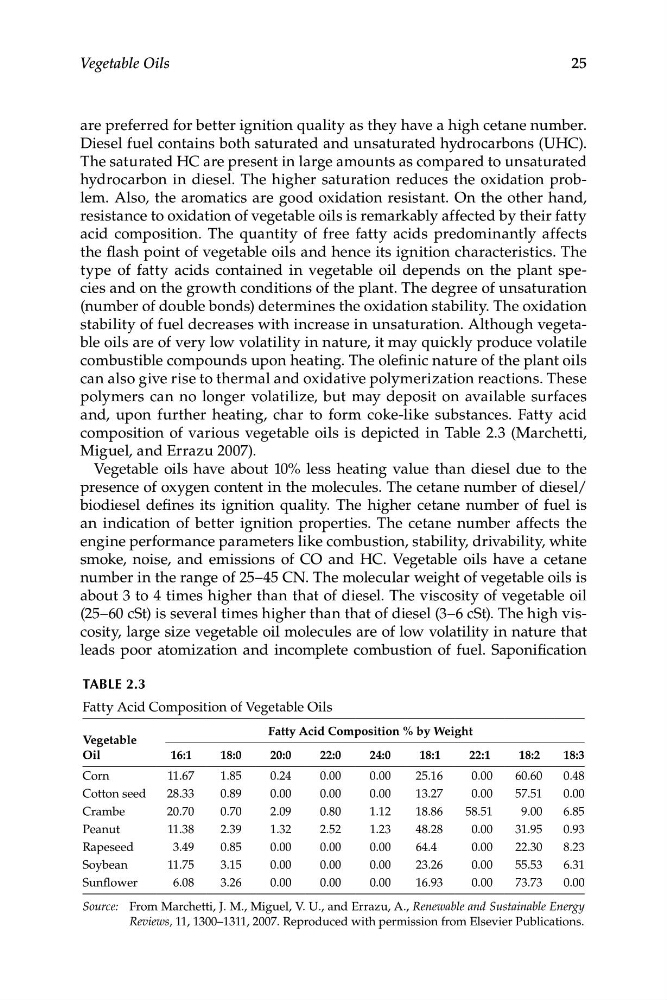
composition of various vegetable oils is depicted in Table 2.3 (Marchetti,
Miguel, and Errazu 2007).
Vegetable oils have about 10% less heating value than diesel due to the
presence of oxygen content in the molecules. The cetane number of diesel/
biodiesel defines its ignition quality. The higher cetane number of fuel is
an indication of better ignition properties. The cetane number affects the
engine performance parameters like combustion, stability, drivability, white
smoke, noise, and emissions of CO and HC. Vegetable oils have a cetane
number in the range of 25–45 CN. The molecular weight of vegetable oils is
about 3 to 4 times higher than that of diesel. The viscosity of vegetable oil
(25–60 cSt) is several times higher than that of diesel (3–6 cSt). The high viscosity, large size vegetable oil molecules are of low volatility in nature that
leads poor atomization and incomplete combustion of fuel. Saponification
TABLe 2.3
Fatty Acid Composition of Vegetable Oils
Vegetable
Fatty Acid Composition % by Weight
Oil
16:1
18:0
20:0
22:0
24:0
18:1
22:1
18:2
18:3
Corn
11.67
1.85
0.24
0.00
0.00
25.16
0.00
60.60
0.48
Cotton seed
28.33
0.89
0.00
0.00
0.00
13.27
0.00
57.51
0.00
Crambe
20.70
0.70
2.09
0.80
1.12
18.86
58.51
9.00
6.85
Peanut
11.38
2.39
1.32
2.52
1.23
48.28
0.00
31.95
0.93
Rapeseed
3.49
0.85
0.00
0.00
0.00
64.4
0.00
22.30
8.23
Soybean
11.75
3.15
0.00
0.00
0.00
23.26
0.00
55.53
6.31
Sunflower
6.08
3.26
0.00
0.00
0.00
16.93
0.00
73.73
0.00
Source: From Marchetti, J. M., Miguel, V. U., and Errazu, A., Renewable and Sustainable Energy
Reviews, 11, 1300–1311, 2007. Reproduced with permission from Elsevier Publications.
Vegetable Oils
are preferred for better ignition quality as they have a high cetane number.
Diesel fuel contains both saturated and unsaturated hydrocarbons (UHC).
The saturated HC are present in large amounts as compared to unsaturated
hydrocarbon in diesel. The higher saturation reduces the oxidation problem. Also, the aromatics are good oxidation resistant. On the other hand,
resistance to oxidation of vegetable oils is remarkably affected by their fatty
acid composition. The quantity of free fatty acids predominantly affects
the flash point of vegetable oils and hence its ignition characteristics. The
type of fatty acids contained in vegetable oil depends on the plant species and on the growth conditions of the plant. The degree of unsaturation
(number of double bonds) determines the oxidation stability. The oxidation
stability of fuel decreases with increase in unsaturation. Although vegetable oils are of very low volatility in nature, it may quickly produce volatile
combustible compounds upon heating. The olefinic nature of the plant oils
can also give rise to thermal and oxidative polymerization reactions. These
polymers can no longer volatilize, but may deposit on available surfaces
and, upon further heating, char to form coke-like substances. Fatty acid
composition of various vegetable oils is depicted in Table 2.3 (Marchetti,
Miguel, and Errazu 2007).
Vegetable oils have about 10% less heating value than diesel due to the
presence of oxygen content in the molecules. The cetane number of diesel/
biodiesel defines its ignition quality. The higher cetane number of fuel is
an indication of better ignition properties. The cetane number affects the
engine performance parameters like combustion, stability, drivability, white
smoke, noise, and emissions of CO and HC. Vegetable oils have a cetane
number in the range of 25–45 CN. The molecular weight of vegetable oils is
about 3 to 4 times higher than that of diesel. The viscosity of vegetable oil
(25–60 cSt) is several times higher than that of diesel (3–6 cSt). The high viscosity, large size vegetable oil molecules are of low volatility in nature that
leads poor atomization and incomplete combustion of fuel. Saponification
TABLe 2.3
Fatty Acid Composition of Vegetable Oils
Vegetable
Fatty Acid Composition % by Weight
Oil
16:1
18:0
20:0
22:0
24:0
18:1
22:1
18:2
18:3
Corn
11.67
1.85
0.24
0.00
0.00
25.16
0.00
60.60
0.48
Cotton seed
28.33
0.89
0.00
0.00
0.00
13.27
0.00
57.51
0.00
Crambe
20.70
0.70
2.09
0.80
1.12
18.86
58.51
9.00
6.85
Peanut
11.38
2.39
1.32
2.52
1.23
48.28
0.00
31.95
0.93
Rapeseed
3.49
0.85
0.00
0.00
0.00
64.4
0.00
22.30
8.23
Soybean
11.75
3.15
0.00
0.00
0.00
23.26
0.00
55.53
6.31
Sunflower
6.08
3.26
0.00
0.00
0.00
16.93
0.00
73.73
0.00
Source: From Marchetti, J. M., Miguel, V. U., and Errazu, A., Renewable and Sustainable Energy
Reviews, 11, 1300–1311, 2007. Reproduced with permission from Elsevier Publications.