

23
Vegetable Oils
Palm kernal
2%
Sunflower seed
Cottonseed
11%
Rapeseed
12%
Soybean
56%
Copra
2%
Peanut
10%
7%
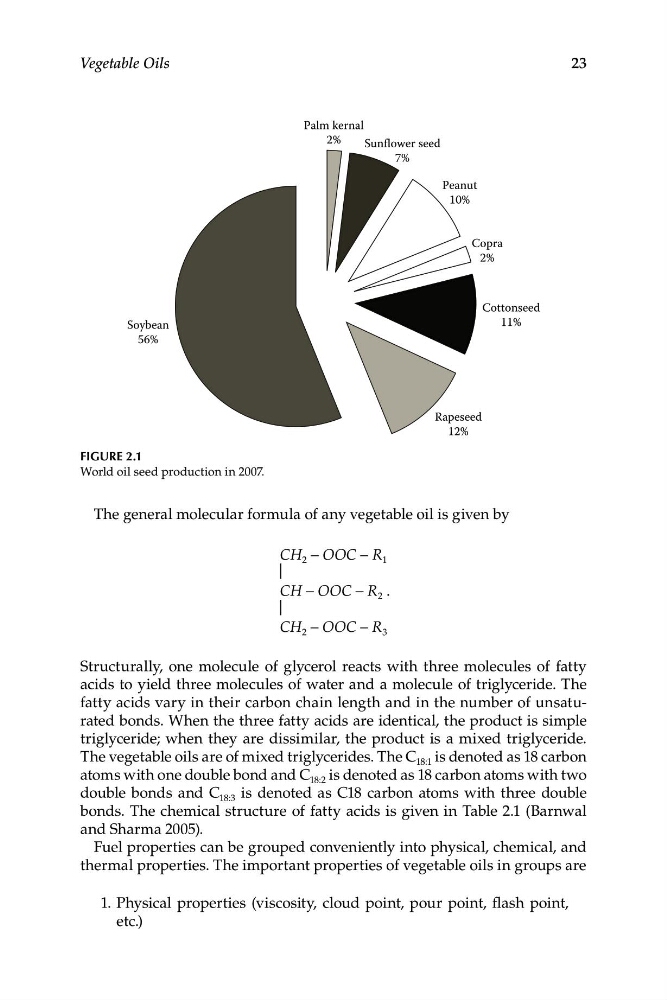
Figure 2.1
World oil seed production in 2007.
The general molecular formula of any vegetable oil is given by
CH 2 − OOC − R 1
⎪
CH − OOC − R 2 .
⎪
CH 2 − OOC − R 3
Structurally, one molecule of glycerol reacts with three molecules of fatty
acids to yield three molecules of water and a molecule of triglyceride. The
fatty acids vary in their carbon chain length and in the number of unsaturated bonds. When the three fatty acids are identical, the product is simple
triglyceride; when they are dissimilar, the product is a mixed triglyceride.
The vegetable oils are of mixed triglycerides. The C 18:1 is denoted as 18 carbon
atoms with one double bond and C 18:2 is denoted as 18 carbon atoms with two
double bonds and C 18:3 is denoted as C18 carbon atoms with three double
bonds. The chemical structure of fatty acids is given in Table 2.1 (Barnwal
and Sharma 2005).
Fuel properties can be grouped conveniently into physical, chemical, and
thermal properties. The important properties of vegetable oils in groups are
1. Physical properties (viscosity, cloud point, pour point, flash point,
etc.)
Vegetable Oils
Palm kernal
2%
Sunflower seed
Cottonseed
11%
Rapeseed
12%
Soybean
56%
Copra
2%
Peanut
10%
7%
Figure 2.1
World oil seed production in 2007.
The general molecular formula of any vegetable oil is given by
CH 2 − OOC − R 1
⎪
CH − OOC − R 2 .
⎪
CH 2 − OOC − R 3
Structurally, one molecule of glycerol reacts with three molecules of fatty
acids to yield three molecules of water and a molecule of triglyceride. The
fatty acids vary in their carbon chain length and in the number of unsaturated bonds. When the three fatty acids are identical, the product is simple
triglyceride; when they are dissimilar, the product is a mixed triglyceride.
The vegetable oils are of mixed triglycerides. The C 18:1 is denoted as 18 carbon
atoms with one double bond and C 18:2 is denoted as 18 carbon atoms with two
double bonds and C 18:3 is denoted as C18 carbon atoms with three double
bonds. The chemical structure of fatty acids is given in Table 2.1 (Barnwal
and Sharma 2005).
Fuel properties can be grouped conveniently into physical, chemical, and
thermal properties. The important properties of vegetable oils in groups are
1. Physical properties (viscosity, cloud point, pour point, flash point,
etc.)