

416
Alternative Fuels for Transportation
TABLe 13.8
Oil Production Rate Per
Hectare
Oil Seed
Liters
Castor
1413
Sunflower
952
Safflower
779
Palm
5950
Soy
446
Coconut
2689
Algae
100,000
Source: www.oilgae.com.
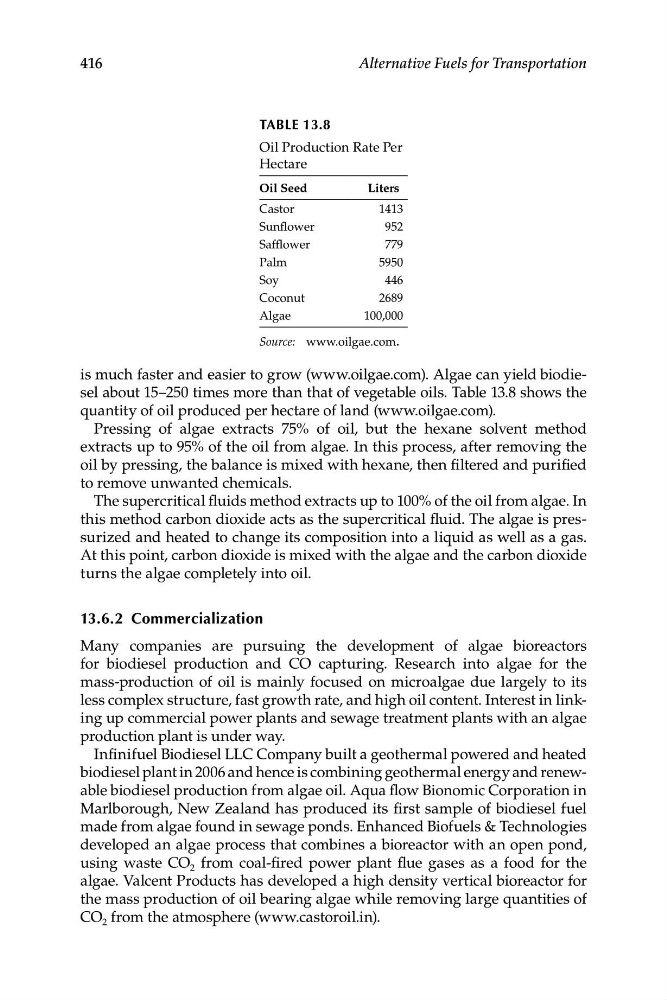
is much faster and easier to grow (www.oilgae.com). Algae can yield biodiesel about 15–250 times more than that of vegetable oils. Table 13.8 shows the
quantity of oil produced per hectare of land (www.oilgae.com).
Pressing of algae extracts 75% of oil, but the hexane solvent method
extracts up to 95% of the oil from algae. In this process, after removing the
oil by pressing, the balance is mixed with hexane, then filtered and purified
to remove unwanted chemicals.
The supercritical fluids method extracts up to 100% of the oil from algae. In
this method carbon dioxide acts as the supercritical fluid. The algae is pressurized and heated to change its composition into a liquid as well as a gas.
At this point, carbon dioxide is mixed with the algae and the carbon dioxide
turns the algae completely into oil.
13.6.2 Commercialization
Many companies are pursuing the development of algae bioreactors
for biodiesel production and CO capturing. Research into algae for the
mass-production of oil is mainly focused on microalgae due largely to its
less complex structure, fast growth rate, and high oil content. Interest in linking up commercial power plants and sewage treatment plants with an algae
production plant is under way.
Infinifuel Biodiesel LLC Company built a geothermal powered and heated
biodiesel plant in 2006 and hence is combining geothermal energy and renewable biodiesel production from algae oil. Aqua flow Bionomic Corporation in
Marlborough, New Zealand has produced its first sample of biodiesel fuel
made from algae found in sewage ponds. Enhanced Biofuels & Technologies
developed an algae process that combines a bioreactor with an open pond,
using waste CO 2 from coal-fired power plant flue gases as a food for the
algae. Valcent Products has developed a high density vertical bioreactor for
the mass production of oil bearing algae while removing large quantities of
CO 2 from the atmosphere (www.castoroil.in).
Alternative Fuels for Transportation
TABLe 13.8
Oil Production Rate Per
Hectare
Oil Seed
Liters
Castor
1413
Sunflower
952
Safflower
779
Palm
5950
Soy
446
Coconut
2689
Algae
100,000
Source: www.oilgae.com.
is much faster and easier to grow (www.oilgae.com). Algae can yield biodiesel about 15–250 times more than that of vegetable oils. Table 13.8 shows the
quantity of oil produced per hectare of land (www.oilgae.com).
Pressing of algae extracts 75% of oil, but the hexane solvent method
extracts up to 95% of the oil from algae. In this process, after removing the
oil by pressing, the balance is mixed with hexane, then filtered and purified
to remove unwanted chemicals.
The supercritical fluids method extracts up to 100% of the oil from algae. In
this method carbon dioxide acts as the supercritical fluid. The algae is pressurized and heated to change its composition into a liquid as well as a gas.
At this point, carbon dioxide is mixed with the algae and the carbon dioxide
turns the algae completely into oil.
13.6.2 Commercialization
Many companies are pursuing the development of algae bioreactors
for biodiesel production and CO capturing. Research into algae for the
mass-production of oil is mainly focused on microalgae due largely to its
less complex structure, fast growth rate, and high oil content. Interest in linking up commercial power plants and sewage treatment plants with an algae
production plant is under way.
Infinifuel Biodiesel LLC Company built a geothermal powered and heated
biodiesel plant in 2006 and hence is combining geothermal energy and renewable biodiesel production from algae oil. Aqua flow Bionomic Corporation in
Marlborough, New Zealand has produced its first sample of biodiesel fuel
made from algae found in sewage ponds. Enhanced Biofuels & Technologies
developed an algae process that combines a bioreactor with an open pond,
using waste CO 2 from coal-fired power plant flue gases as a food for the
algae. Valcent Products has developed a high density vertical bioreactor for
the mass production of oil bearing algae while removing large quantities of
CO 2 from the atmosphere (www.castoroil.in).