

Future Fuels
415
and water. Photosynthesis is an important biochemical process in which
plants, algae, and some bacteria convert the energy of sunlight to chemical
energy. In open ponds unassisted growth is slow, owing to the lower concentration of carbon dioxide; where carbon dioxide concentrations are increased
artificially, higher growth rates can be achieved in open ponds as well. Algae
could be grown in closed structures called photobioreactors, where the environment is better controlled than in open ponds. The cost of setting up and
operating a photobioreactor would be higher than for those for open ponds.
But, the oil yields from these photobioreactors could be significantly higher
than open ponds. This offsets the initial investment in the medium/long run
(Shay 1993 and www.oilgae.com).
Some of the challenges in cultivation of algae include: too much sunlight kills algae growth, overcrowding reduces the growth of algae, excess/
waste produced in the ponds is required to be removed continuously,
temperature needs to be steadily maintained, and open ponds, which are
subjected to evaporation and rain fall, may cause an imbalance in pH value
(Wagner 2007).
Algae are cultivated in closed containers and fed sugar to promote growth.
This method eliminates problems since it allows growers to control all environmental factors. The benefit of this process is that it allows the algae biodiesel to be produced anywhere as the environmental conditions are controlled.
Photobioreactor equipment is used to harvest algae. Photobioreactor set up
can be continuous or batch process. A batch photobioreactor is set up with
nutrients and algal seed and allowed to grow until the batch is harvested.
A photobioreactor is continually harvested daily or at frequent intervals.
Photobioreactors can be of glass or plastic tubes, tanks, plastic sleeves, or bags.
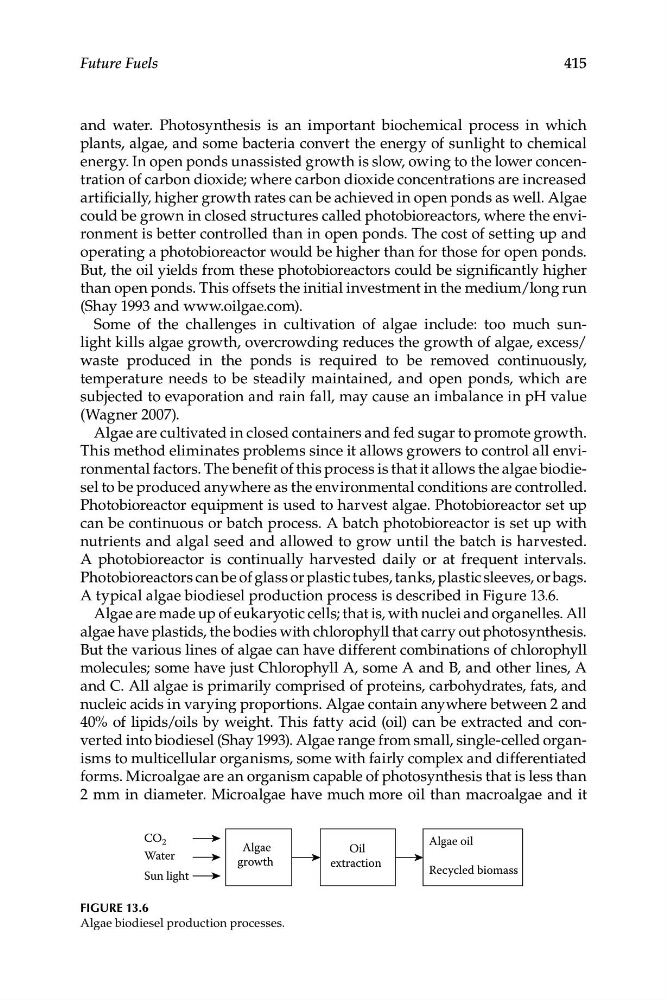
A typical algae biodiesel production process is described in Figure 13.6.
Algae are made up of eukaryotic cells; that is, with nuclei and organelles. All
algae have plastids, the bodies with chlorophyll that carry out photosynthesis.
But the various lines of algae can have different combinations of chlorophyll
molecules; some have just Chlorophyll A, some A and B, and other lines, A
and C. All algae is primarily comprised of proteins, carbohydrates, fats, and
nucleic acids in varying proportions. Algae contain anywhere between 2 and
40% of lipids/oils by weight. This fatty acid (oil) can be extracted and converted into biodiesel (Shay 1993). Algae range from small, single-celled organisms to multicellular organisms, some with fairly complex and differentiated
forms. Microalgae are an organism capable of photosynthesis that is less than
2 mm in diameter. Microalgae have much more oil than macroalgae and it
Algae
growth
CO 2
Water
Sun light
Oil
extraction
Algae oil
Recycled biomass
Figure 13.6
Algae biodiesel production processes.
415
and water. Photosynthesis is an important biochemical process in which
plants, algae, and some bacteria convert the energy of sunlight to chemical
energy. In open ponds unassisted growth is slow, owing to the lower concentration of carbon dioxide; where carbon dioxide concentrations are increased
artificially, higher growth rates can be achieved in open ponds as well. Algae
could be grown in closed structures called photobioreactors, where the environment is better controlled than in open ponds. The cost of setting up and
operating a photobioreactor would be higher than for those for open ponds.
But, the oil yields from these photobioreactors could be significantly higher
than open ponds. This offsets the initial investment in the medium/long run
(Shay 1993 and www.oilgae.com).
Some of the challenges in cultivation of algae include: too much sunlight kills algae growth, overcrowding reduces the growth of algae, excess/
waste produced in the ponds is required to be removed continuously,
temperature needs to be steadily maintained, and open ponds, which are
subjected to evaporation and rain fall, may cause an imbalance in pH value
(Wagner 2007).
Algae are cultivated in closed containers and fed sugar to promote growth.
This method eliminates problems since it allows growers to control all environmental factors. The benefit of this process is that it allows the algae biodiesel to be produced anywhere as the environmental conditions are controlled.
Photobioreactor equipment is used to harvest algae. Photobioreactor set up
can be continuous or batch process. A batch photobioreactor is set up with
nutrients and algal seed and allowed to grow until the batch is harvested.
A photobioreactor is continually harvested daily or at frequent intervals.
Photobioreactors can be of glass or plastic tubes, tanks, plastic sleeves, or bags.
A typical algae biodiesel production process is described in Figure 13.6.
Algae are made up of eukaryotic cells; that is, with nuclei and organelles. All
algae have plastids, the bodies with chlorophyll that carry out photosynthesis.
But the various lines of algae can have different combinations of chlorophyll
molecules; some have just Chlorophyll A, some A and B, and other lines, A
and C. All algae is primarily comprised of proteins, carbohydrates, fats, and
nucleic acids in varying proportions. Algae contain anywhere between 2 and
40% of lipids/oils by weight. This fatty acid (oil) can be extracted and converted into biodiesel (Shay 1993). Algae range from small, single-celled organisms to multicellular organisms, some with fairly complex and differentiated
forms. Microalgae are an organism capable of photosynthesis that is less than
2 mm in diameter. Microalgae have much more oil than macroalgae and it
Algae
growth
CO 2
Water
Sun light
Oil
extraction
Algae oil
Recycled biomass
Figure 13.6
Algae biodiesel production processes.