

Future Fuels
417
13.6.3 Advantages of Algae Biofuel
• Higher yield per hectare and hence lower cost.
• Algae can grow in any place where there is enough sunshine and
water.
• Algae captures CO 2 for its growth. If the algae cultivation set up is
established near thermal power plants/industry it absorbs the CO 2
emitted by them and hence reduces the greenhouse effect.
• Algae biofuel contains no sulfur, is nontoxic, and biodegradable.
13.7 C omparison between First and Second-Generation
Biofuels
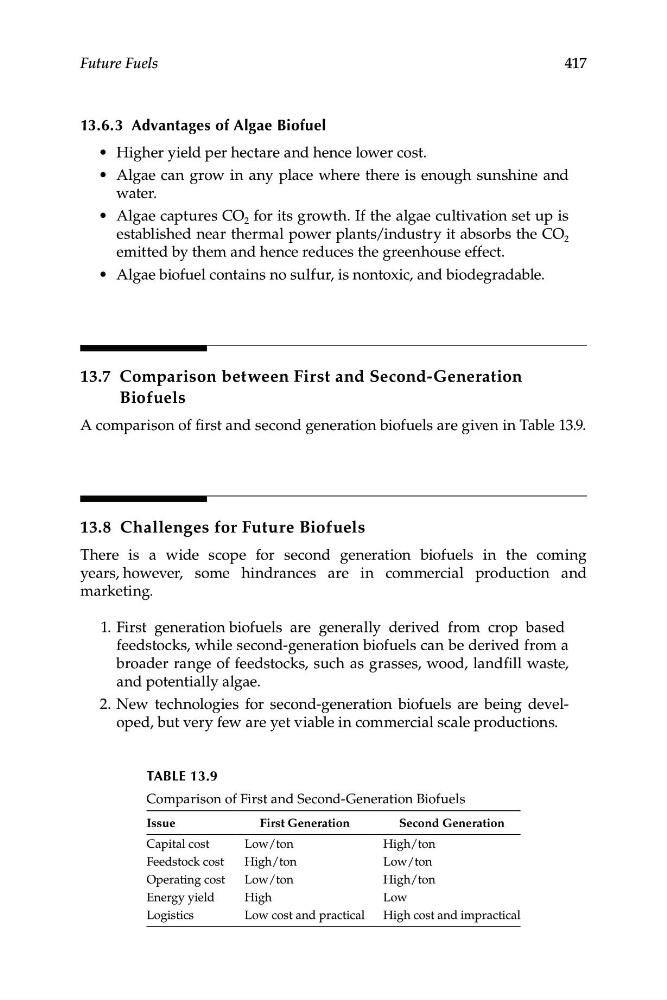
A comparison of first and second generation biofuels are given in Table 1 3.9.
13.8 Challenges for Future Biofuels
There is a wide scope for second generation biofuels in the coming
years, however, some hindrances are in commercial production and
marketing.
1. First generation biofuels are generally derived from crop based
feedstocks, while second-generation biofuels can be derived from a
broader range of feedstocks, such as grasses, wood, landfill waste,
and potentially algae.
2. New technologies for second-generation biofuels are being developed, but very few are yet viable in commercial scale productions.
TABLe 13.9
Comparison of First and Second-Generation Biofuels
Issue
First Generation
Second Generation
Capital cost
Feedstock cost
Operating cost
Energy yield
Logistics
Low/ton
High/ton
Low/ton
High
Low cost and practical
High/ton
Low/ton
High/ton
Low
High cost and impractical
417
13.6.3 Advantages of Algae Biofuel
• Higher yield per hectare and hence lower cost.
• Algae can grow in any place where there is enough sunshine and
water.
• Algae captures CO 2 for its growth. If the algae cultivation set up is
established near thermal power plants/industry it absorbs the CO 2
emitted by them and hence reduces the greenhouse effect.
• Algae biofuel contains no sulfur, is nontoxic, and biodegradable.
13.7 C omparison between First and Second-Generation
Biofuels
A comparison of first and second generation biofuels are given in Table 1 3.9.
13.8 Challenges for Future Biofuels
There is a wide scope for second generation biofuels in the coming
years, however, some hindrances are in commercial production and
marketing.
1. First generation biofuels are generally derived from crop based
feedstocks, while second-generation biofuels can be derived from a
broader range of feedstocks, such as grasses, wood, landfill waste,
and potentially algae.
2. New technologies for second-generation biofuels are being developed, but very few are yet viable in commercial scale productions.
TABLe 13.9
Comparison of First and Second-Generation Biofuels
Issue
First Generation
Second Generation
Capital cost
Feedstock cost
Operating cost
Energy yield
Logistics
Low/ton
High/ton
Low/ton
High
Low cost and practical
High/ton
Low/ton
High/ton
Low
High cost and impractical