

Characteristic
Diesel
Aliphatic Diesel A
Aliphatic Diesel B
Density at 15°C (kg/m 3 )
832.0
775.7
775.7
Viscosity at 40°C (mm 2 /s)
2.78
2.39
2.68
Cetane number
52.8
71.3
74.8
Sulfur content (mg/kg)
206
<1
<1
Water content (mg/kg)
—
23
16
Cold filter plugging point (°C)
–27
–28
–6
Distillation curve (°C)
Initial point
188
160.0
189.2
5%
210
186.2
206.6
10%
225
199.0
213.2
20%
—
219.2
227.4
30%
—
236.2
241.7
50%
271
264.0
271.6
70%
—
290.7
302.9
80%
—
305.0
318.9
90%
329
322.8
337.3
95%
345
335.2
349.3
Final point
356
344.3
359.9
Residue, %
—
1
1
Monoaromatics (%v)
—
0.2
<0.1
Bioaromatics (%v)
—
<0.1
<0.1
Total aromatics (%v)
—
0.2
<0.1
H/C
1.92
2.18
2.24
Source: Reprinted with permission from Zervas, E., Fuel, 87, 1141–47, 2008.
Future Fuels
409
sequestration. F–T power plants with CO 2 capture have better life-cycle
greenhouse emission profiles in comparison with petroleum products production in refineries.
F–T processes yield diesel as the main product and gasoline, kerosene,
and gases as by-products. Synthetic diesel fuel provides benefits in terms of
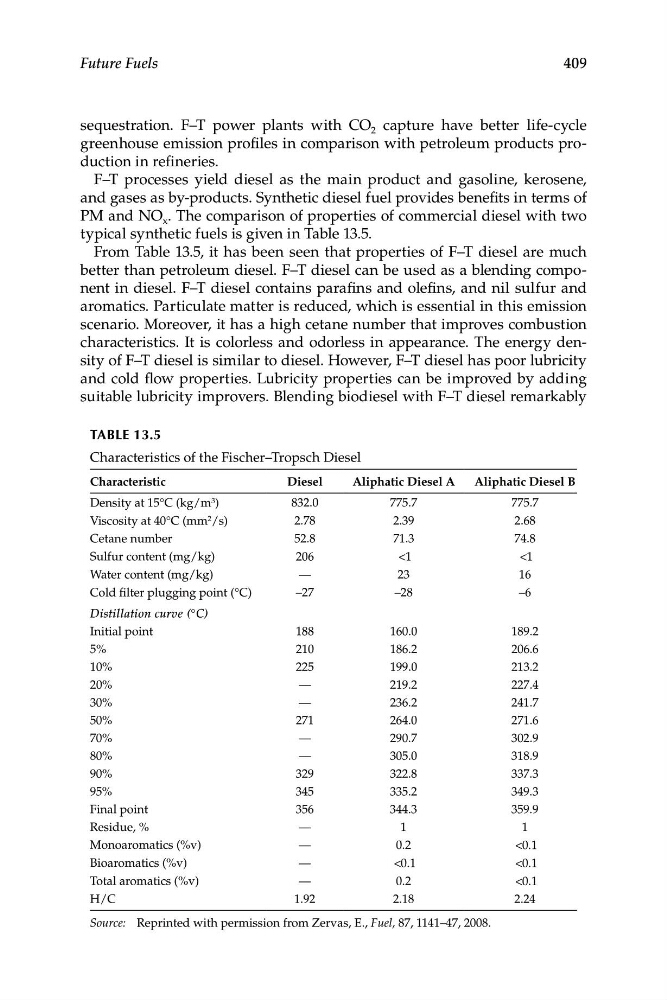
PM and NO x . The comparison of properties of commercial diesel with two
typical synthetic fuels is given in Table 13.5.
From Table 13.5, it has been seen that properties of F–T diesel are much
better than petroleum diesel. F–T diesel can be used as a blending component in diesel. F–T diesel contains parafins and olefins, and nil sulfur and
aromatics. Particulate matter is reduced, which is essential in this emission
scenario. Moreover, it has a high cetane number that improves combustion
characteristics. It is colorless and odorless in appearance. The energy density of F–T diesel is similar to diesel. However, F–T diesel has poor lubricity
and cold flow properties. Lubricity properties can be improved by adding
suitable lubricity improvers. Blending biodiesel with F–T diesel remarkably
TABLe 13.5
Characteristics of the Fischer–Tropsch Diesel
Diesel
Aliphatic Diesel A
Aliphatic Diesel B
Density at 15°C (kg/m 3 )
832.0
775.7
775.7
Viscosity at 40°C (mm 2 /s)
2.78
2.39
2.68
Cetane number
52.8
71.3
74.8
Sulfur content (mg/kg)
206
<1
<1
Water content (mg/kg)
—
23
16
Cold filter plugging point (°C)
–27
–28
–6
Distillation curve (°C)
Initial point
188
160.0
189.2
5%
210
186.2
206.6
10%
225
199.0
213.2
20%
—
219.2
227.4
30%
—
236.2
241.7
50%
271
264.0
271.6
70%
—
290.7
302.9
80%
—
305.0
318.9
90%
329
322.8
337.3
95%
345
335.2
349.3
Final point
356
344.3
359.9
Residue, %
—
1
1
Monoaromatics (%v)
—
0.2
<0.1
Bioaromatics (%v)
—
<0.1
<0.1
Total aromatics (%v)
—
0.2
<0.1
H/C
1.92
2.18
2.24
Source: Reprinted with permission from Zervas, E., Fuel, 87, 1141–47, 2008.
Future Fuels
409
sequestration. F–T power plants with CO 2 capture have better life-cycle
greenhouse emission profiles in comparison with petroleum products production in refineries.
F–T processes yield diesel as the main product and gasoline, kerosene,
and gases as by-products. Synthetic diesel fuel provides benefits in terms of
PM and NO x . The comparison of properties of commercial diesel with two
typical synthetic fuels is given in Table 13.5.
From Table 13.5, it has been seen that properties of F–T diesel are much
better than petroleum diesel. F–T diesel can be used as a blending component in diesel. F–T diesel contains parafins and olefins, and nil sulfur and
aromatics. Particulate matter is reduced, which is essential in this emission
scenario. Moreover, it has a high cetane number that improves combustion
characteristics. It is colorless and odorless in appearance. The energy density of F–T diesel is similar to diesel. However, F–T diesel has poor lubricity
and cold flow properties. Lubricity properties can be improved by adding
suitable lubricity improvers. Blending biodiesel with F–T diesel remarkably
TABLe 13.5
Characteristics of the Fischer–Tropsch Diesel