

408
Alternative Fuels for Transportation
cyclone separator, bag filter and carbonyl sulfide hydrolysis in a scrubber
at 100–250ºC, tar condensation, and ammonia and hydrogen cyanide scrubbing with sulfuric acid (Speight 2008; http://blogs.princeton.edu/chm333/
f2005/group2/03_chemistry/01_current_chemistry/03_sulfur_and_carbon_
dioxide_removal/).
Fischer–Tropsch fuels may be produced in three steps:
1. Synthesis gas generation: production of synthesis gas (CO + H 2 )
using the gasification process. If the synthesis gas with an H 2 /CO
ratio less than two is used, the composition is not stoichiometric
for the F–T reactions. Hence, the water–gas shift reaction is used to
modify the H 2 /CO ratio to two.
2. Hydrocarbon synthesis: conversion of syngas into a mixture of liquid hydrocarbon and wax.
3. Fuel upgrading: syngas upgraded through hydrocracking and
isomerization and fractionated middle distillate fuels (liquid fuels).
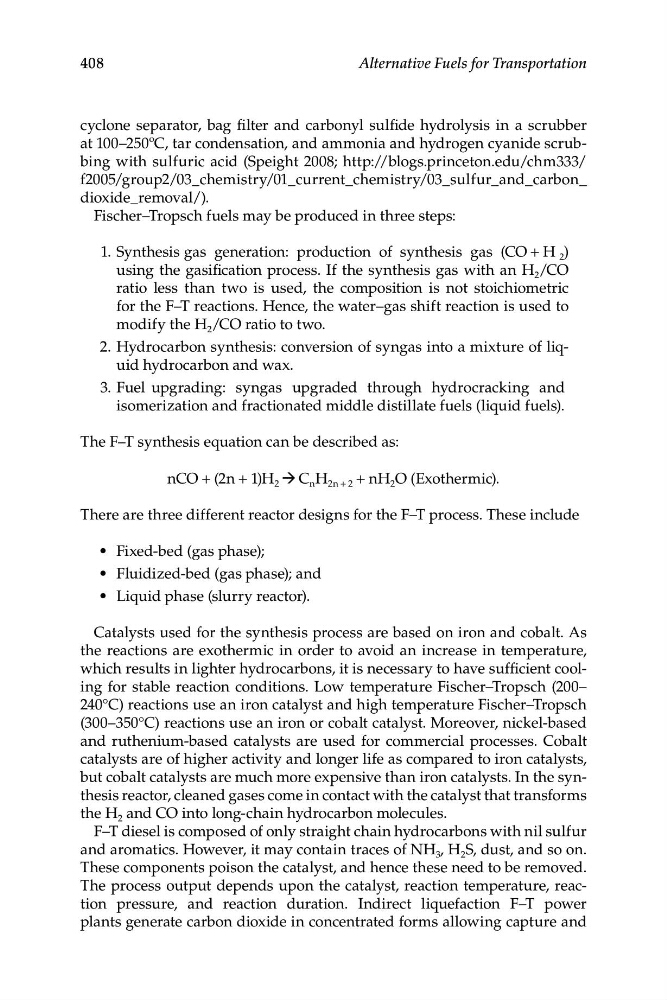
The F–T synthesis equation can be described as:
nCO + (2n + 1)H 2 C n H 2n + 2 + nH 2 O (Exothermic).
There are three different reactor designs for the F–T process. These include
• Fixed-bed (gas phase);
• Fluidized-bed (gas phase); and
• Liquid phase (slurry reactor).
Catalysts used for the synthesis process are based on iron and cobalt. As
the reactions are exothermic in order to avoid an increase in temperature,
which results in lighter hydrocarbons, it is necessary to have sufficient cooling for stable reaction conditions. Low temperature Fischer–Tropsch (200–
240°C) reactions use an iron catalyst and high temperature Fischer–Tropsch
(300–350°C) reactions use an iron or cobalt catalyst. Moreover, nickel-based
and ruthenium-based catalysts are used for commercial processes. Cobalt
catalysts are of higher activity and longer life as compared to iron catalysts,
but cobalt catalysts are much more expensive than iron catalysts. In the synthesis reactor, cleaned gases come in contact with the catalyst that transforms
the H 2 and CO into long-chain hydrocarbon molecules.
F–T diesel is composed of only straight chain hydrocarbons with nil sulfur
and aromatics. However, it may contain traces of NH 3 , H 2 S, dust, and so on.
These components poison the catalyst, and hence these need to be removed.
The process output depends upon the catalyst, reaction temperature, reaction pressure, and reaction duration. Indirect liquefaction F–T power
plants generate carbon dioxide in concentrated forms allowing capture and
Alternative Fuels for Transportation
cyclone separator, bag filter and carbonyl sulfide hydrolysis in a scrubber
at 100–250ºC, tar condensation, and ammonia and hydrogen cyanide scrubbing with sulfuric acid (Speight 2008; http://blogs.princeton.edu/chm333/
f2005/group2/03_chemistry/01_current_chemistry/03_sulfur_and_carbon_
dioxide_removal/).
Fischer–Tropsch fuels may be produced in three steps:
1. Synthesis gas generation: production of synthesis gas (CO + H 2 )
using the gasification process. If the synthesis gas with an H 2 /CO
ratio less than two is used, the composition is not stoichiometric
for the F–T reactions. Hence, the water–gas shift reaction is used to
modify the H 2 /CO ratio to two.
2. Hydrocarbon synthesis: conversion of syngas into a mixture of liquid hydrocarbon and wax.
3. Fuel upgrading: syngas upgraded through hydrocracking and
isomerization and fractionated middle distillate fuels (liquid fuels).
The F–T synthesis equation can be described as:
nCO + (2n + 1)H 2 C n H 2n + 2 + nH 2 O (Exothermic).
There are three different reactor designs for the F–T process. These include
• Fixed-bed (gas phase);
• Fluidized-bed (gas phase); and
• Liquid phase (slurry reactor).
Catalysts used for the synthesis process are based on iron and cobalt. As
the reactions are exothermic in order to avoid an increase in temperature,
which results in lighter hydrocarbons, it is necessary to have sufficient cooling for stable reaction conditions. Low temperature Fischer–Tropsch (200–
240°C) reactions use an iron catalyst and high temperature Fischer–Tropsch
(300–350°C) reactions use an iron or cobalt catalyst. Moreover, nickel-based
and ruthenium-based catalysts are used for commercial processes. Cobalt
catalysts are of higher activity and longer life as compared to iron catalysts,
but cobalt catalysts are much more expensive than iron catalysts. In the synthesis reactor, cleaned gases come in contact with the catalyst that transforms
the H 2 and CO into long-chain hydrocarbon molecules.
F–T diesel is composed of only straight chain hydrocarbons with nil sulfur
and aromatics. However, it may contain traces of NH 3 , H 2 S, dust, and so on.
These components poison the catalyst, and hence these need to be removed.
The process output depends upon the catalyst, reaction temperature, reaction pressure, and reaction duration. Indirect liquefaction F–T power
plants generate carbon dioxide in concentrated forms allowing capture and