

410
Alternative Fuels for Transportation
TABLe 13.6
Exhaust Emissions of F–T Diesel in Comparison with Conventional Diesel
Fuel
HC
CO
NO X
PM
CO 2
Conventional U.S. #2 diesel
0.346
1.584
5.373
0.120
643.75
California #2 diesel
0.274
1.091
4.893
0.109
615.85
F-T diesel
0.198
0.968
4.607
0.104
611.49
Source: www.environment.gov.au/settlements/transport/comparison/pubs/ 2ch3.
pdf (accessed on October 25, 2009).
improves lubricity properties and reduces engine exhaust emissions. F–T
fuels can provide 40–60% emission benefits in light duty vehicles and 5% in
heavy duty vehicles for CO, HC, and PM (Majewski and Khair 2006).
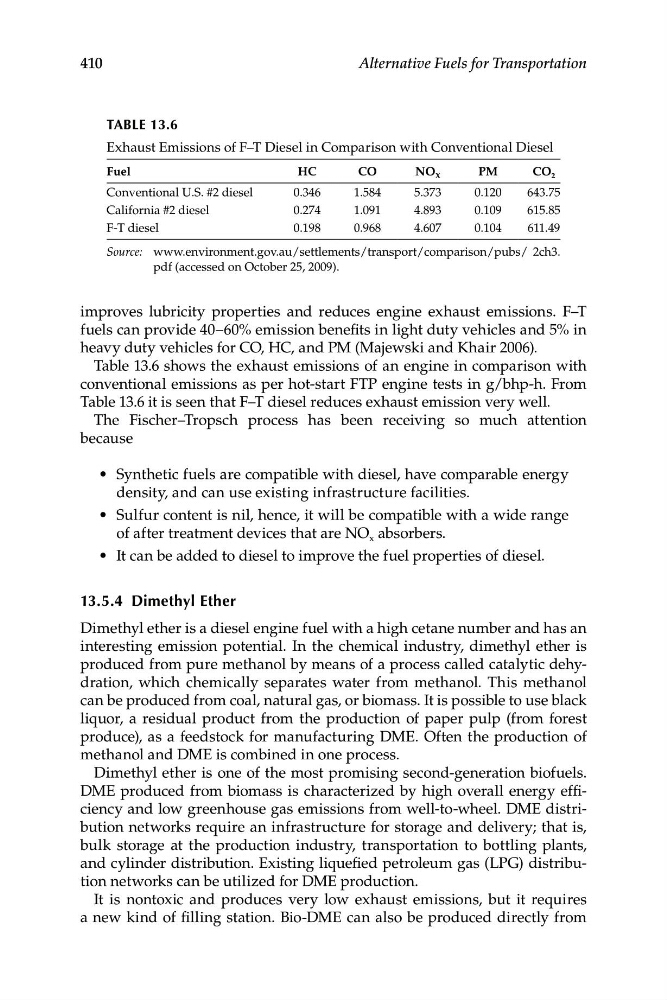
Table 13.6 shows the exhaust emissions of an engine in comparison with
conventional emissions as per hot-start FTP engine tests in g/bhp-h. From
Table 13.6 it is seen that F–T diesel reduces exhaust emission very well.
The Fischer–Tropsch process has been receiving so much attention
because
• Synthetic fuels are compatible with diesel, have comparable energy
density, and can use existing infrastructure facilities.
• Sulfur content is nil, hence, it will be compatible with a wide range
of after treatment devices that are NO x absorbers.
• It can be added to diesel to improve the fuel properties of diesel.
13.5.4 Dimethyl ether
Dimethyl ether is a diesel engine fuel with a high cetane number and has an
interesting emission potential. In the chemical industry, dimethyl ether is
produced from pure methanol by means of a process called catalytic dehydration, which chemically separates water from methanol. This methanol
can be produced from coal, natural gas, or biomass. It is possible to use black
liquor, a residual product from the production of paper pulp (from forest
produce), as a feedstock for manufacturing DME. Often the production of
methanol and DME is combined in one process.
Dimethyl ether is one of the most promising second-generation biofuels.
DME produced from biomass is characterized by high overall energy efficiency and low greenhouse gas emissions from well-to-wheel. DME distribution networks require an infrastructure for storage and delivery; that is,
bulk storage at the production industry, transportation to bottling plants,
and cylinder distribution. Existing liquefied petroleum gas (LPG) distribution networks can be utilized for DME production.
It is nontoxic and produces very low exhaust emissions, but it requires
a new kind of filling station. Bio-DME can also be produced directly from
Alternative Fuels for Transportation
TABLe 13.6
Exhaust Emissions of F–T Diesel in Comparison with Conventional Diesel
Fuel
HC
CO
NO X
PM
CO 2
Conventional U.S. #2 diesel
0.346
1.584
5.373
0.120
643.75
California #2 diesel
0.274
1.091
4.893
0.109
615.85
F-T diesel
0.198
0.968
4.607
0.104
611.49
Source: www.environment.gov.au/settlements/transport/comparison/pubs/ 2ch3.
pdf (accessed on October 25, 2009).
improves lubricity properties and reduces engine exhaust emissions. F–T
fuels can provide 40–60% emission benefits in light duty vehicles and 5% in
heavy duty vehicles for CO, HC, and PM (Majewski and Khair 2006).
Table 13.6 shows the exhaust emissions of an engine in comparison with
conventional emissions as per hot-start FTP engine tests in g/bhp-h. From
Table 13.6 it is seen that F–T diesel reduces exhaust emission very well.
The Fischer–Tropsch process has been receiving so much attention
because
• Synthetic fuels are compatible with diesel, have comparable energy
density, and can use existing infrastructure facilities.
• Sulfur content is nil, hence, it will be compatible with a wide range
of after treatment devices that are NO x absorbers.
• It can be added to diesel to improve the fuel properties of diesel.
13.5.4 Dimethyl ether
Dimethyl ether is a diesel engine fuel with a high cetane number and has an
interesting emission potential. In the chemical industry, dimethyl ether is
produced from pure methanol by means of a process called catalytic dehydration, which chemically separates water from methanol. This methanol
can be produced from coal, natural gas, or biomass. It is possible to use black
liquor, a residual product from the production of paper pulp (from forest
produce), as a feedstock for manufacturing DME. Often the production of
methanol and DME is combined in one process.
Dimethyl ether is one of the most promising second-generation biofuels.
DME produced from biomass is characterized by high overall energy efficiency and low greenhouse gas emissions from well-to-wheel. DME distribution networks require an infrastructure for storage and delivery; that is,
bulk storage at the production industry, transportation to bottling plants,
and cylinder distribution. Existing liquefied petroleum gas (LPG) distribution networks can be utilized for DME production.
It is nontoxic and produces very low exhaust emissions, but it requires
a new kind of filling station. Bio-DME can also be produced directly from