

404
Alternative Fuels for Transportation
TABLe 13.3
Typical Composition of Syngas
Composition
Percentage
Carbon monoxide
18–22%
Hydrogen
15–19%
Methane
1–5%
Hydrocarbons
0.2–0.4%
Nitrogen
45–55%
Water vapor
4%
TABLe 13.4
Properties of Various Biomass
Bulk
Ash
Calorific
Density
Content
C
H
N
O
Value
Biomass
(kg/m 3 )
(%)
(%)
(%)
(%)
(%)
(MJ /kg)
Bagasse
74
4.00
47.00
6.50
0.0
42.50
17.5
Coir pith
47
13.60
41.27
4.02
1.51
39.60
16.7
Ground nut shell
165
3.10
33.90
1.97
1.10
59.93
18.8
Saw dust
177
1.20
52.28
5.20
0.47
40.85
18.4
Straw
80
15.50
35.97
5.28
0.17
43.08
15.5
Wood
330
1.50
52.30
5.20
0.50
42.00
18.4
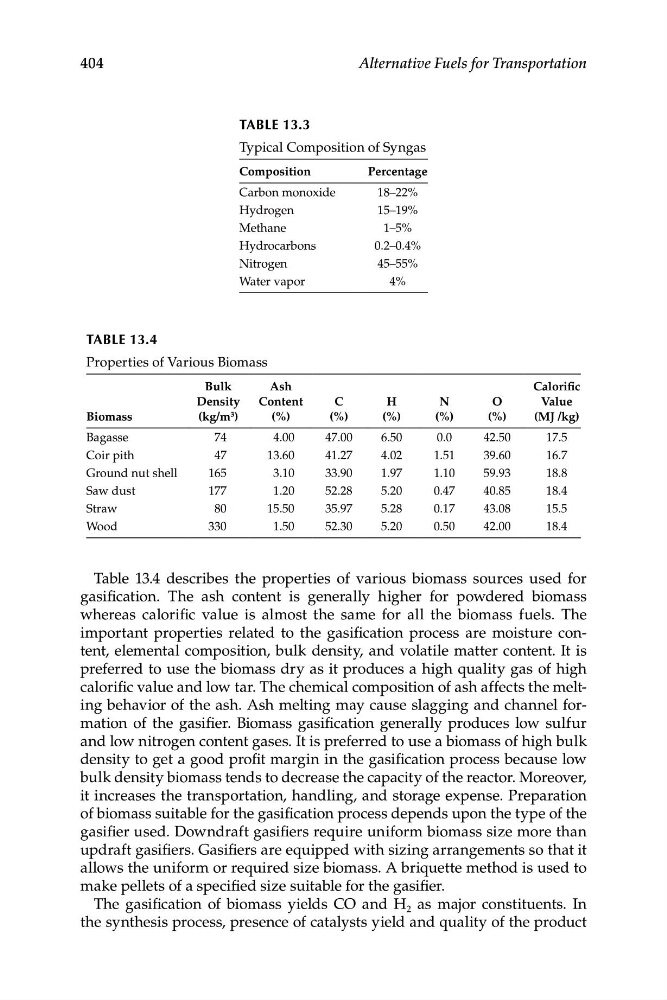
Table 13.4 describes the properties of various biomass sources used for
gasification. The ash content is generally higher for powdered biomass
whereas calorific value is almost the same for all the biomass fuels. The
important properties related to the gasification process are moisture content, elemental composition, bulk density, and volatile matter content. It is
preferred to use the biomass dry as it produces a high quality gas of high
calorific value and low tar. The chemical composition of ash affects the melting behavior of the ash. Ash melting may cause slagging and channel formation of the gasifier. Biomass gasification generally produces low sulfur
and low nitrogen content gases. It is preferred to use a biomass of high bulk
density to get a good profit margin in the gasification process because low
bulk density biomass tends to decrease the capacity of the reactor. Moreover,
it increases the transportation, handling, and storage expense. Preparation
of biomass suitable for the gasification process depends upon the type of the
gasifier used. Downdraft gasifiers require uniform biomass size more than
updraft gasifiers. Gasifiers are equipped with sizing arrangements so that it
allows the uniform or required size biomass. A briquette method is used to
make pellets of a specified size suitable for the gasifier.
The gasification of biomass yields CO and H 2 as major constituents. In
the synthesis process, presence of catalysts yield and quality of the product
Alternative Fuels for Transportation
TABLe 13.3
Typical Composition of Syngas
Composition
Percentage
Carbon monoxide
18–22%
Hydrogen
15–19%
Methane
1–5%
Hydrocarbons
0.2–0.4%
Nitrogen
45–55%
Water vapor
4%
TABLe 13.4
Properties of Various Biomass
Bulk
Ash
Calorific
Density
Content
C
H
N
O
Value
Biomass
(kg/m 3 )
(%)
(%)
(%)
(%)
(%)
(MJ /kg)
Bagasse
74
4.00
47.00
6.50
0.0
42.50
17.5
Coir pith
47
13.60
41.27
4.02
1.51
39.60
16.7
Ground nut shell
165
3.10
33.90
1.97
1.10
59.93
18.8
Saw dust
177
1.20
52.28
5.20
0.47
40.85
18.4
Straw
80
15.50
35.97
5.28
0.17
43.08
15.5
Wood
330
1.50
52.30
5.20
0.50
42.00
18.4
Table 13.4 describes the properties of various biomass sources used for
gasification. The ash content is generally higher for powdered biomass
whereas calorific value is almost the same for all the biomass fuels. The
important properties related to the gasification process are moisture content, elemental composition, bulk density, and volatile matter content. It is
preferred to use the biomass dry as it produces a high quality gas of high
calorific value and low tar. The chemical composition of ash affects the melting behavior of the ash. Ash melting may cause slagging and channel formation of the gasifier. Biomass gasification generally produces low sulfur
and low nitrogen content gases. It is preferred to use a biomass of high bulk
density to get a good profit margin in the gasification process because low
bulk density biomass tends to decrease the capacity of the reactor. Moreover,
it increases the transportation, handling, and storage expense. Preparation
of biomass suitable for the gasification process depends upon the type of the
gasifier used. Downdraft gasifiers require uniform biomass size more than
updraft gasifiers. Gasifiers are equipped with sizing arrangements so that it
allows the uniform or required size biomass. A briquette method is used to
make pellets of a specified size suitable for the gasifier.
The gasification of biomass yields CO and H 2 as major constituents. In
the synthesis process, presence of catalysts yield and quality of the product